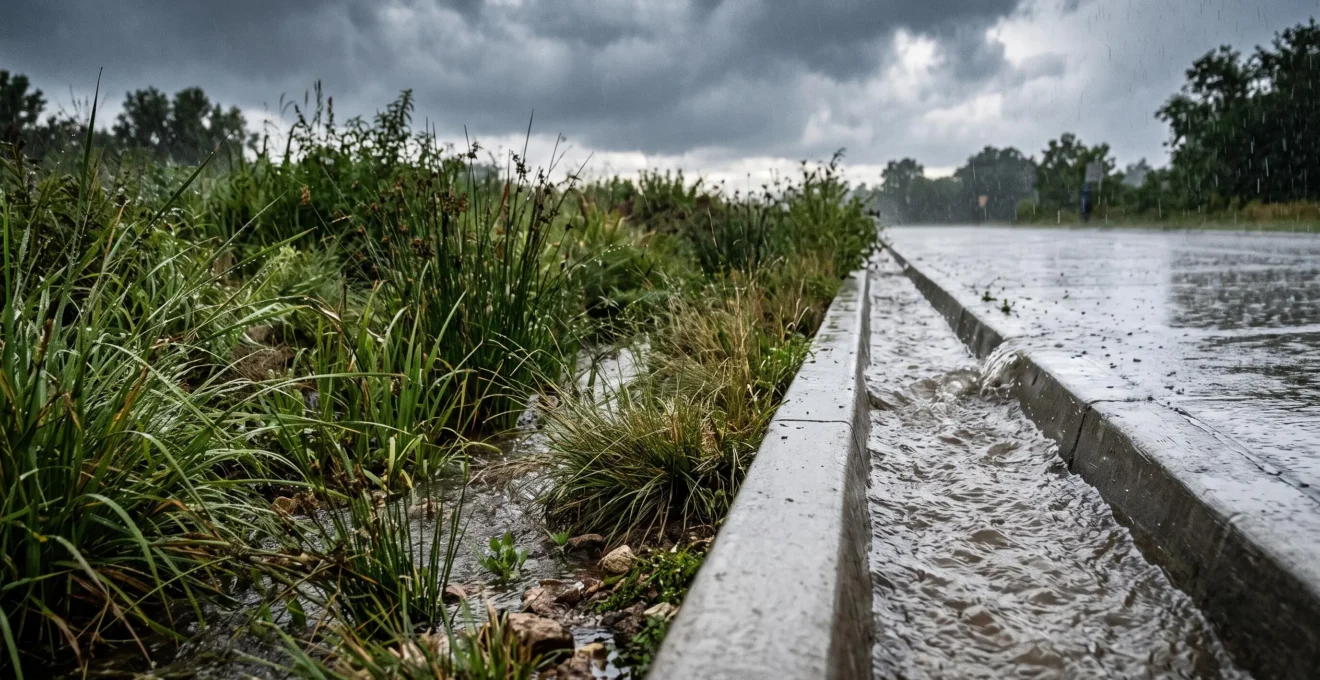
Bioswales are not just eco-friendly alternatives; they are high-performance green infrastructure that functionally surpasses traditional drains in managing heavy rainfall when properly engineered.
- They actively treat stormwater by filtering pollutants and reducing volume, rather than simply displacing the problem downstream.
- They manage peak flow by slowing water velocity, decreasing erosion and downstream flooding risks associated with conventional systems.
Recommendation: Transition from a water ‘disposal’ mindset (traditional drains) to a holistic water ‘management’ system (bioswales) for resilient, long-term hydrological control.
For managers of community gardens, large estates, or public lands, the increasing intensity of rainfall events presents a significant infrastructure challenge. The conventional response has long been a network of concrete drains, grates, and pipes—a system designed for one purpose: rapid water disposal. This approach, however, merely transfers the hydraulic load downstream, often exacerbating flooding and pollution in adjacent areas. In this context, bioswales are frequently presented as a “green” alternative, a perception that often belittles their true capability.
This perspective overlooks a critical reality: a bioswale is not a decorative garden ditch; it is a piece of engineered ecological infrastructure. When designed, installed, and maintained with the same rigor as traditional civil engineering projects, it represents a functionally superior system for large-scale water management. It shifts the paradigm from water disposal to water treatment, detention, and integration. The key lies in understanding the complex interplay between soil media, hydraulic design, and vegetative components—a system that actively works to mitigate the very problems that traditional drains create.
This guide will dissect the functional mechanics of bioswales, moving beyond surface-level aesthetics to examine their performance as critical infrastructure. We will explore their pollutant-filtering mechanisms, essential maintenance protocols, design considerations for controlling water velocity, and their potential to create valuable habitat. This analysis provides a strategic framework for implementing bioswales not as an alternative, but as the advanced standard for resilient stormwater management.
Summary: A Strategic Comparison of Bioswales and Conventional Drainage
- How Bioswales Filter Oil and Pollutants From Driveway Runoff?
- Mowing or Weeding: How to Maintain a Functioning Bioswale?
- How to Use Check Dams to Slow Water Speed on Slopes?
- The Silt Mistake That Blocks Bioswales After Two Years
- Turning Drainage into Habitat: Attracting Amphibians to Swales
- How Big Should Your Rain Garden Be to Handle Roof Runoff?
- 3 Native Grasses With Roots That Drink Excess Groundwater
- How to Build Rain Gardens to Handle British Storm Surges?
How Bioswales Filter Oil and Pollutants From Driveway Runoff?
Unlike a traditional drain, which transports pollutants directly into waterways, a bioswale acts as a linear bioreactor. Its primary function is not just to convey water but to treat it through a combination of physical and biological processes. As runoff from driveways, parking lots, or roads enters the swale, the initial velocity is reduced by the vegetation, causing heavier sediments to drop out of suspension. This is the first stage of physical filtration. The true work, however, happens within the soil itself.
The system relies on a carefully selected, multi-layered substrate known as engineered media. This is a precise blend of sand, compost, and topsoil designed to optimize both infiltration and pollutant capture. The sand component ensures adequate drainage to prevent prolonged ponding, while the organic compost and soil particles contain a thriving ecosystem of microorganisms. These microbes are the system’s workhorses, breaking down complex hydrocarbons—like oil and grease—into simpler, less harmful compounds. This process, known as bioremediation, is what sets a bioswale fundamentally apart from a sterile concrete channel. Furthermore, heavy metals and other chemical pollutants bind to the soil particles through a process called adsorption, effectively trapping them within the swale instead of releasing them into the environment. The performance of these systems is not trivial; a 2011 study of bioswales with trees and engineered soils found a 95% overall pollutant removal and 88% runoff volume reduction, demonstrating their power as decentralized treatment facilities.
This cross-section reveals the intricate structure of the engineered media. Each layer plays a specific role, from the coarse upper mulch that traps debris to the fine sand and compost layers where microbial action and chemical adsorption occur. The slow percolation of water through this matrix is the key to its high filtration efficiency, a stark contrast to the high-velocity, no-treatment flow of a traditional drain pipe.
Mowing or Weeding: How to Maintain a Functioning Bioswale?
A common misconception is that a bioswale, being a “natural” system, is maintenance-free. This is a critical error. A bioswale is a high-performance system, and like any piece of infrastructure, it requires a structured and proactive maintenance regime to ensure its long-term functionality. Neglect leads to reduced infiltration capacity, weed invasion, and eventual system failure. The question is not *if* maintenance is needed, but *what kind* and *how often*.
Maintenance activities differ significantly from typical landscaping. The goal is not purely aesthetic but functional. Key tasks include managing vegetation to ensure it does not impede water flow, removing invasive species that outcompete the desired native plants, and clearing accumulated sediment and trash from inlets and outlets. Unlike a lawn, a bioswale should not be uniformly mowed; instead, selective cutting is required to manage overgrowth while preserving the dense root systems that are crucial for soil structure and infiltration. The City of Portland’s experience is instructive. To counter performance decline, their program adopted a structured approach combining annual sediment removal, regular replanting to maintain vegetative cover, and periodic soil tilling to restore infiltration.
A seasonal approach is most effective. Scheduling major work like sediment removal during drier seasons allows for easier access and minimizes disruption. A consistent program of inspection and targeted intervention is far more effective and cost-efficient than reactive, large-scale remediation after a system has already failed. The essential maintenance tasks include:
- Schedule inspections and work during drier months for easier access.
- Remove invasive grasses and weeds, especially those blocking flow paths.
- Selectively cut back overgrown vegetation to maintain flow capacity.
- Address woody vegetation (unwanted saplings) early.
- Re-seed or replant bare areas to prevent erosion and maintain dense cover.
- Check for and alleviate soil compaction, which hinders water infiltration.
- Routinely remove sediment, trash, and debris from all inlets and outlets.
How to Use Check Dams to Slow Water Speed on Slopes?
On sloped terrain, the primary challenge is managing hydraulic velocity. Unchecked, fast-moving water possesses immense erosive power, scouring channels, undermining vegetation, and transporting large volumes of sediment downstream. A traditional piped drain accelerates this problem. A bioswale, however, can be engineered to solve it using a simple but highly effective tool: the check dam.
A check dam is a small, permeable barrier built across the channel of the bioswale. Its purpose is not to stop water, but to slow it down. As water pools temporarily behind the dam, its energy is dissipated, its velocity decreases, and it has more time to infiltrate into the soil. This process also encourages sediment to settle out behind the dam, where it can be more easily removed during maintenance, rather than clogging the entire length of the swale. The placement and design of these structures are governed by specific engineering thresholds; for example, planning guidelines recommend their use in channels with a maximum 10% slope and serving a drainage area no larger than 10 acres.
The choice of material for a check dam depends on the project’s permanency, flow rates, and aesthetic goals. Rock check dams are durable for permanent, high-flow situations, while biodegradable options like coir logs are excellent for temporary control and supporting new vegetation. A well-designed series of check dams transforms a potential erosion gully into a stepped sequence of calm pools, maximizing infiltration and minimizing erosion.
This table outlines the trade-offs between common materials, guiding the selection process based on site-specific needs and long-term management goals.
| Material | Typical Use | Durability | Ecological / Visual Integration |
|---|---|---|---|
| Rock check dam | Permanent installations, moderate to high flow channels | High, long-term | Blends naturally into landscaped or rural swales |
| Log check dam | Wooded or naturalized sites | Moderate, biodegrades over years | High habitat and aesthetic value |
| Brush check dam | Temporary, low-flow gullies | Low, short-term | Very natural appearance, decomposes quickly |
| Sandbag / gravel check dam | Construction sites, temporary erosion control | Low to moderate, temporary | Utilitarian, low visual integration |
| Fiber roll / coir log check dam | Slopes and channels needing quick vegetation establishment | Moderate, biodegrades while allowing plant growth | Good, supports vegetation establishment |
The Silt Mistake That Blocks Bioswales After Two Years
The single greatest threat to the long-term performance of a bioswale is sediment—specifically, the fine particles of silt and clay washed off from surrounding impervious surfaces. While a bioswale is designed to capture sediment, it is not an infinite sink. Without a proper management strategy, this constant influx of fine material, or sediment loading, will clog the pores in the engineered soil media. This clogging action dramatically reduces the swale’s infiltration capacity, turning a functional drainage system into a stagnant, waterlogged trench in as little as two years.
The mistake is assuming the bioswale itself can handle the entire sediment load from its catchment area. A high-performance design anticipates this problem and incorporates a dedicated pre-treatment feature, most commonly a structure called a forebay. A forebay is a small, deep pool, often lined with concrete or riprap, located at the primary inlet of the bioswale. Its sole purpose is to slow the initial rush of runoff, allowing the majority of the incoming sediment to settle in this one, easy-to-clean location. This protects the main body of the bioswale from the heaviest sediment load. The scale of the problem is significant, with studies finding that sediment loading rates from impervious surfaces can be around 0.3–0.6 m³/ha/yr. A forebay is the sacrificial component designed to capture this load.
Protecting a bioswale from sediment overload requires a multi-pronged approach, starting upstream of the swale itself. Managing erosion in the drainage area is the first line of defense. The second is the implementation of structures like forebays and check dams to capture sediment before it reaches the primary filtration media. Finally, a vigilant maintenance program to clean these structures and address any erosion within the swale is essential for sustained performance.
Action Plan: Preventing Sediment Clogging
- Manage the upstream drainage area specifically to reduce the incoming sediment load at its source.
- Inspect all inflow points regularly for clogging and remove accumulated sediment from forebays and check dams promptly.
- Construct a dedicated forebay or protective structure at the swale’s primary inlet to act as a sediment trap.
- Protect forebay inlets with erosion-resistant material (e.g., riprap) to dissipate energy from incoming runoff.
- Maintain a dense and healthy vegetative cover, re-sodding or re-seeding any eroded areas immediately to stabilize the soil.
Turning Drainage into Habitat: Attracting Amphibians to Swales
While the primary driver for implementing a bioswale is stormwater management, its potential extends far beyond mere drainage and filtration. A well-designed and mature bioswale can evolve into a vibrant, linear wetland habitat, creating significant ecological value. Unlike a sterile concrete drain, the combination of clean, slow-moving water, dense native vegetation, and a healthy soil ecosystem provides the perfect conditions for attracting a diverse range of wildlife, particularly amphibians.
Amphibians like frogs, toads, and salamanders are excellent bio-indicators; their presence is a sign of a healthy, low-pollution environment. They require clean water for breeding and moist, sheltered environments for their adult life. A bioswale provides both. The shallow, intermittently pooled water is ideal for egg-laying, free from the fast currents and predatory fish of larger ponds. The dense grasses and rushes offer cover from predators and the sun, maintaining the cool, damp conditions they need to survive. The Cornell Botanic Gardens bioswale serves as a prime example, functioning as a demonstration landscape that provides habitat for everything from pollinators and birds to reptiles and amphibians, turning a utility feature into a rich ecological asset.
This transformation from utility to habitat requires a conscious design shift. It means selecting a diverse palette of native plants—sedges, rushes, and moisture-loving wildflowers—that offer varied structure. It may also mean designing sections of the swale to hold water for slightly longer periods after a storm. This dual-purpose approach is the pinnacle of green infrastructure design, where a functional solution to an engineering problem simultaneously creates a ecological benefit.
A bioswale is a description of function.
– Dan Carpenter, Chartered Environmentalist (CEnv), LinkedIn Pulse
This quote and image capture the essence of the concept. The “function” is not just drainage; it is the creation of a system that supports life. This shift in perspective is what elevates a bioswale from a simple ditch to a valuable piece of living infrastructure.
How Big Should Your Rain Garden Be to Handle Roof Runoff?
While the term “bioswale” often applies to linear features managing runoff from larger surfaces, a “rain garden” is its cousin, typically designed to handle a concentrated source like a building’s roof. Determining the correct size for a rain garden is a critical engineering calculation, not a matter of guesswork. An undersized garden will be overwhelmed by a moderate storm, failing to provide any meaningful storage or infiltration. An oversized one may be an inefficient use of land and resources.
The core calculation depends on three main variables:
- The Catchment Area: This is the total area of the surface that drains into the garden—in this case, the footprint of the roof. A larger roof collects more water and requires a larger garden.
- The Rainfall Volume: This is determined by the “design storm” you wish to manage. For large-scale infrastructure, this is often the volume of rain from a 24-hour storm event that has a specific recurrence interval (e.g., a 10-year or 25-year storm).
- The Soil Infiltration Rate: This is the most crucial—and most variable—factor. It measures how quickly water can soak into the native soil beneath the rain garden. Sandy soils drain quickly, while heavy clay soils drain very slowly. A simple “percolation test” is required to measure this on-site.
A simplified rule of thumb often cited for residential projects is to size the garden to be 10-20% of the catchment area. However, for a professional, large-scale application, this is too simplistic. The proper method involves calculating the total volume of runoff from the design storm (Catchment Area x Rainfall Depth) and then sizing the garden’s surface area and depth to hold that volume long enough for it to infiltrate into the ground, based on the measured infiltration rate of the underlying soil. The goal is typically to have the garden drain completely within 24 to 48 hours to prevent mosquito breeding and ensure it is ready for the next storm event.
3 Native Grasses With Roots That Drink Excess Groundwater
The vegetation in a bioswale is not merely decorative; it is a functional component of the infrastructure. The root systems of selected plants are critical for maintaining soil structure, creating channels for water infiltration, and drawing moisture from the soil profile through evapotranspiration. For large-scale projects dealing with significant water loads, deep-rooted native grasses are unparalleled in their performance.
These grasses are adapted to a wide range of moisture conditions and have developed extensive fibrous root systems that can penetrate deep into the ground, acting like a living sponge. They are the engine that powers the bioswale’s ability to de-water itself between storm events. Three exemplary species for North American contexts include:
- Switchgrass (Panicum virgatum): A powerhouse of green infrastructure. Its roots can reach depths of 10 feet (3 meters) or more. This vast network not only absorbs tremendous amounts of water but also holds soil together, preventing erosion and maintaining porosity. It is exceptionally tolerant of both drought and periodic flooding.
- Big Bluestem (Andropogon gerardii): Often called the “king of the prairies,” this grass has a complex, fibrous root system that makes up two-thirds of the plant’s total biomass, extending down 6-8 feet (2-2.5 meters). It creates stable soil aggregates and improves infiltration capacity year after year.
- Prairie Cordgrass (Spartina pectinata): This species is particularly well-suited for the wettest zones of a bioswale. It thrives in saturated soils and has a tough, rhizomatous root system that aggressively stabilizes channel bottoms and banks, preventing scour during high-flow events. Its roots anchor the soil with incredible strength.
Compared to the shallow roots of conventional turfgrass, which typically only reach a few inches deep, these native grasses create a super-highway for water to move from the surface deep into the subsoil. Their use is a clear example of engineering with nature, leveraging millions of years of evolutionary adaptation to perform a critical infrastructure task.
Key Takeaways
- Bioswales are not passive landscape features; they are engineered ecological systems requiring technical design and proactive maintenance to function.
- The primary value of a bioswale over a traditional drain is its ability to treat stormwater—filtering pollutants and reducing flow velocity—rather than simply displacing it.
- Long-term performance is entirely dependent on a structured maintenance plan focused on managing sediment, vegetation, and infiltration capacity.
How to Build Rain Gardens to Handle British Storm Surges?
Designing green infrastructure in the context of the United Kingdom presents a unique set of challenges and opportunities. The climate is characterized by frequent, often prolonged rainfall rather than the short, intense cloudbursts common in other regions. Furthermore, many areas are dominated by heavy clay soils, which have a naturally low infiltration capacity. A rain garden or bioswale design that works in a sandy, arid climate will fail quickly here.
The key to success is to engineer for the specific conditions. The primary challenge with clay soil is its poor drainage. To counter this, the design must incorporate an engineered soil media that is significantly more permeable than the surrounding ground. This often involves over-excavating the rain garden area and replacing a substantial depth of the native clay with a specified mix of sand, compost, and topsoil. A high sand content (typically 50-60%) is crucial for creating the pore space necessary for water to infiltrate.
Furthermore, for heavy clay sites, it is often necessary to include an underdrain. This is a perforated pipe laid in a gravel bed at the bottom of the rain garden. During a prolonged “storm surge” or period of incessant rain, once the engineered soil is saturated, the underdrain provides a controlled outlet, preventing the garden from becoming a permanent, stagnant pond. It’s a hybrid approach that provides the treatment and storage benefits of a rain garden while including a failsafe for the worst-case scenario. Plant selection is also critical, requiring species tolerant of “winter wet” conditions—plants that can survive having their roots in cold, saturated soil for extended periods, such as certain sedges (Carex) and rushes (Juncus).
To move forward, the first step is to shift your perspective: begin by auditing your property’s runoff patterns not as a nuisance to be disposed of, but as a resource to be managed. Treat the planning of your first bioswale as the critical infrastructure project it is, and you will build a resilient, high-performance asset that adds value for decades.