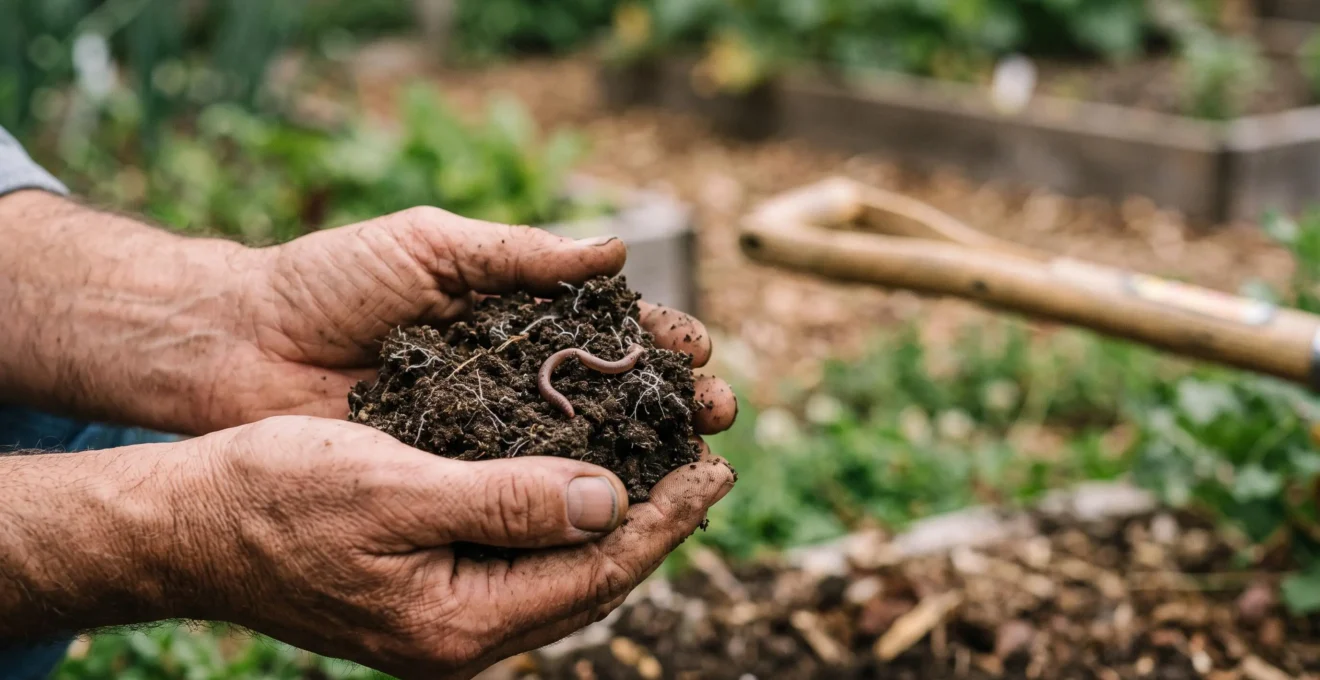
Contrary to generations of gardening wisdom, digging and tilling are the most destructive things you can do to your soil’s health and fertility.
- Digging shatters the delicate fungal networks that feed your plants and creates a hardpan layer beneath the surface.
- It awakens millions of dormant weed seeds, creating more work, and releases stored carbon into the atmosphere.
Recommendation: Adopt the no-dig method by layering organic matter (like cardboard and compost) on the surface to feed the soil from the top down, letting worms and microbes do the work for you.
For generations, the image of a gardener has been inseparable from a spade. We’ve been taught that good gardening starts with turning the soil, breaking up clumps, and digging in amendments. This back-breaking work is seen as a necessary ritual for a healthy garden. But what if this fundamental belief is wrong? What if the very act of digging, meant to improve the soil, is actively destroying its living architecture and creating more work for you in the long run?
The conventional approach treats soil as an inert substance—a simple mix of minerals, water, and air to be physically manipulated. This perspective overlooks the most critical component: life. Your garden soil is not dirt; it is a teeming, complex ecosystem, a ‘Soil Food Web’ of billions of microorganisms, fungi, and invertebrates. When you plunge a spade into the ground, you are not just ‘fluffing it up’; you are causing a catastrophic event in a subterranean metropolis.
This article introduces a revolutionary but simple paradigm shift. Instead of battling your soil, you can partner with it. We will dismantle the myths surrounding digging and reveal how a ‘no-dig’ approach regenerates soil structure, boosts fertility, suppresses weeds, and saves your back. It’s time to put down the spade and learn to work with the powerful natural forces already present beneath your feet.
This guide explores the science and practical steps behind this powerful method. We will cover how soil life builds structure, how to convert a weedy lawn into a productive bed without digging, and how to create a self-sustaining garden that needs less and less from you each year.
Summary: A Guide to Natural Soil Regeneration by Abandoning the Spade
- The Mycorrhizal Web: How Fungi Transport Nutrients When You Don’t Dig?
- Cardboard and Compost: How to Convert a Lawn to a Bed in One Day?
- The Compaction Myth: Does Not Digging Make Soil Hard?
- Hoeing or Pulling: Which Disturbs the Soil Web Less?
- Worm Counts: How to Measure Regeneration Success in 12 Months?
- Digging vs Top Dressing: How to Apply Amendments Without Wrecking Structure?
- Chop-and-Drop: Is It Messy or the Ultimate Fertilizer technique?
- Creating Self-Sustaining Ecosystems: How to Stop Buying Compost and Fertilizer?
The Mycorrhizal Web: How Fungi Transport Nutrients When You Don’t Dig?
Beneath the surface of your garden lies a vast, intricate network often called the ‘wood wide web’. This is the mycorrhizal network, a symbiotic partnership between fungi and plant roots. Digging, tilling, or even excessive forking shatters this delicate web, effectively destroying the soil’s natural nutrient delivery system. When left undisturbed, these fungal threads act as a superhighway, extending far beyond the reach of a plant’s own roots to mine for water and essential minerals like phosphorus and nitrogen.
This underground economy is not a minor phenomenon; a landmark global survey found that mycorrhizal fungi partner with around 70% of plant species, moving staggering amounts of carbon and nutrients through the soil. When you dig, you sever these connections, forcing plants to rely solely on the limited area their own roots can explore. This makes them more dependent on you for water and fertilizer.
The impact of this destruction isn’t just theoretical. In a long-term experiment known as the Three-Strip Trial, no-dig pioneer Charles Dowding has meticulously compared plots that are dug versus those that are left undisturbed. His findings consistently show that the dug strips, where the fungal network is broken each year, suffer from reduced yields compared to the no-dig beds. This real-world case study provides powerful evidence that protecting the soil’s living infrastructure is key to a more productive garden.
Cardboard and Compost: How to Convert a Lawn to a Bed in One Day?
The idea of starting a new garden bed often conjures images of back-breaking work: slicing up and removing tough lawn, digging over compacted earth, and pulling endless weeds. The no-dig method replaces all of that with a simple, elegant process called sheet mulching. By layering cardboard and compost directly on top of an existing lawn or weedy area, you can create a fertile, ready-to-plant bed in a single afternoon, letting nature do the hard work of clearing the ground for you.
The process works by smothering the existing vegetation. The cardboard layer blocks all light, killing the grass and weeds underneath without you ever lifting a spade. As they die back, they decompose in place, becoming food for the Soil Food Web. Earthworms and other soil life are drawn up to the feast, pulling the organic matter down, aerating the soil, and creating perfect planting conditions. This method is so effective and reliable that it’s a trusted technique for professional landscapers converting lawns to drought-tolerant gardens, even on compacted clay or weedy slopes.
You simply lay down a layer of plain brown cardboard (removing all plastic tape and labels), ensuring the pieces overlap generously to prevent light from getting through. Water it well, then top it with a thick layer of compost—at least 4-6 inches (10-15 cm). You can plant directly into the compost layer immediately for larger plants or wait a few months for the layers to break down before sowing seeds. The result is a weed-free, fertile bed created with minimal effort.
The Compaction Myth: Does Not Digging Make Soil Hard?
One of the most common fears among gardeners considering the no-dig method is compaction. The logic seems simple: if you don’t ‘fluff up’ the soil with a spade, won’t it eventually become a hard, impenetrable brick? This is perhaps the biggest myth of conventional gardening. In reality, digging is a primary cause of compaction, not its solution. While digging provides temporary aeration, it destroys the very thing that gives soil its long-term, stable structure: the living ecosystem within it.
Healthy, undisturbed soil develops what is called ‘aggregate structure’. Soil particles are glued together by microbial secretions and woven into a stable, sponge-like matrix by fungal hyphae and root hairs. This creates a network of pores and channels that allow air and water to move freely. Earthworms, the undisputed champions of biological tillage, constantly tunnel through the soil, further enhancing its porosity. When you dig, you shatter these aggregates, pulverizing the soil into a fine powder. After the first rain, these fine particles settle and compact into a dense, airless layer, often forming a hardpan just below the depth of your spade.
In a no-dig system, you protect this natural structure. By continuously adding organic matter to the surface, you feed the soil life that builds and maintains this spongy, resilient texture. You may walk on designated paths, but the growing areas are left to the worms and microbes, who are far better at creating a permanent, well-aerated structure than any spade could ever be. The soil doesn’t become hard; it becomes a living sponge.
Hoeing or Pulling: Which Disturbs the Soil Web Less?
Weeds are an inevitable part of gardening, but how you deal with them has a profound impact on your soil’s health. The traditional approach of deep hoeing or aggressive cultivation to uproot weeds is a form of digging. It disrupts the soil surface, damages the shallow-living fungal network, and, most counter-productively, brings a fresh batch of dormant weed seeds to the surface where they can germinate. The soil is a ‘seed bank’ containing thousands of seeds, but research on weed seed fate shows that only 1 to 30% of weed seeds in the soil typically germinate in a given year, many triggered by exposure to light.
In a no-dig system, the goal is minimal disturbance. The thick layer of compost mulch already suppresses most weeds by blocking light. For the few that do appear, the strategy is surgical rather than destructive. Lightly slicing the weed at the soil line with a sharp hoe is often enough to kill it without disturbing the soil below. This leaves the weed’s roots to decompose in place, adding organic matter and feeding the soil life. For perennial weeds with persistent roots, a narrow trowel or a specific weeding tool can be used to lever them out with minimal disruption to the surrounding area. Gentle pulling after a rain when the soil is soft is also effective.
The key is to think of weeding not as a battle to excavate enemies, but as a precise activity to maintain the mulch layer’s integrity. By avoiding deep cultivation, you stop giving new weed seeds the signal they need to sprout, leading to significantly less weeding over time.
Action Plan: Minimal-Disturbance Weed Management
- Recognize that many weed seeds germinate in response to soil surface disturbance, with light being the most common trigger.
- Favor surgical, surface-only tools like sharp hoes instead of deep cultivators to avoid bringing new seeds to the light.
- Where possible, use punch planters or similarly designed tools that plant crops with minimal soil disturbance.
- Be mindful that even routine transplanting can disturb the soil enough to stimulate weed emergence in the crop row; apply mulch right up to the stem.
Worm Counts: How to Measure Regeneration Success in 12 Months?
One of the most satisfying aspects of switching to a no-dig method is witnessing the rapid return of life to your soil. But how can you measure this regeneration? While complex soil tests can provide data, one of the best and easiest bio-indicators of soil health is the earthworm population. Earthworms are ecosystem engineers, and their presence in large numbers is a clear sign that your soil is becoming a healthy, functioning ecosystem.
Their benefits are immense. As they move through the soil, they create stable, mucus-lined burrows that improve drainage and aeration. They pull organic matter from the surface down into the root zone, a process called ‘bioturbation’. Their digestive process transforms this organic matter into nutrient-rich ‘worm castings,’ which are one of the best natural fertilizers available. The positive impact is so significant that research on earthworm distribution and soil function shows up to a 25% enhancement in crop yields where they are abundant.
To measure your success, you can conduct a simple survey. A year after starting your no-dig bed, choose a damp day and dig up a single cubic foot (roughly 30x30x30 cm) of soil. Place the soil on a tarp and carefully count the number of earthworms you find. A count of 10-15 worms in this small sample is good, but in a mature no-dig system, it’s not uncommon to find 30, 40, or even more. This simple, tangible metric is a powerful confirmation that by stopping digging and starting to mulch, you have successfully kickstarted a process of profound ecological regeneration.
Digging vs Top Dressing: How to Apply Amendments Without Wrecking Structure?
A common gardening task is adding soil amendments like compost, manure, or specific minerals to improve fertility. The conventional method involves ‘digging in’ or ‘incorporating’ these materials, once again requiring the destructive use of a spade or tiller. This practice is based on the flawed assumption that nutrients need to be mechanically mixed into the root zone. In a no-dig system, the approach is radically simpler and aligns with how natural ecosystems work: top dressing.
Top dressing is simply the act of spreading amendments on the surface of the soil. Just as leaves fall and decompose on a forest floor, you apply your compost, manure, or other organic materials as a layer on top of your beds. You are not feeding the plants directly; you are feeding the Soil Food Web that lives in the top few inches of soil. The organisms in this web—bacteria, fungi, protozoa, and especially earthworms—do the work of ‘incorporation’ for you.
Earthworms are particularly crucial in this process. They come to the surface (especially under the cover of mulch) to consume the fresh organic matter and pull it down into their burrows, distributing it throughout the root zone. This ‘biological tillage’ delivers nutrients exactly where they are needed without ever shattering the soil’s delicate structure. This method is not only less work but also more effective, as it fosters a slow and steady release of nutrients that supports robust, healthy plant growth, rather than the boom-and-bust cycle often caused by synthetic fertilizers.
Chop-and-Drop: Is It Messy or the Ultimate Fertilizer technique?
As your no-dig garden matures, you can begin to create a closed-loop system where the garden largely fertilizes itself. One of the most powerful techniques to achieve this is ‘chop-and-drop’. The concept is simple: instead of removing plant debris (like finished crops, pruned leaves, or cover crops) to a compost pile, you simply chop it up and drop it in place to decompose on the soil surface. To some, this might seem messy or untidy compared to a bare, ‘clean’ garden bed.
However, from a soil ecosystem perspective, it is the ultimate fertilizer technique. This fresh organic matter, often called ‘green manure,’ is a perfect food source for the soil life. It provides a balanced diet of carbon and nitrogen that fuels the microbial community. As it breaks down, it forms a natural mulch layer that protects the soil surface from sun and erosion, conserves moisture, and suppresses weeds. It is, in effect, feeding the soil in place with materials grown on-site, completely eliminating the need to import fertility.
This technique is particularly powerful when used with specific ‘dynamic accumulator’ plants like comfrey, borage, or yarrow, which are known to draw up minerals from deep in the soil and concentrate them in their leaves. When you chop-and-drop these plants, you are effectively mining minerals from the subsoil and delivering them to the surface for your vegetable crops. While it may look less manicured than a traditional garden, a bed managed with chop-and-drop is a vibrant, living system that is constantly recycling nutrients and building its own fertility.
Key Takeaways
- Soil is a living ecosystem, not inert dirt. The goal of a gardener is to feed and protect the ‘Soil Food Web’.
- Digging is destructive. It shatters fungal networks, causes compaction, and activates dormant weed seeds, creating more work.
- Feed the soil from the top down. Layering organic mulch like compost is the most effective way to build fertility and structure.
Creating Self-Sustaining Ecosystems: How to Stop Buying Compost and Fertilizer?
The ultimate goal of a no-dig garden is to move beyond simply avoiding destructive practices and toward creating a truly self-sustaining ecosystem. The journey starts by replacing digging with top-dressing compost, but it culminates in a system that generates most, if not all, of its own fertility. This is achieved by thinking of your garden not as a collection of individual plants, but as a holistic, interconnected community.
By combining techniques like chop-and-drop, planting green manures, and integrating perennial plants, you can create a closed-loop system. Cover crops like clover or vetch can be grown in the off-season to ‘fix’ nitrogen from the atmosphere, which is then released into the soil when they are chopped down. Strips of perennial flowers and herbs can be interplanted to attract beneficial insects that control pests. Dynamic accumulators like comfrey can be grown in designated patches to be harvested for mulch, creating an on-site fertilizer factory.
This approach transforms your role from a laborer who constantly inputs materials into a conductor who orchestrates natural cycles. The focus shifts from annual, intensive work to establishing a permanent, living system. It requires less effort over time, is more resilient to drought and pests, and produces nutrient-dense food. You stop being just a consumer of compost and fertilizer and become a facilitator of a vibrant, productive garden ecosystem.
Your first step in this revolutionary journey is simple. Find a patch of lawn, gather some cardboard and compost, and create your first no-dig bed. Start small, observe the return of life to your soil, and you will never want to pick up a spade again.