Botany and science
Botany stands at the intersection of scientific inquiry and practical application, offering a framework for understanding the living systems that sustain life on Earth. Whether you’re cultivating a garden, conserving native species, or simply curious about the green world around you, grasping the scientific principles behind plant life transforms observation into insight. The science of botany reveals why certain plants thrive in specific conditions, how they adapt to environmental challenges, and what mechanisms drive their growth from seed to maturity.
This comprehensive exploration covers the fundamental scientific disciplines that inform modern botany: from cellular structures and metabolic processes to taxonomic classification and ecological relationships. Each concept connects directly to practical gardening and conservation decisions, demonstrating how scientific knowledge empowers more informed, successful plant cultivation. By understanding these foundational principles, you’ll develop a deeper appreciation for the complexity of plant life and the tools to nurture it effectively.
Plant Anatomy and Structure: The Building Blocks of Botanical Life
Every plant, from towering trees to delicate herbs, shares a fundamental architectural blueprint refined over millions of years of evolution. Understanding plant anatomy provides the foundation for recognizing how different species adapt to their environments and how gardeners can support healthy development.
Roots, Stems and Leaves: The Essential Organs
The root system serves multiple critical functions: anchoring the plant, absorbing water and dissolved minerals, and often storing energy reserves. Taproots penetrate deeply to access groundwater, while fibrous root systems spread horizontally to maximize surface absorption. This distinction explains why some plants tolerate drought better than others and informs watering strategies.
Stems provide structural support and house the vascular tissues that transport nutrients throughout the plant. Woody stems develop secondary growth that increases diameter over time, while herbaceous stems remain soft and flexible. Recognizing stem types helps predict plant longevity and pruning requirements.
Leaves function as the primary sites of photosynthesis and gas exchange. Their shapes, sizes, and arrangements reflect adaptations to light availability, temperature regulation, and water conservation. Broad leaves maximize light capture in shaded environments, while small, waxy leaves reduce water loss in arid conditions.
Vascular Systems: The Plant Highway Network
Two specialized tissues form the plant’s circulatory system. Xylem transports water and minerals upward from roots to leaves through a combination of root pressure and transpiration pull. Phloem carries dissolved sugars produced during photosynthesis from leaves to growing tissues and storage organs. Understanding this directional flow explains why girdling damages trees and how nutrient deficiencies manifest in specific plant parts.
Reproductive Organs: Flowers, Fruits and Seeds
Flowers represent highly specialized structures designed for sexual reproduction. Their diversity reflects different pollination strategies: showy petals and nectar attract animal pollinators, while wind-pollinated species produce abundant lightweight pollen. Recognizing flower structure helps identify plant families and predict fruiting patterns.
Fruits develop from fertilized ovaries to protect and disperse seeds. The extraordinary variety of fruit types—from dry capsules to fleshy berries—demonstrates different dispersal strategies that influence where and how plants colonize new areas.
Understanding Photosynthesis and Plant Metabolism
Photosynthesis stands as one of the most significant biological processes on Earth, converting light energy into chemical energy stored in glucose molecules. This process occurs primarily in leaf chloroplasts, where chlorophyll pigments capture light wavelengths while reflecting green light, giving plants their characteristic color.
The simplified equation—carbon dioxide plus water plus light energy yields glucose plus oxygen—masks extraordinary complexity involving light-dependent and light-independent reactions. During daylight, plants split water molecules, release oxygen, and generate energy carriers used to fix atmospheric carbon into sugars. These sugars fuel all plant growth and development.
Plant respiration, occurring continuously in all living cells, breaks down glucose to release energy for cellular processes. Unlike animals, plants produce more energy through photosynthesis than they consume through respiration, contributing the net oxygen production that supports aerobic life. Understanding this balance explains why adequate light proves essential for healthy plant growth and why poorly lit plants become weak and leggy.
For gardeners, photosynthesis principles inform practical decisions about plant placement, pruning for light penetration, and recognizing signs of insufficient light exposure. Plants struggling to photosynthesize efficiently display pale leaves, elongated stems, and reduced flowering—visual cues that prompt environmental adjustments.
Plant Taxonomy and Classification: Organizing Botanical Diversity
With over 300,000 known plant species, systematic classification provides essential organization for understanding relationships, predicting characteristics, and communicating about plants precisely. Modern botanical taxonomy combines traditional morphological observations with molecular genetic analysis to establish evolutionary relationships.
The hierarchical classification system organizes plants into increasingly specific categories: kingdom, division (phylum), class, order, family, genus, and species. The binomial nomenclature system assigns each species a two-part Latin name—the genus name followed by the specific epithet—creating a universal language that transcends regional common names. For example, Solanum lycopersicum identifies tomatoes regardless of whether you call them tomatoes, tomates, or pomodori.
Recognizing plant families offers powerful predictive tools for gardeners. Members of the same family typically share growth requirements, pest vulnerabilities, and cultural needs. The characteristics that define major families become recognizable patterns:
- Fabaceae (legume family): nitrogen-fixing root nodules, compound leaves, distinctive pea-like flowers
- Rosaceae (rose family): five-petaled flowers, numerous stamens, diverse fruit types including apples, cherries, and strawberries
- Asteraceae (daisy family): composite flower heads containing many tiny florets, often with ray and disc flowers
- Brassicaceae (mustard family): four-petaled flowers in cross formation, pungent oils, includes cabbage, broccoli, and radishes
Understanding these patterns helps diagnose problems, predict behavior, and select compatible companion plants based on shared or complementary family traits.
Plant Physiology and Growth Processes
Plant growth and development involve precisely coordinated processes regulated by internal signals and environmental cues. Unlike animals with predetermined body plans, plants exhibit indeterminate growth, continuously producing new organs throughout their lifespan in response to conditions.
Hormones and Growth Regulators
Plant hormones coordinate growth, development, and stress responses in remarkably low concentrations. Auxins promote cell elongation and apical dominance, explaining why removing terminal buds stimulates lateral branching. Cytokinins stimulate cell division and delay senescence. Gibberellins trigger stem elongation and seed germination. Ethylene promotes fruit ripening and leaf abscission. Abscisic acid regulates stress responses, particularly drought tolerance and dormancy.
Understanding hormone interactions illuminates pruning effects, rooting stimulation, fruit ripening control, and stress management strategies that improve cultivation success.
Tropisms and Plant Responses
Plants actively respond to environmental stimuli through directional growth movements. Phototropism directs shoots toward light sources, maximizing photosynthetic potential. Gravitropism orients roots downward and shoots upward, ensuring proper organ positioning. Thigmotropism enables climbing plants to wrap around supports. These responses demonstrate that plants actively sense and respond to their environment, adjusting growth patterns to optimize resource acquisition.
Seasonal Cycles and Dormancy
Photoperiod sensitivity allows plants to track seasonal progression through night length detection, triggering flowering, dormancy, and other seasonal transitions at appropriate times. Understanding whether species require long days, short days, or day-neutral conditions for flowering enables gardeners to manipulate bloom timing or select regionally appropriate varieties.
Soil Science and Plant Nutrition
Healthy soil provides the foundation for successful plant cultivation, functioning as a complex ecosystem that supplies water, nutrients, anchorage, and beneficial organisms. Soil science examines the physical, chemical, and biological properties that influence plant growth.
Plants require sixteen essential nutrients in varying quantities. Macronutrients—nitrogen, phosphorus, and potassium—are needed in largest amounts and form the basis of most fertilizers. Secondary macronutrients include calcium, magnesium, and sulfur. Micronutrients such as iron, manganese, zinc, copper, boron, molybdenum, chlorine, and nickel are required in trace amounts but prove equally essential.
Nutrient availability depends heavily on soil pH, which affects chemical solubility and microbial activity. Most plants prefer slightly acidic to neutral conditions, though specific species adapted to acidic bogs or alkaline soils demonstrate the importance of matching plants to appropriate soil chemistry. Visual symptoms of nutrient deficiencies—yellowing patterns, stunted growth, leaf discoloration—provide diagnostic clues guiding soil amendment strategies.
The soil food web encompasses bacteria, fungi, protozoa, nematodes, and larger organisms that decompose organic matter, cycle nutrients, improve soil structure, and support plant health. Mycorrhizal fungi form symbiotic associations with most plant roots, extending nutrient and water absorption capacity in exchange for plant sugars. Nitrogen-fixing bacteria in legume root nodules convert atmospheric nitrogen into plant-available forms. Supporting these biological partnerships through organic matter additions and minimal chemical disruption enhances long-term soil fertility.
Plant Ecology and Environmental Interactions
Plants exist within intricate ecological networks involving pollinators, herbivores, decomposers, competitors, and countless other organisms. Understanding these relationships reveals how natural systems function and how gardens can support broader ecological health.
Pollination ecology encompasses the diverse strategies plants employ to achieve sexual reproduction. Approximately 80% of flowering plant species rely on animal pollinators—bees, butterflies, moths, flies, beetles, birds, and bats—each attracted by specific flower characteristics including color, scent, shape, and nectar rewards. Wind-pollinated species produce abundant pollen but lack showy flowers, relying instead on strategic timing and positioning.
Seed dispersal mechanisms demonstrate remarkable adaptations for colonizing new areas. Wind-dispersed seeds often feature wings or plumes that carry them considerable distances. Fleshy fruits attract animals that consume seeds and deposit them elsewhere with a nutrient package. Explosive mechanisms propel seeds away from parent plants, while hooked or sticky seeds hitchhike on passing animals. Recognizing dispersal strategies explains plant distribution patterns and unexpected volunteer seedlings.
Plant communities develop through succession, competition, and environmental filtering. Pioneer species colonize disturbed areas, modifying conditions that enable later-arriving species. Climax communities represent relatively stable assemblages adapted to local conditions. Understanding successional dynamics helps gardeners work with natural processes rather than fighting them, selecting species appropriate for site conditions and existing community context.
These ecological principles extend beyond wild landscapes into gardens, where supporting pollinator populations, encouraging beneficial insects, and creating diverse plant communities enhances resilience, reduces pest problems, and contributes to conservation of declining species.
Botanical science provides the interpretive framework for understanding plant life in all its complexity and diversity. These foundational principles—from cellular structures to ecosystem interactions—transform gardening from trial-and-error into informed practice. As you explore specific topics in greater depth, this scientific foundation will help you ask better questions, interpret observations accurately, and make decisions that support healthy, thriving plants in any growing situation.
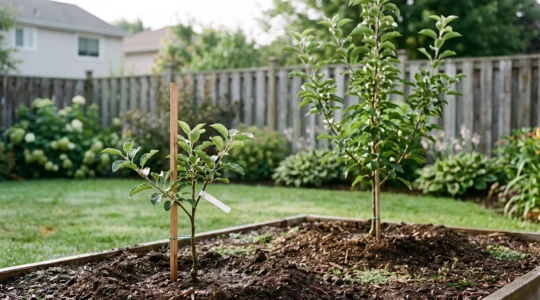
M9 or MM106: Which Grafted Rootstock Suits Your Garden Size?
Choosing a fruit tree rootstock isn’t about picking a final size; it’s about understanding the lifelong contract of support and care you are signing up for. Extreme dwarfism (M27, M9) comes with a mechanical trade-off: brittle roots that demand permanent,…
Read more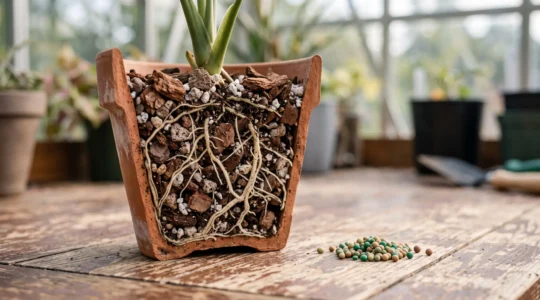
Why Substrate Porosity Is More Important Than Fertilizer for Pot Plants?
The primary cause of container plant failure is not starvation but suffocation, making substrate porosity a more critical factor for success than fertilizer application. Most potting mixes degrade within months, losing the air-filled porosity essential for root respiration, leading to…
Read more
Why Fibrous Root Systems are the Unsung Engineers Preventing Soil Erosion on Sloped Plots
Stabilising a sloped UK garden is less about choosing plants and more about engineering a soil-root composite material. Fibrous root systems act as a “living rebar,” creating a high-tensile mesh that binds heavy clay soil from the surface downward. Watering…
Read more
Beyond the Gloom: How to Scientifically Boost Photosynthesis in Your Shady UK Garden
Contrary to popular belief, the key to a thriving UK shade garden isn’t just finding more light—it’s about systematically improving your plants’ ability to use the limited light they receive. Standard “bright” grow lights often fail because they don’t provide…
Read more