The increasing cycle of winter deluges and summer heatwaves is causing conventional gardens to fail. The solution is not merely choosing different plants, but re-engineering your garden’s fundamental structure. By focusing on soil permeability, deep-rooted anchorage, and intelligent water management, you can create a passive, resilient ecosystem that buffers itself against both flood and drought without constant intervention.
For homeowners in temperate climates, the weather has become a source of horticultural whiplash. The garden that was waterlogged and drowning in February is baked, cracked, and gasping by August. This new reality of extreme, opposing weather events renders much traditional gardening advice obsolete. Simply adding more mulch or installing a small rain barrel feels like placing a sticking plaster on a systemic wound. These are reactive tactics in a world that demands a proactive strategy.
The common response is to seek out lists of “invincible” plants, hoping a species-based solution exists. While plant choice matters, it’s a secondary concern. The true weakness lies not in the foliage, but in the foundation: the soil, the topography, and the lack of biological diversity. Relying on a handful of species or a flat, compacted landscape is a high-risk gamble against an increasingly unpredictable climate. It’s an approach destined for repeated failure and frustration.
But what if the key to a future-proof garden wasn’t in constantly fighting the weather, but in designing a landscape that passively manages its extremes? The answer lies in ecological engineering. By rethinking the very structure of your garden—from its ability to absorb water to the subterranean networks that anchor it—you can build a resilient system. This is not about more work; it is about smarter, front-loaded design that creates a self-sustaining garden for the long term.
This guide will walk you through the core engineering principles for building a truly resilient garden. We will explore how to manage water, strengthen your plants from the roots up, leverage diversity as an insurance policy, and reshape your land to work with the climate, not against it. Prepare to shift your perspective from gardener to climate adaptation designer.
Summary: A Guide to Engineering a Garden for Extreme Weather
- Why Gravel Gardens Handle Both Deluge and Drought Best?
- Rooting Depth: Which Trees Won’t Topple in 80mph Winds?
- The Monoculture Risk: Why Diversity is Your Insurance Policy?
- How to Shape Your Land to Hold Water Longer in Summer?
- Autumn Planting: Why It’s Now Safer Than Spring Planting?
- Plants That Survive Both Drowning and Drought in Rain Gardens
- Fleece or Sheets: Improvising Shade During a Red Warning?
- Handling Summer Heat Stress: How to Cool Roots When Temperatures Hit 30°C?
Why Gravel Gardens Handle Both Deluge and Drought Best?
The twin challenges of modern gardening are excess water and extreme water scarcity. A conventional lawn or bare soil bed performs poorly in both scenarios: it becomes a sodden swamp during a deluge and a hard, cracked desert in a drought. The solution lies in a surface that can handle both extremes, and the most effective is a deep gravel mulch. This approach, famously championed by pioneering gardener Beth Chatto, is a masterclass in passive water management.
During a heavy downpour, a 4-5 inch layer of gravel acts as a highly permeable surface. Water doesn’t pool or run off; it drains through the stones almost instantly, infiltrating the soil below without causing erosion or waterlogging plant crowns. This rapid absorption is crucial for preventing flash floods in your garden. Then, during a heatwave, the same layer of gravel becomes a formidable shield. It reflects solar radiation, keeping the soil beneath it significantly cooler, and acts as a barrier that dramatically reduces moisture evaporation from the soil surface. It creates a stable, insulated root environment.
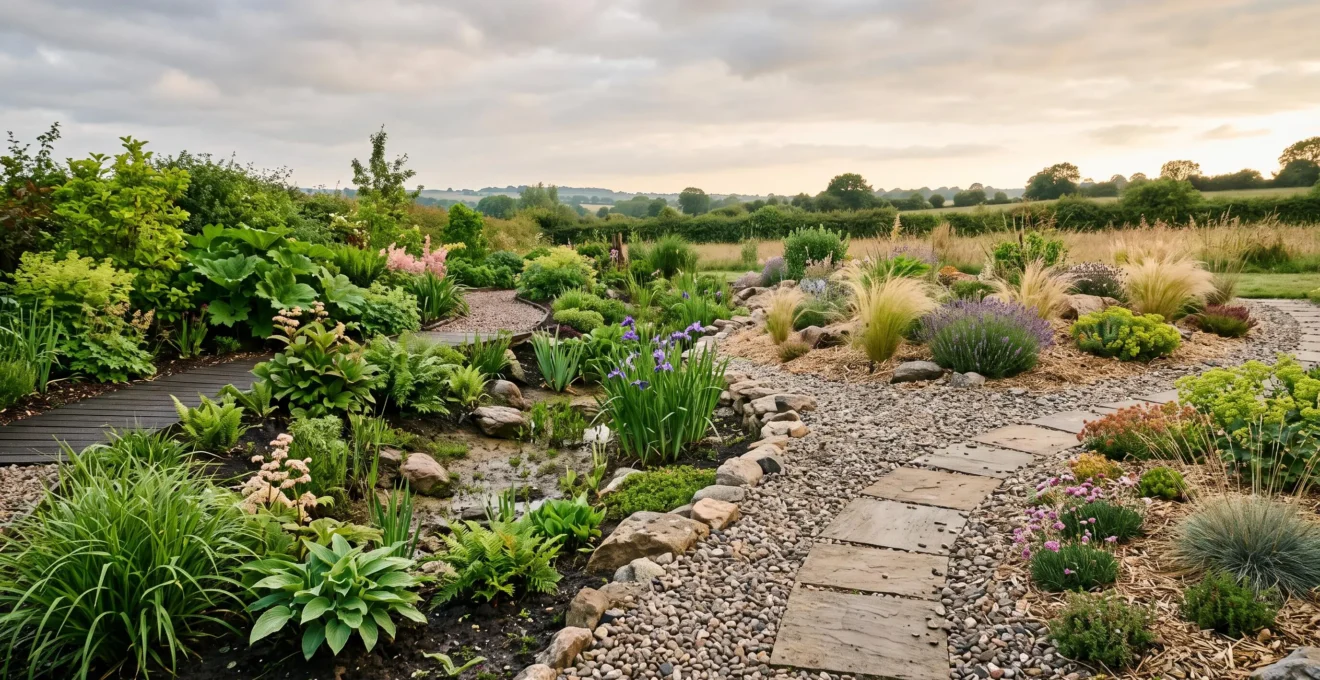
This paragraph introduces a key concept. To truly appreciate its visual impact, the illustration below showcases a thriving gravel garden, demonstrating that drought-resilience can be lush and beautiful.
As this image shows, the result is not a barren rockery but a vibrant tapestry of plants. By choosing species adapted to sharp drainage and dry conditions, you create a garden that needs virtually no irrigation once established. It is a system engineered to thrive on ambient rainfall, whether it comes all at once or not at all for weeks on end.
Rooting Depth: Which Trees Won’t Topple in 80mph Winds?
As windstorms become more frequent and intense, the stability of our garden trees is a primary concern. The solution, however, is not found above ground in pruning techniques, but below ground in the unseen world of roots. A tree’s ability to withstand high winds is almost entirely dependent on its root system’s depth, spread, and mechanical strength. This is a matter of subterranean engineering, not just horticulture.
Research confirms that a tree’s anchorage is a direct function of its root architecture. Key metrics like root tensile strength, elasticity, and toughness are what enable a plant to resist the immense mechanical force of wind. According to recent research on root mechanical performance in woody plants, these physical properties are the critical basis for wind anchorage and soil stabilization. Therefore, our goal must be to encourage the development of deep, robust, and structurally sound root systems from the very beginning. This means avoiding compacted soil, providing deep but infrequent watering to encourage downward growth, and choosing species known for deep taproots or wide, fibrous root plates.
This underground network is made even more resilient by a hidden ally: mycorrhizal fungi. These fungi form a symbiotic web connecting the roots of multiple plants. One study on a forest devastated by a storm found these networks are key to regeneration, as they can transfer carbon, water, and nutrients between trees, creating a shared subterranean support system. By fostering healthy soil biology, we are effectively reinforcing our garden’s natural foundations.
This symbolic view illustrates the concept of an intertwined, reinforced root system. Thinking of the soil not as dirt but as a living matrix of roots and fungi is the first step towards building a garden that can stand firm against the wind. It’s about creating an integrated anchor, not just planting a tree.
The Monoculture Risk: Why Diversity is Your Insurance Policy?
Relying on a single type of plant for a hedge, lawn, or border—a practice known as monoculture—is one of the biggest risks in a climate-stressed garden. When a new pest, disease, or specific weather event arrives that targets that one species, the entire planting can be wiped out in a single season. The alternative is to embrace diversity, specifically through the creation of ‘plant guilds’. This isn’t just about mixing different plants for aesthetic reasons; it’s about building a team where each member performs a function, creating functional redundancy.
A plant guild is a polyculture, a small, man-made ecosystem designed around a central plant (like a fruit tree) and supported by a variety of other plants that provide services. These can include nitrogen-fixers that enrich the soil, aromatic pest-repellents that confuse insects, deep-rooted plants that draw up nutrients, and groundcovers that suppress weeds and cool the soil. This web of mutual support creates a system that is far more resilient than the sum of its parts. The proof is in the data, as comparative data on permaculture guild performance shows that pest pressure often drops significantly, soil cover is vastly improved, and overall yield per square meter can be double that of monocultures.
By having multiple species performing similar functions, the system has a built-in insurance policy. If one plant fails due to a specific stress, others are there to fill the gap, ensuring the ecosystem as a whole continues to function. This approach transforms the garden from a fragile collection of individuals into a robust, interconnected community.
Action Plan: Designing a Resilient Plant Guild
- Designate a Space: If you are new to this concept, start small with a manageable area, such as a 20 ft x 20 ft square, to test your design.
- Choose a Central Player: Select the main, long-lived perennial, such as a fruit tree or large shrub, that will be the anchor of your guild.
- Select Supporting Players by Function: Layer in companion plants that provide specific services, such as nitrogen-fixers (clover, beans), pest-repellents (marigolds, garlic), and pollinator-attractors (borage, comfrey).
- Plan for Niches in Time and Space: Consider how the plants will interact throughout the seasons and at different heights, creating vertical layers from root to canopy.
- Implement and Observe: Plant your guild and watch how the species interact, making adjustments over time to optimize the relationships and overall health of the system.
How to Shape Your Land to Hold Water Longer in Summer?
A flat landscape is an inefficient landscape. When rain falls, it either pools on the surface or runs off quickly, taking valuable topsoil with it. In a climate of extremes, we need to actively shape our land to slow, spread, and sink water, turning our gardens into giant sponges that can hydrate themselves through dry spells. This practice of hydrological management through topography is a cornerstone of climate resilience.
One of the most effective techniques for this is the ‘Hügelkultur’ bed. German for “mound culture,” this is essentially a raised bed with a core of decaying wood. As a case study from Oklahoma State University explains, a Hügelkultur functions as a self-watered, self-composting raised garden with few irrigation needs. The mound’s shape slows rainwater runoff, allowing it to percolate deep into the structure rather than flooding the surrounding area. Inside, the rotting logs and branches act like a reservoir, absorbing vast amounts of water during wet periods and slowly releasing it back to the plant roots during droughts.
Building a Hügelkultur bed is a strategic layering process designed to maximize this sponge-like effect. The structure is built from the ground up to create a long-lasting, water-retentive, and nutrient-rich growing environment. The key is the careful sequencing of materials:
- Base Layer (Woody Core): The foundation is made of large logs and thick branches. This woody heart provides the primary structure and long-term water storage capacity.
- Second Layer (Smaller Branches): A layer of smaller sticks and twigs goes on top, filling gaps and ensuring good aeration while adding to the water-retention matrix.
- Third Layer (Organic Matter): Next comes a thick layer of green waste, such as grass clippings, leaves, and vegetable scraps. As this layer decomposes, it releases a steady stream of nutrients into the mound.
- Top Layer (Compost and Soil): The mound is capped with a final layer of compost and topsoil, providing an immediate planting medium for your crops or perennials.
This simple act of land shaping creates a passive irrigation system that can sustain plants through a hot summer with significantly less—or even zero—supplemental watering.
Autumn Planting: Why It’s Now Safer Than Spring Planting?
The traditional gardening calendar, with its emphasis on a flurry of spring planting, is becoming increasingly outdated and risky. Spring is no longer the gentle, dewy season it once was; it is often characterized by sudden heatwaves and prolonged dry spells. Planting young, vulnerable plants into this environment is a recipe for stress and failure. A strategic temporal shift in our planting schedule is required: for many perennials, shrubs, and trees, autumn is the new spring.
The logic is simple and rooted in soil science. In autumn, the soil is still warm from the summer, but the air temperature is cooling. This is the perfect combination for root growth. A plant put in the ground in September or October will focus all its energy on establishing a deep and extensive root system, without the pressure of having to support leaf growth or flowers. It is not battling the intense transpiration stress caused by hot sun and dry winds.
This period of uninterrupted root development is the greatest gift you can give a new plant. It spends the autumn and winter months creating the subterranean architecture it needs to face the following year’s challenges. By the time the heat and potential drought of summer arrive, its roots are already deep in the soil profile, able to access moisture reserves that a spring-planted specimen could never reach. This simple change in timing is a low-cost, high-impact strategy that dramatically improves long-term survival rates and builds a more resilient garden from the ground up.
Plants That Survive Both Drowning and Drought in Rain Gardens
A rain garden is one of the most elegant solutions to the flood-and-drought cycle. It is a shallow, landscaped depression designed to intercept, hold, and absorb rainwater runoff from roofs, driveways, or lawns. Instead of letting storm water overwhelm drains, a rain garden turns a deluge into a resource. However, its success depends on choosing plants that can tolerate both periods of temporary inundation and subsequent dry spells. The key is not finding one ‘super plant’, but designing a zoned plant community.
The topography of a rain garden creates distinct hydrological zones. The bottom of the basin will be the wettest area and will hold water the longest after a storm. The sloping sides will be moderately moist, while the upper banks or berms will be the driest. The design principle is to match the plant to the zone. Place water-loving species like irises or rushes in the center, which can handle having “wet feet” for a day or two. On the slopes, use adaptable perennials that tolerate both moisture and drier conditions. Finally, plant drought-tolerant species around the edges and on the berms.
This zoned approach creates a resilient and functional ecosystem. As one guide on climate resilience points out, strategies like rain gardens and permeable surfaces are crucial because they both reduce flood risk and recharge groundwater. The rain garden acts as a temporary reservoir during a storm, protecting your property. Then, during dry periods, that stored groundwater creates a more humid microclimate and provides a deep source of moisture for the established plants, making the entire system more drought-resistant.
Key Takeaways
- Resilience is built from the ground up: prioritize soil structure and permeability over all else.
- A diverse garden is a safe garden: functional redundancy from plant guilds provides an insurance policy against pests, disease, and weather.
- Work with water, don’t fight it: use land shaping and passive systems like rain gardens to turn storm runoff into a stored resource.
Fleece or Sheets: Improvising Shade During a Red Warning?
When a heatwave is forecast and a red weather warning is issued, the instinct is to panic and reach for temporary fixes. We rush out to rig up shade cloth, old bedsheets, or horticultural fleece to shield our wilting plants from the scorching sun. While these can offer some last-minute relief, the very need for such emergency measures is a sign of a fundamentally flawed garden design. A truly resilient garden should not require frantic, reactive interventions; it should have passive cooling systems built into its very fabric.
The most effective shade is not a sheet, but a leaf. A well-designed garden with high-density planting creates its own shade. As plants mature and their canopies touch, they form a ‘living mulch’ that shades the soil, keeping it dramatically cooler and reducing water evaporation. The goal is to eliminate bare soil entirely, replacing it with layers of foliage. Larger shrubs and trees can be strategically placed to cast shade on more vulnerable understory plants during the hottest part of the day.
This approach emphasizes proactive design over reactive measures. As climate-resilient garden designer Siobhan Shaw notes, in a well-structured garden, shade cloth often isn’t necessary even during extreme temperatures because the design itself creates cooler microclimates. By focusing on creating a dense, multi-layered plant community, you are building a self-regulating system that moderates its own temperature. The best defence against a heatwave was planted three years ago.
Handling Summer Heat Stress: How to Cool Roots When Temperatures Hit 30°C?
During a severe heatwave, our focus is often on the visible signs of stress: wilting leaves. But the real danger lies underground. When soil temperatures soar above 30°C (86°F), plant roots begin to struggle and even die, cutting off the plant’s ability to absorb water and nutrients no matter how much you irrigate. The primary strategy for handling extreme heat stress is therefore not to water the leaves, but to protect and cool the root zone.
Eliminating bare soil is the first and most critical step. A covering—either living or inert—acts as a crucial layer of insulation. The best options are passive and integrated into the garden’s design. This includes high-density planting where foliage naturally shades the ground, and establishing living groundcovers that form a protective mat over the soil. If that is not possible, a thick layer of organic mulch (like wood chips or straw) is essential for stabilizing soil temperature and reducing evaporation.
For delivering water during these extreme periods, efficiency is key. Rather than spraying water over the surface where much of it will evaporate, it must be delivered directly to the root zone. A highly effective, low-tech method for this is the use of buried, unglazed terracotta pots known as ‘ollas’.
When filled with water, the porous clay of the olla allows moisture to seep out slowly and directly into the surrounding soil, driven by the moisture gradient. This delivers water exactly where it’s needed with almost zero evaporative loss. It is a perfect example of a passive, efficient system that cools the soil and sustains plants through the most intense heat, building true, long-term drought resilience.
By adopting these structural and ecological design principles, you can move beyond a cycle of seasonal panic and begin to create a garden that is not a victim of the climate, but a resilient partner with it. The process starts now, by assessing your landscape not for what you can plant, but for how you can re-engineer its very foundation.