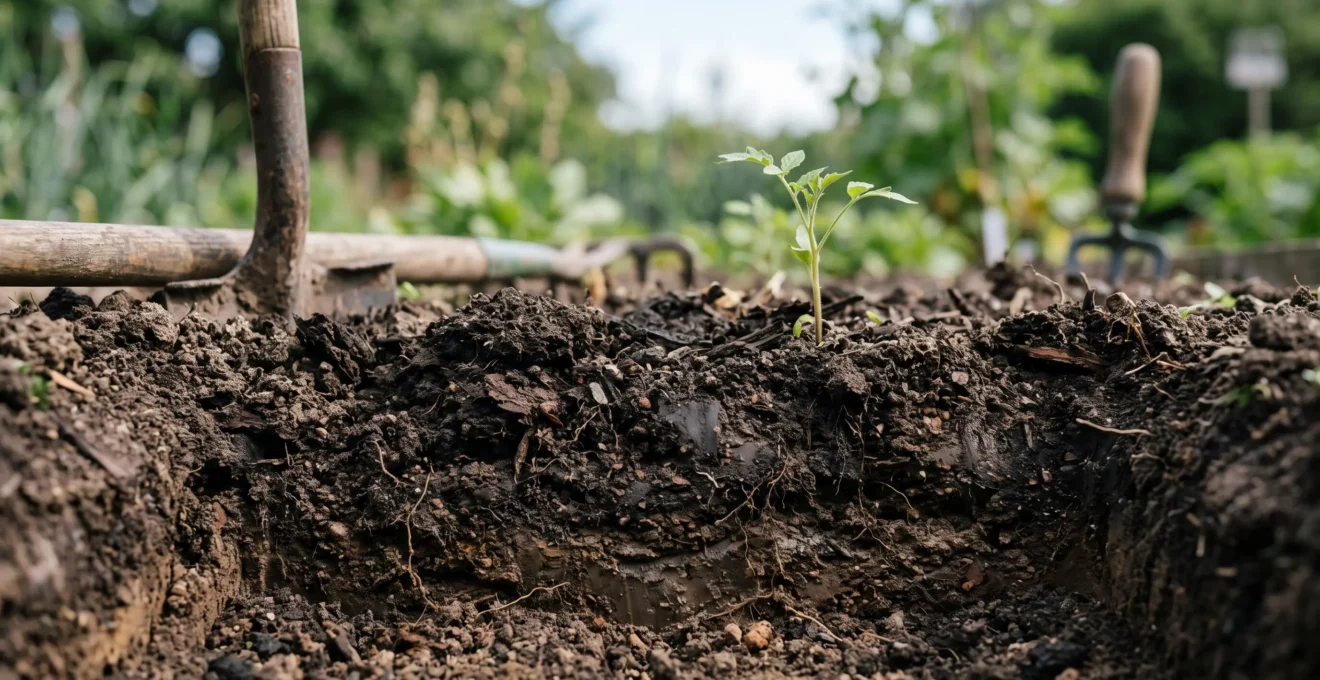
Stopping persistent garden diseases like blight and black spot requires a strategic shift from seasonal reactions to a multi-year campaign against soil-borne inoculum.
- Pathogen spores can survive for several years in soil, making simple garden cleanup insufficient for long-term control.
- “Hot” composting, which reaches a sanitization threshold above 55°C, is essential to destroy pathogens in infected plant material, not just recycle it.
Recommendation: Focus on disrupting the pathogen’s lifecycle through scientifically informed crop rotations, active soil sanitation, and choosing genetically diverse resistant varieties.
For the dedicated gardener, there is no greater frustration than watching the same diseases return with relentless predictability. Year after year, the tell-tale lesions of blight appear on tomato leaves, or black spot marches across rose foliage, despite your best efforts. You follow the common advice: you clear away fallen leaves, you practice crop rotation, and you try to improve air circulation. Yet, the infection cycle seems unbreakable, suggesting the enemy is not just on the leaves, but entrenched in the very soil beneath your feet.
This recurring battle often leads to a reliance on fungicides or a sense of resignation. The conventional wisdom about garden hygiene, while not incorrect, often lacks the strategic depth required to tackle a persistent pathogen population. It treats symptoms rather than the root cause. But what if the key wasn’t simply cleaning up, but actively waging a campaign of epidemiological warfare? What if the solution lies in understanding and systematically disrupting the fungal spore’s lifecycle at its most vulnerable points?
This guide moves beyond generic tips to offer a strategic framework for disease management. We will dissect the problem from a plant epidemiologist’s perspective, focusing on breaking the chain of infection. By understanding how long spores survive, how to properly sanitize your compost, and the real science behind crop rotation and genetic resistance, you can shift from a reactive gardener to a proactive disease manager. It’s time to stop fighting the same battle every year and start dismantling the enemy’s stronghold.
This article provides a detailed roadmap for this strategic shift. We will explore the science behind pathogen survival in the soil, the critical role of composting temperature, the nuances of crop rotation, and the long-term strategy of genetic resistance to finally break the cycle of infection in your garden.
Summary: A Strategic Guide to Eradicating Persistent Garden Pathogens
- How Long Do Blight Spores Survive in UK Soil?
- Soil Solarization: Can Plastic Sheets Kill Fungi in the UK Climate?
- The Compost Loophole: Why Your Heap is Re-Infecting Your Garden?
- Resistance Breeding: The Only Real Cure for Clubroot?
- 3 Years or 5 Years: How Long is a Safe Rotation Gap?
- Black Spot or Blight
- The ‘Leave it All’ Mistake That Harbours Black Spot Spores
- How to Prevent Foliar Diseases in Damp UK Gardens Without Fungicides?
How Long Do Blight Spores Survive in UK Soil?
The first step in breaking the disease cycle is understanding the enemy’s resilience. For many devastating diseases like potato and tomato blight (caused by Phytophthora infestans), the pathogen creates tough, long-lasting resting spores called oospores. These are not delicate structures; they are survival pods designed to withstand winter and wait for a suitable host. A common question is whether you can reuse soil after a blight infection. The answer depends on the immense inoculum pressure these oospores create. Simply turning the soil does not eliminate blight; it often just redistributes the infectious material, ensuring its contact with new roots.
The survival duration of these spores is not indefinite, but it is alarmingly long, often outlasting simple one- or two-year crop rotations. The specific lifespan is heavily influenced by environmental factors, particularly soil type and moisture levels. For instance, detailed research using a floating-leaflet bioassay found that oospores could remain infectious for up to 48 months in sandy soil, compared to 34 months in heavier clay soil, particularly under flooded conditions. This means a standard three-year rotation might not be enough to starve out the pathogen in certain garden soils. This long-term persistence is why blight can feel like an unavoidable annual curse; the reservoir of infection is already waiting in the ground before you even plant.
Understanding this timeline is critical for strategy. It invalidates the idea that a single fallow season is a ‘reset’. Instead, it forces a long-term view where soil management over multiple years becomes the primary theatre of operations. The goal must be to reduce the soil’s inoculum load below a critical threshold, a task that requires a multi-pronged approach beyond just waiting.
Soil Solarization: Can Plastic Sheets Kill Fungi in the UK Climate?
Given the persistence of soil-borne pathogens, gardeners need methods to actively sanitize their beds. Soil solarization is one such technique, using the sun’s energy to heat the soil to temperatures lethal for many fungi, bacteria, nematodes, and weed seeds. The process involves covering moist soil with clear plastic sheeting during the hottest part of the year. The transparency of the plastic allows solar radiation to pass through and heat the soil, while the sheeting itself traps the heat, creating a greenhouse effect.
This is not a quick fix. Effective solarization requires a sustained period of high temperatures. According to guidance from university extension researchers, it can take 4 to 6 weeks of continuous cover during hot, sunny weather to sufficiently heat the top 12 to 18 inches of soil to a pathogen-killing temperature. This presents a significant challenge in the often-cloudy and temperate UK climate, where achieving and maintaining the necessary heat is far from guaranteed.
The effectiveness of solarization is highly dependent on climate and the depth you need to treat. While it can be a powerful tool in hotter, sunnier regions, its application in the UK requires careful consideration and management. Heat-retentive films or double layers of plastic can improve performance, but it may not be a reliable method for eliminating deep-seated issues like clubroot or Verticillium wilt every year.
This comparative data highlights the challenge for UK gardeners. Achieving the high surface temperatures seen in desert climates is unlikely, making the technique more suited for suppressing, rather than eliminating, certain pathogens in the upper soil layers.
| Climate / Setup | Recorded Soil Temperature | Depth Achieved | Reported Effect |
|---|---|---|---|
| Hot/desert climate | Up to 140°F (60°C) near surface | Top 6 inches | Broad pathogen and weed seed kill |
| Continental (Oklahoma trial) | 126°F at 1 inch / 98°F at 12 inches | Up to 12 inches | Controlled Verticillium dahliae |
| Humid/cloudy temperate climate (heat-retentive films) | Elevated vs standard clear film (site-specific) | Variable, improved with insulating film layers | Improved heat retention for disease suppression in humid regions |
| Deeper soil profile studies | Not surface-lethal, but effect persists | 70-120 cm | Reduced Verticillium dahliae populations at depth |
The Compost Loophole: Why Your Heap is Re-Infecting Your Garden?
Composting is the cornerstone of sustainable gardening, turning waste into ‘black gold’. However, a poorly managed compost pile can become a Trojan horse, reintroducing the very diseases you seek to eliminate. The common advice to “never compost diseased plants” is a cautious but overly simplistic rule. The reality is that the composting process, when done correctly, is a highly effective sanitization system. The key lies in one critical factor: heat. A ‘hot’ compost pile will destroy pathogens, while a ‘cold’ one will merely incubate them.
The science is clear on the temperature required. Comprehensive composting science shows that maintaining a temperature of 55°C (131°F) and above is sufficient to destroy most plant pathogens, including tough fungal spores and viruses. This is the sanitization threshold. If the core of your pile fails to reach and sustain this temperature, you are not composting; you are just creating a debris-as-reservoir, a perfect overwintering site for blight, black spot, and clubroot spores that will be spread throughout your garden with the finished compost.
Achieving this temperature requires a large enough pile (at least one cubic metre), a good balance of ‘green’ (nitrogen-rich) and ‘brown’ (carbon-rich) materials, adequate moisture, and turning to introduce oxygen. Relying on guesswork is a recipe for re-infection. The only way to be certain is to use a long-stemmed compost thermometer to monitor the core temperature of your heap.
Action Plan: Verifying Compost Sanitization
- Insert a compost thermometer into the center of the pile, not just the surface, to get an accurate core reading.
- Confirm the core reaches at least 131°F (55°C) for a minimum of three consecutive days if using a contained, aerated system.
- For open windrow-style piles, extend this sanitization period to roughly 15 days, ensuring you turn the pile at least five times to rotate cooler outer material into the hot center.
- Never rely on a hand-on-the-pile test alone; the outer edges can remain cool even when the core is actively sanitizing pathogens.
- If your pile repeatedly fails to reach these temperature thresholds, treat the finished compost as unsanitized and avoid using it on or near susceptible crops.
Resistance Breeding: The Only Real Cure for Clubroot?
For some of the most stubborn soil-borne diseases like clubroot in brassicas, cultural controls and rotation can feel like a losing battle. This is where genetic resistance becomes a powerful, and sometimes essential, tool. Plant breeders have worked for decades to develop cultivars with innate resistance to specific diseases. Choosing a clubroot-resistant cabbage or a blight-resistant tomato variety provides a built-in defence mechanism, allowing the plant to thrive even in the presence of the pathogen. For diseases with extremely long-lived spores, this can seem like the only truly viable long-term solution.
However, genetic resistance is not an invincible silver bullet. It is a biological arms race. Pathogens are genetically diverse, and over-reliance on a single resistance gene can impose immense selective pressure, favouring the evolution of new pathogen strains, or ‘pathotypes’, that can overcome that specific defence. This is known as pathotype shift. Once a resistance gene is ‘broken’, the variety is no longer protected. The most durable form of resistance comes from ‘stacked’ genes, where breeders incorporate multiple different resistance genes into a single variety, making it much harder for the pathogen to evolve a way around all of them simultaneously.
The data on this is striking. A controlled multi-cycle trial found that disease severity rose from just 9% to 39% over five planting cycles when using a single resistance gene, as the pathogen adapted. In contrast, severity remained below 3% in varieties with stacked genes. This underscores the need for a strategic approach to using resistant cultivars, not as a standalone cure, but as part of an integrated strategy that also includes rotation and sanitation to reduce the overall inoculum pressure and slow the rate of pathogen evolution.
As plant pathologist Dr. Sheau-Fang Hwang noted, relying exclusively on this one tool can have unintended consequences, accelerating the very problem we aim to solve:
By growing genetically resistant varieties and relying solely on genetic resistance, we’re depleting the inoculum of the most dominant pathotypes in the soil.
– Dr. Sheau-Fang Hwang, Alberta Farmer Express
3 Years or 5 Years: How Long is a Safe Rotation Gap?
Crop rotation is a foundational principle of organic gardening and farming, but the common “three-year rule” is often applied as a blanket prescription without understanding the ‘why’. The primary purpose of rotation in disease management is to create a gap where a pathogen, which is often host-specific, is deprived of the plant family it needs to multiply. During this fallow period for the pathogen, its population in the soil (the inoculum) should decline. The critical question is: how long is long enough? As we’ve seen, a three-year gap may be insufficient for blight spores that can survive for four years or more.
A truly safe rotation gap is not a fixed number; it is dictated by the specific pathogen you are trying to manage. Diseases whose spores survive primarily on last season’s crop debris, like bacterial spot, can be effectively managed with a shorter 2-3 year rotation. In contrast, pathogens with extremely persistent resting spores or a very broad host range, such as Clubroot and Verticillium wilt, demand much longer and more complex rotation strategies. For these, a 5, 7, or even longer break from all susceptible plant families may be necessary to significantly reduce inoculum pressure.
Therefore, an effective rotation plan is not just about moving things around. It’s an informed strategy based on identifying your specific disease problem and matching the rotation length to its known survival capabilities. Combining rotation with other practices, like planting disease-suppressive cover crops (e.g., mustards for their biofumigant properties), can further enhance its effectiveness.
| Disease / Pathogen | Persistence Pattern | Rotation Implication |
|---|---|---|
| Clubroot (Plasmodiophora brassicae) | Long-term soil resident; severity linked to soil pH | Extended rotation away from brassicas, combined with liming |
| Verticillium Wilt | Broad host range, long-lived in soil | Rotation alone often insufficient; needs a very wide non-host gap |
| Bacterial Spot (Xanthomonas) | Cannot survive once infected debris decomposes | Minimum 2 years without a host crop |
| General soil/stubble-borne fungi | Survive mainly in crop debris for a few years | Best candidates for standard 3-5 year rotation cycles |
For a more practical approach, especially in smaller gardens, focus on these core principles:
- Switch plant families in each bed or container every season to disrupt the life cycles of host-specific pathogens.
- Adhere to a minimum 3-year rotation rule before replanting the same family (e.g., Solanaceae – tomatoes, potatoes) in the same spot.
- Incorporate disease-fighting cover crops like mustard or cereal rye during fallow periods to actively suppress soil pathogens.
- Even in small spaces, create as much distance as possible between related plants to slow the spread of airborne spores.
- The most powerful approach combines all these tactics: a long rotation, suppressive cover crops, and smart spacing.
Black Spot or Blight
To execute a targeted attack, a gardener must first correctly identify the pathogen. While both cause unsightly leaf damage, Black Spot and Blight are distinct diseases caused by different fungi with different lifecycles. Misidentification leads to ineffective control measures. Black Spot (Diplocarpon rosae) is the bane of rose growers. It manifests as dark, circular spots with fringed or feathery edges, typically on the upper surface of leaves. These spots are often surrounded by a yellow halo, and infected leaves tend to turn yellow and drop prematurely, weakening the plant.
Late Blight (Phytophthora infestans), on the other hand, is infamous for devastating tomatoes and potatoes. Its symptoms begin as water-soaked, greenish-grey spots on leaves, which rapidly enlarge into dark brown or black, irregularly shaped lesions. A tell-tale sign of active blight is a fuzzy, white mould that appears on the underside of the leaves, especially in humid conditions. Unlike the distinct circles of black spot, blight lesions look more like spreading, necrotic blotches, and the disease can quickly move to stems and fruit, causing total plant collapse.
The key difference for management is their host range and overwintering strategy. Black spot is largely specific to roses, overwintering on fallen leaves and infected canes. Blight has a more limited host range (primarily potatoes and tomatoes) but its oospores are incredibly persistent in the soil itself, in addition to surviving in leftover potato tubers. Recognizing these differences is the first step in deploying the right strategy: meticulous sanitation for black spot versus a long-term soil campaign for blight.
The ‘Leave it All’ Mistake That Harbours Black Spot Spores
The “leave the leaves” movement, which advocates for leaving fallen leaves as a natural mulch and habitat, has many ecological benefits. However, in the context of disease management, it can be a critical error. For foliar diseases like rose black spot, apple scab, and many leaf spot fungi, fallen leaves are not just dormant organic matter; they are the primary debris-as-reservoir for the next season’s infection. The fungus does not die with the leaf. Instead, it overwinters safely within the dead leaf tissue, producing a massive load of spores in the spring.
When spring rains and warmer temperatures arrive, these spores are forcefully ejected or splashed from the leaf litter on the ground up onto the newly emerging, vulnerable foliage. This initial outbreak is the source of the primary infection, from which secondary infections will spread throughout the plant and to its neighbours for the rest of the season. By leaving infected debris at the base of the plant, you are essentially providing a perfectly positioned launchpad for the pathogen to restart its lifecycle.
This is why meticulous garden sanitation in autumn is a non-negotiable hygienic practice for controlling these specific diseases. It is a direct act of lifecycle disruption. Removing and destroying (or hot-composting) all fallen leaves and infected prunings from around susceptible plants drastically reduces the primary inoculum pressure for the following spring. It will not eliminate the disease entirely, as some spores may blow in from elsewhere, but it prevents the massive, early-season outbreak that originates from the ground up, making the disease far more manageable throughout the year.
Key Takeaways
- Disease management is a multi-year strategy focused on reducing soil inoculum, not just a seasonal clean-up.
- The temperature of your compost pile is critical; only ‘hot’ composting (above 55°C) reliably sanitizes infected material.
- Effective crop rotation length is determined by the specific pathogen’s survival time, which can exceed the standard three-year rule.
How to Prevent Foliar Diseases in Damp UK Gardens Without Fungicides?
In the damp, humid conditions often found in UK gardens, foliar diseases can thrive. While chemical fungicides are an option, a robust, preventative strategy based on cultural controls can be highly effective and is the foundation of sustainable gardening. This approach focuses on creating an environment that is inhospitable to fungal pathogens, fundamentally disrupting their ability to establish and spread. The core principle is to manage moisture and airflow, denying fungi the stagnant, damp conditions they need.
First, water wisely. Always water the base of your plants, directly onto the soil or mulch, avoiding wetting the foliage. Using soaker hoses or drip irrigation is ideal. If you must use a watering can or hose, do so in the morning so that any splashed leaves have the entire day to dry out completely. Wet leaves overnight are an open invitation for fungal spore germination.
Second, promote airflow. Ensure plants are spaced according to their mature size, not their size at planting. This prevents a dense, crowded canopy that traps humidity. Regularly prune susceptible plants like tomatoes and roses to open up their structure, allowing air to circulate freely among the leaves and stems. This not only helps foliage dry faster but also allows for better spray coverage if you are using organic treatments.
Finally, use mulch. A layer of organic mulch (like wood chip, straw, or compost you have confirmed is sanitized) serves a dual purpose. It suppresses weeds, but more importantly, it creates a physical barrier that prevents soil-borne spores from splashing up onto the lower leaves of plants during heavy rain. This single action can significantly delay the onset of diseases like blight and septoria leaf spot. These practices, combined with vigilant monitoring and removal of the first signs of disease, form a powerful, multi-layered defence that reduces reliance on any single intervention.
By adopting this strategic, multi-year mindset, you can transform your garden from a recurring disease hotspot into a resilient ecosystem. Start today by implementing these hygienic practices to dismantle the disease cycle and ensure healthier plants for years to come.