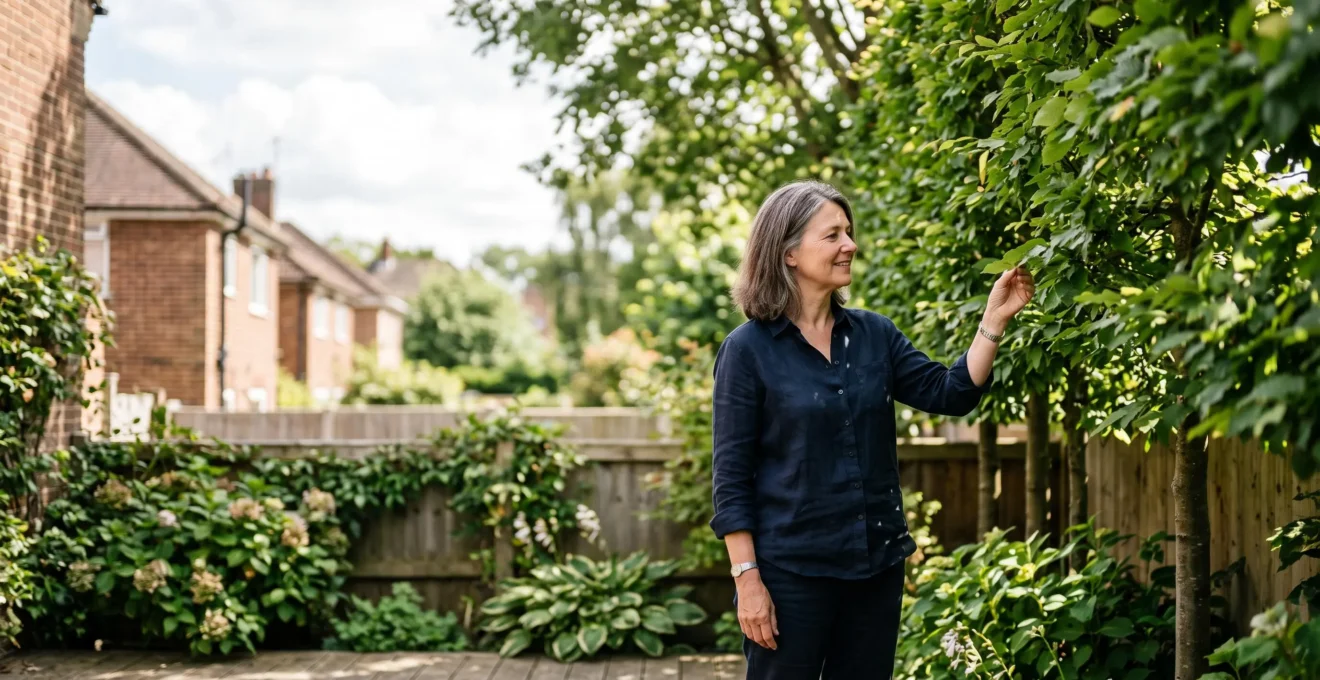
The most effective garden privacy screen isn’t the tallest or fastest-growing; it’s the one that is legally defensible and respects your neighbour’s right to ‘reasonable enjoyment’ of their property.
- Privacy planting is a legal act, governed by principles of nuisance, encroachment, and specific legislation like the High Hedges Act.
- Solutions like pleached trees offer targeted screening, providing privacy where needed while preserving light and avoiding legal thresholds.
- Your liability for invasive species like bamboo can persist even after the plant has been removed from your property.
Recommendation: Before planting any boundary screen, conduct a legal and practical audit of your property line to preemptively design a solution that avoids future disputes.
The desire for a secluded garden sanctuary is a common aspiration for UK homeowners, particularly those in semi-detached or terraced properties. The default solution has often been to plant the fastest, densest hedge available, creating a ‘living wall’ against the outside world. Yet, this approach is the single greatest cause of neighbourly disputes, formal complaints, and costly legal battles. The infamous Leylandii hedge, while effective at blocking sightlines, has become a symbol of how quickly a quest for privacy can descend into acrimony, light deprivation, and official intervention.
The common advice to “just talk to your neighbour” is a necessary first step, but it is fundamentally incomplete. It fails to address the underlying legal frameworks that govern what you can and cannot do on your own property when it affects another’s. The real issue isn’t just horticultural; it’s about navigating the complex interplay between your right to privacy and your neighbour’s ‘Right to Light’ and their right to the peaceful, ‘reasonable enjoyment’ of their home. Thinking like a gardener is not enough; you must also think like a property lawyer.
But what if the entire premise of a ‘solid’ screen is flawed? This guide proposes a different approach: preemptive compliance. Instead of planting a potential problem and hoping for the best, the strategy is to design a privacy solution that is inherently respectful of legal boundaries from day one. It’s about choosing plants and placements that achieve your privacy goals without ever triggering the conditions for a formal complaint. This is not about sacrificing privacy; it’s about achieving it in a smarter, more sustainable, and legally robust way.
This article will deconstruct the common privacy pitfalls from a legal and practical standpoint. We will explore the specific thresholds of the High Hedges Act, analyse legally sound alternatives to solid barriers, and examine your liabilities for invasive species, boundary encroachment, and even water run-off. By understanding the rules of engagement, you can create a beautiful, private space without the looming threat of a dispute.
Summary: A Legal-Minded Approach to Garden Screening
- High Hedges Act: When Does Your Privacy Screen Become Illegal?
- How to Install Pleached Trees for Privacy Above Fence Height?
- Bamboo or Laurel: Which Screen is Less Likely to Invade?
- The Boundary Error: Planting Trees Too Close to Shared Fences
- How to Prune Hedges to Prevent ‘Leggy’ Bottoms?
- Do You Need Planning Permission for Decking in a Conservation Area?
- The Grading Mistake That Floods Your Neighbour’s Property
- Professional Landscape Design vs DIY: Where to Spend Your Budget?
High Hedges Act: When Does Your Privacy Screen Become Illegal?
The term ‘high hedge’ is not a matter of opinion but a specific legal definition under Part 8 of the Anti-social Behaviour Act 2003. For the Act to apply, a hedge must be comprised of a line of two or more evergreen or semi-evergreen trees or shrubs and rise to a height of over two metres. A single tree or a row of deciduous plants, regardless of height, does not fall under this legislation. Understanding this definition is the first step in preemptive compliance; by choosing plants or arrangements that fall outside this strict criteria, you can often bypass the entire legal framework from the outset.
If a neighbour’s hedge meets this definition and you believe it is adversely affecting the reasonable enjoyment of your property, you cannot simply demand the council intervene. The law mandates that you must first attempt to resolve the dispute informally. You must be able to provide documented evidence of your attempts to communicate with your neighbour and seek a resolution. Only when these attempts have failed can you make a formal complaint to your local council, which involves a fee. For example, some councils charge a fee, such as the £300 fee required for a complaint in Cotswold, to assess the case.
Once a formal complaint is accepted, the council’s role is not merely to measure the hedge. As the official guidance states, the core question is one of balance. According to the UK Government:
The council should decide whether the hedge is adversely affecting your ‘reasonable enjoyment’ of your property and, if so, what action (if any) should be taken to put right the situation.
– UK Government, High hedges: complaining to the council
This “reasonable enjoyment” test is subjective and considers factors like light loss to rooms and gardens, but it is not an absolute ‘right to light’. The council will weigh the complainant’s grievance against the hedge owner’s need for privacy. If they find in the complainant’s favour, they can issue a Remedial Notice specifying what action must be taken, which could range from reducing the height to a minimum of two metres to ongoing maintenance. Failure to comply with a Remedial Notice is a criminal offence.
How to Install Pleached Trees for Privacy Above Fence Height?
One of the most elegant and legally sound solutions for achieving privacy is the use of pleached trees. These are often referred to as ‘hedges on stilts’ and involve training trees onto a frame to create a raised, flat panel of foliage. Their primary advantage is that they provide targeted screening precisely where it is needed—typically above a standard fence line to block an overlooking window—while leaving the area below open. This targeted approach allows light to pass underneath the canopy, preserving a sense of space and minimising the light-blocking impact on a neighbour’s property, making them an excellent tool for preemptive compliance.
Unlike a solid hedge, a row of pleached trees with clear stems does not typically form a ‘wall’ of foliage from the ground up. This structural difference is legally significant. It is much harder to argue that a screen on 6-foot stems, which allows ample light and air to pass beneath it, is ‘adversely affecting’ one’s reasonable enjoyment in the same way a 10-foot solid conifer wall might. Strategic placement is key: a short row positioned only to block a specific sightline is far more defensible than a continuous barrier running the length of a boundary.
As landscape designer ‘Garden Ninja’ notes, the benefits are both aesthetic and practical:
In fifteen years of professional design, I have never found a more effective way to add height and privacy to a plot without eating into the usable garden.
– Garden Ninja (professional garden designer), Garden Ninja — Pleached Trees UK: A Garden Designer’s Complete Guide
Species like Hornbeam (Carpinus betulus) and Beech (Fagus sylvatica) are popular choices as they retain their dried leaves through winter, providing a year-round screen. When installing, it is crucial to use a robust support structure of posts and wires to guide the growth and ensure stability. While the initial cost is higher than a simple hedge, the investment is in a long-term, low-dispute privacy solution that adds architectural value to the garden.
Bamboo or Laurel: Which Screen is Less Likely to Invade?
When seeking a fast-growing screen, many homeowners are tempted by bamboo or Cherry Laurel (Prunus laurocerasus). Both can create a dense barrier quickly, but their aggressive growth habits carry significant legal risks related to nuisance and encroachment. From a legal standpoint, the least invasive option is always the one whose growth you can fully control and contain entirely within your own property boundary. By this measure, both species present considerable challenges, but running (leptomorph) bamboo is by far the greater legal liability.
Laurel is a vigorous grower and can easily become a ‘high hedge’ subject to the Act. Its main issue is its sheer bulk and rapid growth, requiring constant pruning to keep it within bounds. However, its root system is generally not considered aggressively invasive in the same way as bamboo. Running bamboo, on the other hand, spreads via underground stems called rhizomes, which can travel many metres and emerge in neighbouring gardens, driveways, or even through building foundations. You, as the planter, are legally responsible for any damage caused by this encroachment.
Case Study: The Persistent Liability of Bamboo
The legal risks of bamboo are not merely theoretical. In a documented UK case handled by solicitors, a homeowner found bamboo growing up through a concrete slab on their property. The bamboo originated from a neighbour’s garden, who claimed to have removed the plant years prior. However, the invasive rhizomes remained active underground, continuing to spread and cause problems. This case demonstrates a crucial legal point: liability for bamboo encroachment can persist long after the visible parent plant is gone, making its initial planting a long-term legal gamble.
If you are set on using bamboo, choosing a clumping (pachymorph) variety like Fargesia is a much safer option as it is far less aggressive. For running types, containment is not a suggestion but a legal necessity. This involves installing a specialist root barrier, which itself must be done correctly to be effective and legally compliant.
Action Plan: How to Contain Potentially Invasive Species
- Verify Boundaries: Install any root barrier system entirely within your own property. Placing a barrier on your neighbour’s land without permission constitutes trespass.
- Go Deep: The barrier material must be buried to a significant depth, typically at least 30 inches (75cm), to prevent rhizomes from travelling underneath it.
- Document Everything: Before planting, take dated photographs of the boundary line and the condition of neighbouring property. This provides a crucial baseline should a dispute arise later.
- Negotiate Shared Barriers: If a plant is on a shared boundary, attempt to get a written agreement with your neighbour for a shared containment solution. This demonstrates a proactive and reasonable approach.
- Consider Alternatives: Before committing to a high-risk species, re-evaluate less invasive native hedging plants that provide similar screening benefits without the associated legal liability.
The Boundary Error: Planting Trees Too Close to Shared Fences
A common and costly error is planting trees, particularly large root-ball specimens, too close to a property boundary. While the initial planting may seem innocuous, the slow, powerful growth of roots and the trunk’s increasing girth (known as root flare) can cause significant issues over time. These can include lifting or breaking fence panels, cracking paths, damaging foundations, and creating a source of perpetual dispute with your neighbour. From a legal perspective, any part of your tree—branches, trunk, or roots—that crosses the boundary line constitutes an encroachment.
Under a long-standing common law right, your neighbour is generally entitled to cut back any overhanging branches or encroaching roots to the boundary line. This right of ‘abatement’ or self-help, established in cases like Lemmon v Webb, means they can do so without your permission or prior notice. However, this right is not absolute. If the tree is protected by a Tree Preservation Order (TPO) or is within a Conservation Area, they (and you) would need to seek council permission before carrying out any work. Damaging a protected tree is a criminal offence.
The key to avoiding these issues is foresight. Before planting, you must consider the tree’s mature size, not its size upon purchase. A good rule of thumb is to plant a tree at a distance from the boundary that is at least half of its eventual spread. This creates a buffer zone that accommodates future growth. For example, a tree with an expected 10-metre canopy spread should be planted at least 5 metres from the fence. This simple act of spatial planning is a powerful form of preemptive dispute resolution.
Before any major planting near a boundary, it is prudent to create a dated record of the existing conditions. Photograph the fence, the ground level, and any nearby structures. An even better step is to have a brief, amicable discussion with your neighbour, perhaps even formalised in a simple written note, about the chosen species and its expected size. This transparency, as confirmed by legal guidance on high hedges and overhanging trees, can prevent misunderstandings from escalating into intractable legal conflicts years down the line.
How to Prune Hedges to Prevent ‘Leggy’ Bottoms?
A common aesthetic and structural failing in hedges is the development of a ‘leggy’ base—a sparse, woody lower section with little to no foliage. This not only compromises the hedge’s value as a privacy screen but is also a direct result of improper pruning technique, specifically failing to account for how light reaches the plant. In the UK’s northern latitudes, the sun is often at a lower angle, meaning the top of a hedge naturally shades the bottom. If a hedge is pruned with vertical sides or, worse, with a top that is wider than its base, the lower branches are starved of light and will eventually die back, creating unsightly gaps.
The correct technique, especially for formal evergreen hedges like Yew, Privet, or Box, is to prune it into a slight ‘A’ shape, with the base being 10-15% wider than the top. This gentle taper ensures that sunlight can penetrate all the way down to the lowest leaves, encouraging dense, healthy growth from top to bottom. This is not just a horticultural tip; it’s a strategy for maintaining the long-term integrity and value of a significant garden asset.
Beyond the shape, the timing of pruning is governed by both horticultural best practice and UK law. The Wildlife and Countryside Act 1981 makes it an offence to intentionally damage or destroy the nest of any wild bird while it is in use or being built. As hedges are prime nesting sites, cutting them during the main nesting season, which runs from March to August, is fraught with legal risk. If you disturb a nest, you could be committing a criminal offence, and the penalties for disturbing a nesting bird can reach up to £5,000 per offence.
Therefore, the safest and most legally compliant approach is to schedule all major hedge trimming outside this period. The ideal times for most species are late winter (February) for a hard renovation prune or late summer/early autumn (September) for a maintenance trim after the nesting season has finished. If a cut is unavoidable during the nesting season, a thorough visual and auditory check for active nests is a legal and moral necessity. If any sign of nesting activity is found, all work must cease immediately.
Do You Need Planning Permission for Decking in a Conservation Area?
Building a deck is often seen as a simple garden upgrade, but in the UK planning system, it is considered an engineering operation that can require planning permission. For most properties, decking falls under ‘permitted development rights’, which allow for certain modifications without a full planning application. The general rule is that a deck is permitted development provided it is not more than 30cm above the ground and, together with other extensions and outbuildings, does not cover more than 50% of the garden area.
However, these permitted development rights are significantly restricted or removed entirely in designated areas, most notably Conservation Areas. A Conservation Area is a location deemed of special architectural or historic interest, and the planning rules within it are much stricter to preserve its character and appearance. If your property is in a Conservation Area, it is highly probable that you will need to apply for full planning permission for any decking, regardless of its height or size. The 30cm rule often does not apply.
Furthermore, if the decking is to be attached to a Listed Building, you will require both planning permission and Listed Building Consent, which is a separate and more rigorous process. Ignoring these requirements is a serious misstep. The local council can take enforcement action, which could result in a notice demanding the removal of the unauthorised structure. There is a common misconception about a ‘4-year rule’ (or 10 years for deliberate concealment) after which a council cannot take enforcement action, but relying on this is a high-risk strategy and does not make the development lawful.
The only correct course of action is to assume nothing. Before purchasing materials or commencing any work, you must contact your Local Planning Authority (LPA). Their duty planning officer can provide definitive advice on whether your project requires permission. This proactive check is a fundamental part of legal risk management for any homeowner in a designated area.
The Grading Mistake That Floods Your Neighbour’s Property
While disputes over hedges and trees are common, a more insidious and often overlooked source of conflict is the alteration of ground levels and its effect on surface water drainage. A property owner is generally not liable if natural rainwater flows from their higher land to a neighbour’s lower land. However, if you carry out works on your property that artificially concentrate, redirect, or increase the volume of water flowing onto your neighbour’s land, you may be liable under the common law of nuisance.
A classic mistake is creating a raised patio, decking area, or compacted lawn without incorporating adequate drainage. This can turn a previously permeable surface into an impermeable one, forcing rainwater that once soaked into the ground to sheet across the surface and onto the adjacent property, potentially causing flooding, waterlogging, or dampness. Another frequent error is the installation of a dense, continuous hedge or a raised border right against a boundary. The compacted soil and dense root mass at the base of the hedge can act as an unintentional dam, preventing natural water run-off from your own garden and causing it to pool against the boundary or divert it in a concentrated flow towards your neighbour’s land.
The legal principle at play is that you must not use your land in a way that causes undue harm to your neighbour. While you are entitled to develop your garden, you have a duty to do so reasonably and with consideration for the consequences. If your landscaping project is the direct cause of a new or worsened flooding problem for your neighbour, they could potentially take legal action to seek an injunction (to stop the nuisance) and/or damages (to pay for repairs).
Before undertaking any significant landscaping that alters ground levels or surfaces—such as building patios, installing artificial grass, or creating substantial raised beds—it is crucial to consider drainage. This might involve installing French drains, soakaways (which may themselves be subject to building regulations), or permeable paving. The goal is to manage the water on your own property and ensure that you are not creating a future legal problem for the sake of a new garden feature.
Key takeaways
- Legality over Speed: A legally defensible privacy screen is always superior to a fast-growing, problematic one. Preemptive compliance avoids future conflict and cost.
- Your Liability Crosses Boundaries: You are legally responsible for the actions of your plants, including invasive roots (bamboo) and encroaching branches, once they cross onto a neighbour’s property.
- Designated Areas Have Different Rules: Permitted development rights are often suspended in Conservation Areas or for Listed Buildings. Always check with your Local Planning Authority before starting work.
Professional Landscape Design vs DIY: Where to Spend Your Budget?
Throughout this guide, a clear theme has emerged: creating a private garden in the UK is as much a legal and logistical exercise as it is a horticultural one. The financial calculus for any garden project should therefore extend beyond the cost of plants and materials to include the potential cost of future disputes, remedial action, or litigation. This is where the debate between a DIY approach and professional intervention comes into sharp focus. The most valuable investment is often not in the most expensive paving stone, but in the expertise that prevents a costly mistake.
A DIY approach can be rewarding and cost-effective for straightforward planting. However, when dealing with boundary issues, privacy screening, or significant landscaping, the risks multiply. A simple error—planting a tree too close to a fence, choosing an invasive species, or altering ground levels without considering drainage—can lead to liabilities that far outweigh the initial savings. The “spend” in a DIY project is often back-loaded in the form of time, stress, and potential legal fees when a problem arises years later.
Engaging a professional, whether a qualified landscape designer, an arborist, or a planning consultant, is an act of risk management. A good designer will not only create an aesthetic plan but will also be versed in the practicalities of species selection, mature sizes, and site-specific challenges like drainage. Their fee should be seen as an insurance policy against the common pitfalls. They can design a pleached tree screen that provides privacy without inciting a High Hedges complaint, or specify a non-invasive bamboo alternative that won’t result in a solicitor’s letter. In complex situations, such as in Conservation Areas or near protected trees, their expertise is not a luxury but a necessity for legal compliance.
Ultimately, the decision of where to spend your budget depends on the project’s complexity and proximity to a boundary. For internal garden beds, DIY is a sensible choice. But for any work that has the potential to impact your neighbour’s property or rights—through light, roots, water, or structure—investing in professional advice upfront is the most financially prudent decision you can make. It transforms the budget from a simple list of expenses into a strategic investment in long-term peace and the quiet enjoyment of your own home.
The most effective way to ensure a beautiful, private, and dispute-free garden is to integrate legal and practical considerations from the very beginning. A proactive audit of your plans against the potential issues of boundaries, light, and species behaviour is the single best investment for safeguarding your peace of mind.