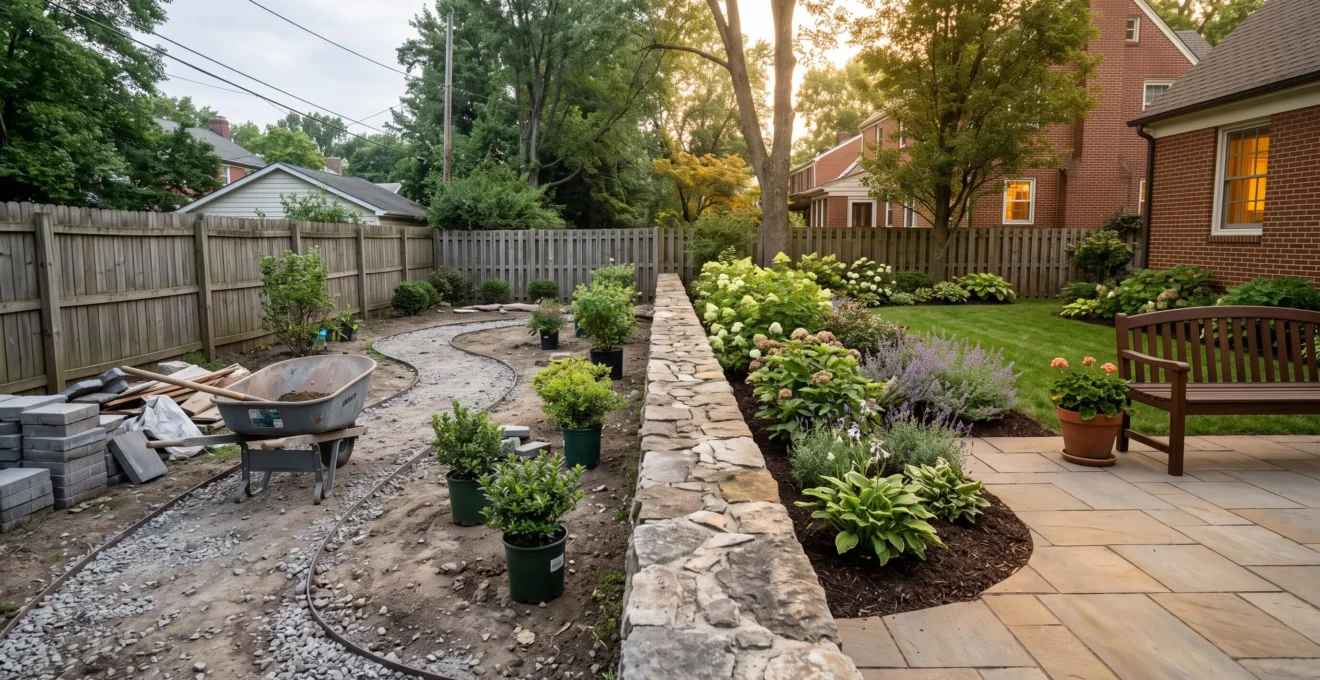
For a £10k-£20k garden renovation, hiring a landscape designer is not a luxury cost but a crucial financial strategy to protect your investment and maximise property value.
- A professional master plan de-risks your budget by preventing costly errors in scale, legal compliance, and material selection.
- DIY projects often fall victim to hidden costs and mistakes that reduce the garden’s visual and financial value, negating initial savings.
Recommendation: Allocate 10-15% of your total budget to professional design fees to safeguard the remaining 85-90% and ensure a significant return on investment.
For homeowners with a garden budget between £10,000 and £20,000, a critical question arises: should a portion of this capital be spent on a professional landscape designer, or should every penny go towards materials and labour in a DIY-led project? The common wisdom often frames this as a simple trade-off between a higher upfront cost for a “wow factor” and the immediate savings of going it alone. This perspective, however, misses the fundamental point from a financial standpoint.
The decision isn’t about aesthetics versus savings; it’s about investment strategy. A professionally designed garden is an appreciable asset, while a poorly executed DIY project can become a financial liability. The real debate is whether the designer’s fee is a justifiable cost to mitigate significant financial risks, avoid catastrophic mistakes, and engineer long-term value. Often, the most expensive garden is the one that has to be redone. This guide moves beyond the surface-level debate to analyse the situation as a budget consultant would: by examining the return on investment (ROI), the cost of error, and the strategic value of expert planning.
This article will dissect the financial implications of your choice. We will analyse how a master plan provides budgetary control, explore common and costly DIY mistakes, navigate the complex legal landscape of planning permissions and regulations, and finally, create a long-term roadmap to ensure your garden investment contributes directly to your property’s value.
Summary: Professional Landscape Design vs DIY: Where to Spend Your Budget?
- Why a Master Plan Saves Money Even if You Build in Stages?
- The Scale Error DIYers Make That Shrinks the Garden Visually
- Do You Need Planning Permission for Decking in a Conservation Area?
- Quotes Vary by 50%: How to Spot a Cowboy Landscaper?
- Porcelain or Sandstone: Which Paving Lasts Longer in UK Weather?
- Hardscaping First or Planting First: The Most Cost-Effective Order
- Why Your New Driveway Needs to Be Permeable by Law?
- Long-Term Garden Planning: The 5-Year Roadmap to Increase Property Value
Why a Master Plan Saves Money Even if You Build in Stages?
A master plan is the single most effective tool for de-risking a substantial garden budget. DIY projects often operate on vague estimations and evolve organically, leading to unforeseen expenses and “scope creep.” A professional designer, acting as a project strategist, front-loads the critical decisions. They create a detailed, phased blueprint that functions like a business plan for your garden, specifying everything from materials and dimensions to drainage and electrical conduits. This isn’t just a drawing; it’s a financial control document.
This detailed planning allows for value engineering—making smart substitutions that save money without compromising the design’s integrity. More importantly, it consolidates major disruptive work. For instance, all trenching for drainage, irrigation, and lighting can be done in one initial, messy phase, even if the features themselves are installed years apart. A DIY approach might involve digging up a new patio three years later to run a cable, effectively paying for the same disruption twice. The master plan ensures every pound spent is a step forward, with no backtracking.
The financial clarity provided is a stark contrast to the guesswork of DIY. A professional plan itemises costs, allowing you to budget with confidence and secure accurate quotes from contractors. This process turns an unpredictable expense into a manageable capital project, saving you money by preventing redundant work, optimising material orders, and eliminating the costly “what if we had…” moments that plague phased but unplanned projects.
The Scale Error DIYers Make That Shrinks the Garden Visually
One of the most common and financially damaging mistakes in DIY landscape design is the failure to correctly manage scale and proportion. This isn’t about personal taste; it’s a fundamental principle of design that directly impacts perceived value. Homeowners often design for the garden as it is viewed from the back door, creating features that are too small and cluttered for the space. Patios become undersized, paths too narrow, and planting beds insignificant.
The result is a garden that feels cramped, busy, and visually “cheap,” no matter how much was spent on expensive materials. A professional designer understands how to use negative space—the open, un-programmed areas like lawns or simple gravel expanses—to make a garden feel larger, more luxurious, and more serene. They design features that are in proportion to the house and the overall plot, creating a cohesive and expansive feel.
As the illustration demonstrates, a large, simple expanse of lawn can create a sense of depth and tranquillity that a dozen small, competing features cannot. This “less is more” approach is a form of financial leverage; it uses thoughtful layout, not just expensive materials, to create value. Correcting a scale error after construction is often impossible without a complete demolition and rebuild, making it one of the costliest DIY mistakes. This is where the designer’s fee pays for itself by preventing a fundamental error that would otherwise tank the investment’s visual and monetary return.
Do You Need Planning Permission for Decking in a Conservation Area?
Navigating the UK’s planning laws is a minefield for the uninitiated and a prime example of where a professional’s fee becomes a form of insurance. While many garden projects fall under “Permitted Development” rights, these rights are significantly curtailed in designated areas such as Conservation Areas, National Parks, or Areas of Outstanding Natural Beauty (AONBs). What is legal in one street may be illegal in the next.
For example, a standard raised deck (over 30cm high) often requires planning permission anywhere. However, in a Conservation Area, even ground-level decking could be subject to an “Article 4 Direction,” which removes Permitted Development rights and requires a full planning application for even minor changes. Furthermore, materials and design must be in keeping with the character of the area. A DIYer might unknowingly install a modern composite deck that violates local planning policy, leading to an enforcement notice from the council, a potential fine, and a legal order to remove the entire structure at their own expense.
A landscape designer or architect is trained to identify these constraints from day one. They will conduct the necessary checks with the local planning authority and, if needed, prepare and submit the application on your behalf. This process not only ensures your project is legal but also that the design has the best chance of being approved. The cost of their expertise is negligible compared to the financial and legal fallout of a planning breach.
Quotes Vary by 50%: How to Spot a Cowboy Landscaper?
When you have a budget of £15,000, receiving one quote for £18,000 and another for £9,000 can be bewildering. The temptation to accept the lower bid is immense, but this is often the gateway to a “cowboy” landscaper—an operator whose low price reflects a lack of insurance, skill, and accountability. A professional design plan is your first line of defence, as it forces all contractors to quote for the exact same specifications, making comparisons transparent. Without it, you’re comparing apples and oranges.
Beyond the price, there are clear warning signs. A legitimate contractor will always provide a detailed, itemised quote, proof of public liability insurance, and verifiable local references. A cowboy will offer a vague, one-line estimate, demand a large cash deposit upfront, and pressure you for a quick decision. The lack of insurance is a critical red flag. As the Landscaping Services Authority warns in its guide, “the absence [of insurance] signals any property damage or worker injury may become the hiring party’s financial liability.” This can turn a “saving” of a few thousand pounds into a ruinous legal claim.
A recent industry evaluation highlighted this risk, finding that a low-bid contractor exhibited 6 out of 8 common red flags and provided no liability coverage. These operators cut corners on unseen but vital elements like sub-bases and drainage, leading to premature failure of patios and walls. The professional designer acts as your advocate, helping you vet contractors and ensuring the work is executed to the specified standard.
Action Plan: Vetting a Landscape Contractor
- Request Documentation: Ask for a copy of their Public Liability Insurance certificate and check that it’s in date. Do not proceed without it.
- Verify References: Obtain contact details for 2-3 recent, local projects. Call them and, if possible, visit the site to inspect the quality of the work.
- Analyse the Quote: Reject any one-line or vague estimates. A professional quote should be itemised, breaking down costs for labour, materials, and site clearance.
- Scrutinise the Payment Schedule: A small deposit to secure a date is normal. A large upfront cash demand (over 25%) before work begins is a major red flag.
- Assess Professionalism: Evaluate their communication, punctuality, and whether they have a registered business address and branded vehicle. Lack of a professional footprint is a warning.
Porcelain or Sandstone: Which Paving Lasts Longer in UK Weather?
Material selection is a key area where a designer’s expertise provides long-term financial value. For patios and paths, the choice between materials like porcelain and natural sandstone is not just aesthetic; it’s a decision about maintenance costs, longevity, and performance in the specific, damp conditions of the UK climate.
Natural sandstone offers a rustic, traditional charm but is porous by nature. It absorbs water, making it susceptible to algae, moss growth, and potential frost damage in winter if not properly and regularly sealed. This creates an ongoing maintenance cost in both time and money. In contrast, modern porcelain paving is engineered to be non-porous. Manufacturers note that high-quality porcelain has a water absorption rate of typically under 0.5%. This makes it highly resistant to staining, algae, and frost, requiring only occasional cleaning rather than periodic chemical sealing.
The following table, based on data from paving specialists, compares the key performance metrics for the UK:
| Criteria | Porcelain | Sandstone |
|---|---|---|
| Water absorption | Very low, non-porous | Porous, absorbs moisture |
| Frost resistance | Excellent | Good if properly sealed |
| Maintenance | Low – occasional cleaning | Higher – periodic sealing |
| Algae/moss resistance | High | Lower, especially in shaded/damp areas |
| Aesthetic character | Modern, consistent | Natural, rustic, traditional |
While porcelain may have a slightly higher initial material cost, a designer can perform a “whole-life cost” analysis, showing how it becomes the more economical choice over a 10-year period by virtually eliminating maintenance expenses. A DIYer, often guided by upfront cost alone, might choose the cheaper initial option, inadvertently locking themselves into a cycle of costly upkeep. This is a classic example of professional value engineering.
Hardscaping First or Planting First: The Most Cost-Effective Order
Project sequencing is a critical, yet often overlooked, component of budget management. The question of whether to install hardscaping (patios, paths, walls) or softscaping (plants, lawns) first has a definitive, financially-driven answer: hardscaping must come first. Reversing this order is a false economy that almost always leads to increased costs and project delays.
Imagine the scenario where beautiful new turf has been laid and expensive, mature shrubs have been planted. Now, the contractor must bring in a mini-digger, wheelbarrows of cement, and paving slabs to build the patio. The new lawn will be destroyed by foot traffic and machinery, requiring costly repairs or complete replacement. Delicate plants can be damaged by construction dust, equipment, and displaced soil. Soil structure itself becomes compacted, harming drainage and future plant growth.
A professional plan dictates a logical, cost-effective workflow. The correct sequence involves: 1) Site clearance and major earthworks. 2) Installation of all “dirty” elements and sub-surfaces like drainage, foundations, and conduits. 3) Construction of all hardscaping features. 4) Final grading, soil preparation, and importation of topsoil. 5) Finally, the installation of softscaping into a clean, finished site. This methodical approach minimises damage, prevents rework, and ensures that each trade can work efficiently without compromising the work of others. A DIY project might save on a planning fee, but can easily lose thousands in remedial work due to inefficient sequencing.
Why Your New Driveway Needs to Be Permeable by Law?
Legislation around surface water drainage is another critical area where professional guidance is essential to avoid costly legal issues. In the UK, government regulations implemented to combat flooding mean that you can no longer simply pave over your front garden with traditional, impermeable materials without consequence. If the new or replacement driveway is larger than five square metres, you must use a permeable (or porous) surface or direct the runoff to a lawn or border to drain naturally.
If you fail to do this and use a traditional impermeable material that drains to the public highway, you are legally required to obtain planning permission, which is unlikely to be granted. Permeable paving systems are designed to allow rainwater to soak through the surface into the ground below. Research shows that, depending on design and soil type, permeable paving can infiltrate as much as 70% to 80% of annual rainfall, reducing the strain on public drainage systems. A DIYer unaware of these Sustainable Drainage Systems (SuDS) regulations could install a beautiful but non-compliant driveway, only to be forced to remove it by the local authority.
The installation of these systems is more complex than standard paving, requiring a specific sub-base design. As the Virginia Cooperative Extension service states, “It is strongly recommended that a trained and/or certified professional be consulted when designing and installing permeable pavement.” A landscape designer will specify a compliant solution from the start, protecting you from legal risk and ensuring the system functions correctly for years to come. This is non-negotiable risk management.
It is strongly recommended that a trained and/or certified professional be consulted when designing and installing permeable pavement.
– Virginia Cooperative Extension, Stormwater Management for Homeowners Fact Sheet 3: Permeable Pavement
Key Takeaways
- A professional master plan is a financial control tool, not just a drawing, preventing costly mistakes and budget overruns.
- DIY projects frequently suffer from errors in scale and legal non-compliance (planning, drainage) that can cost more to fix than the initial design fee.
- The long-term value of a garden is maximised through strategic material selection and planting, turning it into an appreciable asset rather than a depreciating feature.
Long-Term Garden Planning: The 5-Year Roadmap to Increase Property Value
Ultimately, a garden is more than an outdoor room; it’s a financial asset tied to your property. The most significant return on investment comes from viewing it as a long-term project. A designer helps create a 5-year roadmap, strategically phasing investments to align with plant maturation and budget availability, all with the end goal of maximising your home’s resale value.
According to the American Society of Landscape Architects, professional landscaping can boost resale value by 15%-20%. However, this return is not guaranteed; it depends entirely on the quality and nature of the improvements. A well-designed, mature, and low-maintenance garden is a powerful selling point. The ROI table below illustrates where value lies; features that suggest a well-cared-for home (lawn care, maintenance) and expanded living space (patio, outdoor kitchen) offer the highest returns.
A key part of the long-term plan is planting. A designer will select trees and shrubs that will mature to the correct size for the space, providing privacy, structure, and beauty over time. A newly planted sapling may seem insignificant, but in five to ten years, a mature tree can be the garden’s single most valuable feature. A DIY approach often prioritises instant gratification with fast-growing but ultimately inappropriate plants that quickly become overgrown liabilities. The designer’s fee is an investment in this future growth, ensuring your garden becomes more valuable every year, not less.
| Feature | Typical Resale ROI |
|---|---|
| Standard lawn care | 217% |
| Landscape maintenance | 104% |
| Overall landscape upgrade | 100% |
| Outdoor kitchen | 100% |
| New patio | 95% |
| Tree care | 87% |
| New wood deck | 89% |
| Irrigation system | 83% |
| Landscape lighting | 59% |
| Fire feature | 56% |
By shifting the perspective from upfront cost to long-term asset management, the value of professional design becomes clear. It is the most reliable way to ensure your £10k-£20k budget is not just spent, but invested wisely to deliver returns in usability, enjoyment, and ultimately, property value.