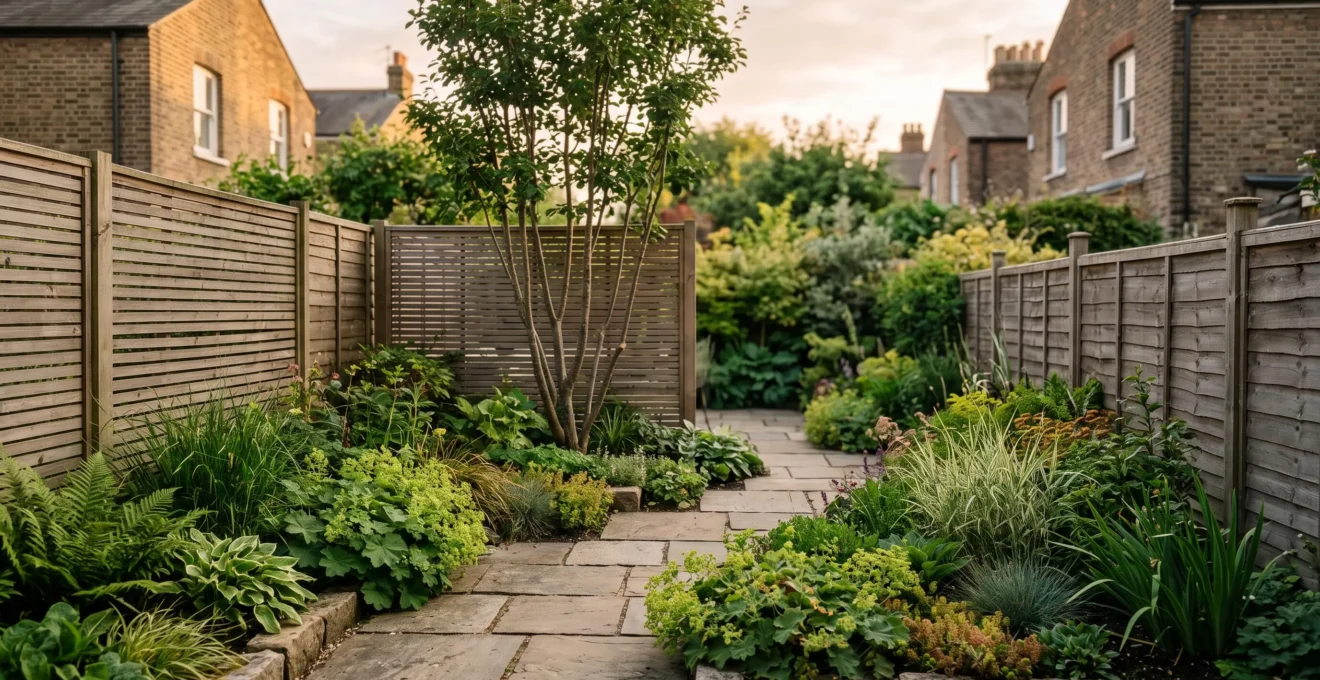
The secret to a wider-feeling narrow garden isn’t adding space, but skilfully manipulating perception.
- Diagonal lines, oversized elements, and obscured views trick the brain into perceiving greater depth and width.
- Dividing the garden into ‘rooms’ and choreographing sightlines creates a rich cognitive journey, making the space feel more substantial.
Recommendation: Stop fighting the ‘corridor effect’ with random planting; start thinking like a perceptual architect to make your garden feel expansive and engaging.
For owners of Victorian terraced houses, the garden can feel more like a bowling alley than a sanctuary. That familiar ‘corridor’ feeling, a long, narrow strip flanked by fences, resists all attempts at creating a sense of spaciousness. The common advice often involves a predictable list of tricks: use mirrors, paint fences white, or plant climbers. While not entirely wrong, these solutions often miss the fundamental issue. They treat the symptom, not the cause, which lies not in the physical dimensions of the space, but in how our brain perceives it.
The true challenge is not a lack of square footage, but a lack of visual complexity. When the eye can take in the entire garden in a single, uninterrupted glance from back door to back fence, the brain instantly processes its limitations. The key to unlocking these spaces is not about adding physical width, but about engaging in a clever game of perceptual manipulation. It’s about interrupting that single glance and replacing it with a carefully curated sequence of views, textures, and experiences.
But what if the most potent tool in your design arsenal wasn’t a spade, but an understanding of cognitive psychology? This guide moves beyond the platitudes to explore the ‘why’ behind the most effective spatial illusions. We will deconstruct the techniques that designers use to choreograph sightlines, create visual friction, and turn a simple path into an enriching cognitive journey. By understanding these principles, you can transform your narrow plot from a simple passage into a destination in its own right.
This article breaks down the core strategies for achieving spatial decompression. We will explore how to bend perspective with diagonal lines, create intrigue with layered ‘rooms’, and master the art of scale to make your garden feel not just wider, but boundless.
Summary: Improving Spatial Flow in Narrow Terraced House Gardens
- Why Diagonal Paths Make Narrow Gardens Look 30% Wider?
- How to Create ‘Rooms’ Without Making the Garden Feel Claustrophobic?
- Focal Points: Where to Place Them to Draw the Eye to the End?
- The Path Width Mistake That Ruins Flow When Plants Grow
- Vertical Gardening: How to Green Walls Without Losing Floor Space?
- Why Trailing Plants Make Small Concrete Spaces Feel Larger?
- The Scale Error DIYers Make That Shrinks the Garden Visually
- Softscape Vegetation to Soften Harsh Concrete Lines in Modern Builds
Why Diagonal Paths Make Narrow Gardens Look 30% Wider?
The most powerful and immediate way to combat the ‘corridor effect’ is to disrupt the brain’s expectation of parallel lines. Our minds are wired to interpret long, straight lines as indicators of distance and confinement. A diagonal line, however, forces the eye to travel from side to side as it moves forward. This lateral movement is the key: it makes the journey feel longer and, by extension, the space feel significantly wider than it is. The longest line in any rectangle is its diagonal, and by aligning paths or paving along this axis, you are tricking the brain into perceiving the garden’s maximum possible dimension.
This isn’t just about the path itself. The principle extends to the very layout of your planting beds. As one professional design demonstrates, replacing a traditional rectangular lawn-and-border layout with a 45-degree diagonal grid completely transforms the space. This strategy not only lengthens the primary sightline but also creates deeper, more interesting triangular planting pockets instead of the usual narrow perimeter strips. These deeper beds allow for more complex and satisfying plant layering, adding to the illusion of depth.
Action plan: Your Optical Illusion Audit
- Lines of Sight: Cross the space with diagonal lines wherever possible, from paving to bed edges.
- Material Direction: Lay decking boards across the width, not down the length, to visually ‘push’ the walls apart.
- Visual Cohesion: Limit your palette to two or three materials to avoid a busy, cluttered look that shrinks the space.
- Rhythm and Repetition: Repeat groups of the same plant at intervals to create a calming rhythm, rather than scattering many single, competing specimens.
- Calculated Concealment: Use a small hedge or a panel of trellis to partially obscure the view, preventing the eye from seeing everything at once and adding intrigue.
How to Create ‘Rooms’ Without Making the Garden Feel Claustrophobic?
The idea of dividing an already small space can seem counter-intuitive. Why add walls when you’re trying to create a feeling of openness? The answer lies in cognitive science. As design expert Agustina points out, the human brain perceives multiple small experiences as more substantial than one uniform space. By breaking a long, monotonous garden into a series of distinct ‘rooms’ or zones, you replace a single, quickly processed view with a journey of discovery. Each new zone offers a fresh perspective, making the overall experience feel richer and the garden itself feel larger.
The key is to create these divisions without erecting solid, claustrophobic barriers. The goal is partial concealment, not total obstruction. This can be achieved with ‘transparent’ dividers like:
- A row of tall, airy ornamental grasses (like Calamagrostis ‘Karl Foerster’).
- A simple open-structured pergola or archway.
- A strategically placed small tree or large shrub that forces the path to curve around it.
One real-world garden project perfectly illustrates this balance. Designers ensured that the view was never completely blocked nor wide open as you moved through the space. By strategically placing plants, open views come in and out of sight, which keeps the garden feeling enclosed and comfortable without ever becoming oppressive. The trick is to create ‘questions’ in the visitor’s mind—”What’s around that corner?”—slowing them down and making them engage more deeply with the space.
The human brain perceives multiple small experiences as more substantial than one uniform space.
– Agustina, London Loves Property
Focal Points: Where to Place Them to Draw the Eye to the End?
In a narrow garden, the end boundary is often the weakest point, a visual full stop that screams “the garden ends here.” A common mistake is to place a single, lonely feature right at the back, which only serves to draw the eye directly to the boundary, accentuating the garden’s length. A more sophisticated approach involves a technique we can call sightline choreography. This means placing focal points strategically to control where the eye looks and, more importantly, to slow its journey down the garden.
Consider placing a strong focal point not at the end, but about two-thirds of the way down. A tall pergola, a striking sculpture, or a specimen tree in a large pot can become a dominant feature that stops the eye in its tracks. As demonstrated in one design case, a tall pergola placed partway down the plot demands attention, preventing the viewer from taking in the whole garden at once. This creates visual friction, forcing a pause and making the space beyond feel like a separate, intriguing destination.
The most advanced technique is to make the boundary itself disappear. This is the Japanese principle of shakkei, or “borrowed scenery.” By creating a deliberate gap or ‘window’ in your rear fence or hedge, you can frame a view of something beyond your own garden—a handsome neighbouring tree, a church spire, or even just a compelling patch of sky. This act of framing visually ‘borrows’ the distant object, incorporating it into your own garden’s composition and making your boundary feel limitless. As one editor notes, “The best gardens refuse to stop at the fence.”
This image perfectly illustrates the concept of a borrowed view. The gap in the slatted screen doesn’t just provide a glimpse outside; it actively pulls the distant tree into the garden’s own narrative, creating an illusion of boundless space.
The Path Width Mistake That Ruins Flow When Plants Grow
One of the most common and frustrating mistakes in narrow garden design is underestimating the future. A path that seems perfectly adequate on day one can become an impassable thicket within two seasons as plants mature and spill over its edges. The flow of a garden is fundamentally about comfortable movement, and a constricted path creates physical and visual tension. A long, thin, straight path not only accentuates the garden’s narrowness but also becomes impractical over time.
As a rule of thumb, experts suggest a path needs a minimum of 80cm of width to feel comfortable for a single person to walk along. If you want two people to walk side-by-side or to easily manoeuvre a wheelbarrow, you should aim for 120cm. Crucially, this measurement is for the *clear, usable width* after accounting for plant growth. When laying your path, you must factor in the mature spread of the plants you intend to use along its borders.
The solution is not just about width, but also about shape and texture. Instead of a rigid, straight line, consider a gently sweeping or curving path. Even a slight ‘S’ curve forces a change in direction and perspective, making the journey more engaging and the garden appear wider. Softening the hard edges of the path is also critical. Allowing low-growing, ‘spillover’ plants like Alchemilla mollis (Lady’s Mantle), Erigeron, or creeping thyme to gently cascade over the paving breaks up the hard lines and integrates the path more naturally into the planting.
This interplay between the hard, geometric edge of the path and the soft, organic forms of the planting is essential. It creates a sensory-rich experience that transforms the path from a mere conduit into a beautiful feature in its own right.
Vertical Gardening: How to Green Walls Without Losing Floor Space?
In a narrow garden, floor space is the most precious commodity. Every square centimetre dedicated to planting is a centimetre lost to paths or seating. The solution is to shift your perspective 90 degrees and start treating your walls and fences as valuable, plantable real estate. Vertical gardening is the ultimate space-saving strategy, allowing you to wrap your garden in lush greenery without sacrificing a single inch of ground.
The most straightforward approach is to use climbers and trained shrubs on a trellis or wire system. In a dedicated design approach for narrow plots, climbers are used aggressively on every available vertical surface. This adds essential greenery and structure without consuming the precious ground-level space needed for paths and seating areas. Choose fast-growing vines like Clematis or annual climbers like sweet peas to establish coverage quickly.
Beyond simply greening the walls, the design of the boundary itself can contribute to the optical illusion. As garden designer Julian Palphramand notes, installing fence panels with a strong horizontal orientation is a clever trick. In one of his projects, he explains that ” horizontal fencing can also help the garden feel broader, especially when softened with layered planting.” The strong horizontal lines draw the eye outwards, visually pushing the boundaries apart and making the space feel wider. Painting a boundary fence a dark colour (charcoal or near-black) can also make it recede, allowing the plants in front of it to pop with greater vibrancy.
Why Trailing Plants Make Small Concrete Spaces Feel Larger?
On a small patio or a concrete yard, space is at an absolute premium. Here, the illusion of expanse comes not from sightlines, but from creating a sense of layered abundance. Trailing plants are the secret weapon in this context. By cascading down from pots, window boxes, and raised beds, they blur the hard edges of containers and hardscaping, creating a soft, three-dimensional tapestry of foliage that makes the space feel fuller and more immersive.
The effect works because trailing plants operate in the vertical plane, connecting different levels. A common mistake in container gardening is to arrange all pots on a single, flat plane. A far more effective strategy is to layer plants at different heights. Combine tall, upright ‘thriller’ plants (like a slender ornamental grass), with mid-level ‘filler’ plants (like Heuchera or Hostas), and finish with ‘spiller’ or trailing plants that cascade over the edges (like Ivy, Bacopa, or Dichondra ‘Silver Falls’).
This layering creates movement and depth. A case study on a small patio showed how positioning trailing plants in ladder shelving and hanging containers created natural visual connections between the different growing levels. This made the compact space feel more cohesive and visually expansive than if the same plants were arranged flat on the ground. The trailing foliage acts as a visual bridge, leading the eye smoothly from one level to the next and creating the illusion of a much larger, unified landscape.
The Scale Error DIYers Make That Shrinks the Garden Visually
When faced with a small space, our instinct is often to use small things: small pots, small pavers, small plants. It feels logical, but it’s a critical design error that has the opposite of the intended effect. A collection of many small, fussy items creates a busy, cluttered look that makes a space feel even smaller and more chaotic. The counter-intuitive but correct approach is to be bold with scale. Using a few large, well-chosen elements creates a sense of calm and grandeur that tricks the eye into perceiving a larger space.
This principle applies most dramatically to paving. As one expert from Ideal Home advises, you should ” go big to trick the eye into thinking the space is bigger than it is by using large unit sizes for paving slabs.” Fewer grout lines mean a less ‘busy’ surface, which the brain interprets as a larger, more unified expanse. Laying these large pavers on a diagonal, as discussed earlier, doubles down on the illusion.
The same logic applies to planting and containers. Instead of ten small pots cluttered together, use three large, statement planters. In one compelling example, a few choice, well-placed large leafy plants were used instead of many small ones. By placing bold specimens in tall tapered planters in the foreground, while smaller, finer-textured plants receded into the background, the designers made the garden seem much longer and more dramatic than it actually was. One magnificent fern in a large pot has more spatial impact than a dozen small pots of pansies. This creates a clear visual hierarchy and a sense of generous, uncluttered space.
Key Takeaways
- Disrupt parallel lines with diagonal paths and paving to force the eye into a wider, side-to-side journey.
- Divide the garden into ‘rooms’ with semi-transparent screens to create a sense of discovery and make the space feel more substantial.
- Use a few large-scale elements (planters, pavers) instead of many small ones to create a bold, uncluttered look that reads as more spacious.
Softscape Vegetation to Soften Harsh Concrete Lines in Modern Builds
Modern architecture often presents a unique challenge: an abundance of hard, clean lines in the form of concrete patios, rendered walls, and sharp-edged raised beds. While minimalist and chic, these spaces can feel sterile and unwelcoming. The key to bringing them to life is a thoughtful use of softscape—vegetation chosen specifically to contrast with and soften the rigid geometry. The goal is to create a dialogue between the hardscape and the softscape, where each enhances the other.
The most effective technique is layering with texture and form. Use plants that offer a direct contrast to the hard surfaces. Wispy, fine-textured ornamental grasses (like Stipa tenuissima) planted along the base of a concrete wall will move and sway in the breeze, introducing a dynamic, organic quality that the static wall lacks. Plants with a naturally mounding or cloud-like form, such as Alchemilla mollis or hardy geraniums, can be used to billow over the sharp edges of a patio or raised bed, blurring the transition from hard to soft.
Creating vertical softness is equally important. Train climbers like jasmine or clematis up a wall to break up a large monolithic surface. In mixed containers, use cascading foliage to spill over the sides, which is particularly effective for softening the hard lines of a built-in bench or concrete planter. Garden writer Rebecca Formichella suggests a powerful trio: “low-growing Creeping Jenny, liquorice vine with its trailing silver-gray foliage, and architectural euphorbia.” This combination provides height, texture, and a spilling element all in one pot, creating a pocket of lushness that stands out against a stark background.
Ultimately, success lies in staggering the plant scale so the eye is drawn both upward and outward. This creates a sense of dimension, transforming a flat, hard-edged space into a living, breathing, and inviting garden.
By embracing these principles of perceptual psychology, you can move beyond simply decorating your narrow garden and begin to truly design it. You become a perceptual architect, choreographing a journey for the eye and the mind, transforming a limitation into a source of endless creative opportunity. Start by applying just one of these techniques and watch as your garden begins to feel more expansive, engaging, and uniquely yours.