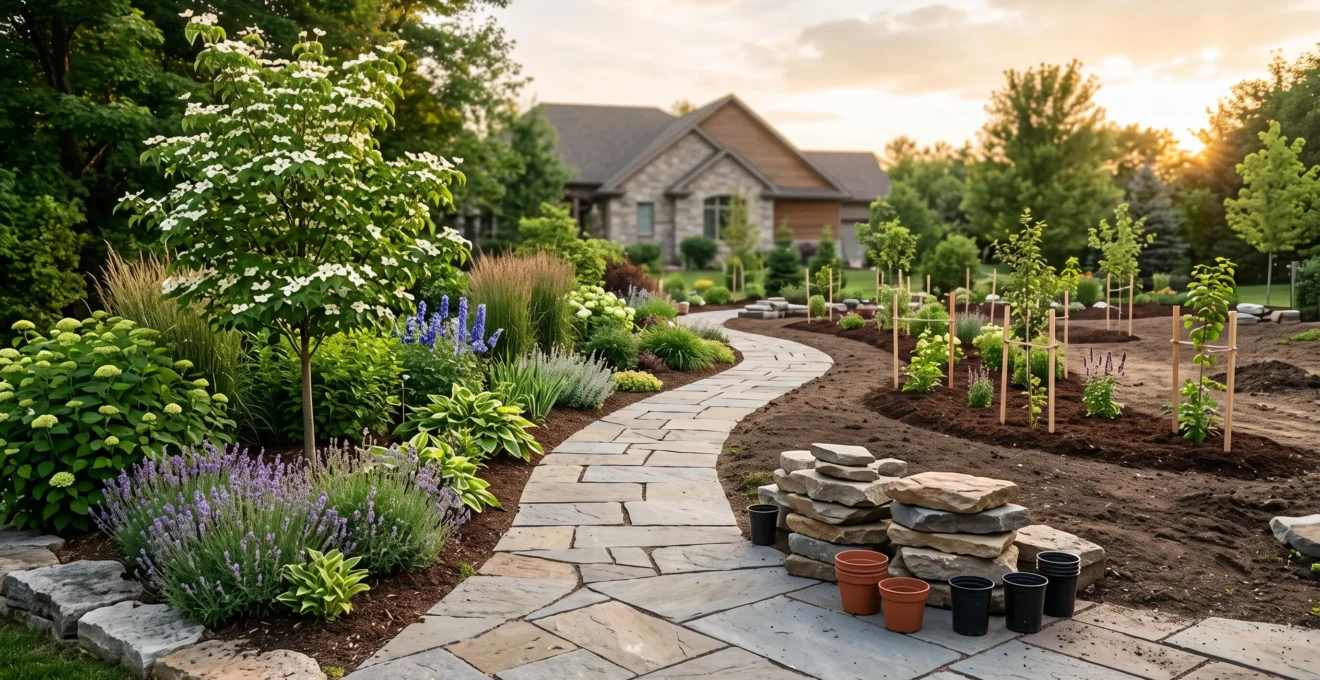
A garden plan is a financial instrument designed to de-risk your property and maximise its final valuation, not just an aesthetic exercise.
- Strategic sequencing of works (hardscaping before planting) prevents costly rework and protects soil, a key asset.
- Choosing slow-growing, strong-wooded plants minimises long-term maintenance overhead and avoids creating future structural liabilities.
Recommendation: Develop a 5-year master plan before breaking ground. This allows for phased, budget-friendly implementation while ensuring every action contributes directly to a higher, more secure property value.
For homeowners looking to sell in the medium term, the garden is often seen as a tool for “kerb appeal”—a quick lick of paint on the front door, some colourful hanging baskets. This approach, however, fundamentally misunderstands the financial nature of your outdoor space. While surface-level improvements provide a fleeting boost, they do little to alter the underlying asset value. The common advice to simply add a patio or plant some mature trees often ignores the critical long-term financial consequences of these decisions.
Thinking like a property valuation expert requires a paradigm shift. Your garden is not a canvas for decoration; it is a balance sheet of assets and liabilities. A poorly placed tree becomes a future subsidence risk. The wrong sequence of construction can permanently degrade your soil, a valuable natural asset. A garden that can’t adapt to changing family needs is an underutilised resource that will require expensive retrofitting before a sale.
But what if the key to unlocking significant property value wasn’t about spending more, but about spending smarter, earlier, and in the right order? This guide reframes garden development as a strategic, 5-year financial plan. It is a roadmap designed to mitigate future costs, sequence capital expenditure for maximum efficiency, and ensure your garden matures into a high-value, low-risk asset that directly contributes to your final sale price.
We will dissect the critical financial decisions that underpin a successful long-term garden strategy. From understanding structural risks to phasing construction and allocating your budget, this article provides a clear framework for turning your garden into a powerful investment vehicle.
Summary: A Strategic Roadmap for Garden Investment
- Why Planting Trees Too Close to the House Costs Thousands Later
- Hardscaping First or Planting First: The Most Cost-Effective Order
- Fast vs. Slow Growers: Which Saves More Maintenance Over 10 Years?
- Designing a Garden That Evolves From Play Area to Entertaining Space
- When to Start Major Earthworks to Avoid Ruining Summer Use
- Why a Master Plan Saves Money Even if You Build in Stages
- The High Hedges Act: When Does Your Privacy Screen Become a Legal Liability?
- Professional Landscape Design vs. DIY: A Strategic Budget Allocation
Why Planting Trees Too Close to the House Costs Thousands Later
One of the most common and costly mistakes in landscaping is misjudging the mature size and impact of trees. A sapling planted for a touch of green can quickly become a significant financial liability. The primary risk is structural damage to the property’s foundation. As trees grow, their root systems expand in search of water and stability, exerting immense pressure on anything in their path. This is especially true for properties built on clay soils, which shrink and swell dramatically with moisture changes.
The financial consequences are not trivial. In the UK, it is estimated that approximately 60% of all subsidence claims are caused by tree roots. These claims can lead to expensive underpinning work, skyrocketing insurance premiums, and a significant reduction in property value, as the issue must be declared to potential buyers. The cost of rectifying subsidence and removing a mature, problematic tree can easily run into thousands of a pounds, erasing any aesthetic value it once provided.
As the image above illustrates, the proximity of roots to a foundation is a tangible threat. Beyond subsidence, large trees can cause blocked drains, lift paving, and create excessive shade that leads to damp issues on walls. The strategic placement of trees, considering their ultimate height and root spread, is a fundamental act of risk mitigation. A 5-year plan must account for this “asset maturity,” ensuring that a tree planted in year one does not become a multi-thousand-pound liability in year ten.
Hardscaping First or Planting First: The Most Cost-Effective Order
A frequent dilemma in garden development is the order of operations: should you build the patio, paths, and walls first, or establish the planting beds? From a financial and project management perspective, the answer is unequivocal. Executing hardscaping projects before any major planting is the most cost-effective sequence. This “hardscape first” rule is a core principle of strategic capital expenditure (CapEx) sequencing in landscaping.
The reasoning is rooted in logistics and the preservation of a critical, often-overlooked asset: your soil. Hardscaping involves heavy machinery, material storage, significant foot traffic, and excavation. Attempting this work after soft landscaping is complete inevitably leads to damaged plants, churned-up lawns, and, most importantly, severe soil compaction. Compacted soil loses its structure, preventing water infiltration and root growth, effectively rendering it useless for healthy planting. As a peer-reviewed study on construction sites confirms, heavy machinery is a fact of life during construction, and protecting the soil from its impact is a mandatory precaution for any successful landscape design.
Rehabilitating compacted soil is an expensive and labour-intensive process that can set a project back months. By completing all structural work first, you confine the disruption and damage. Once the diggers and cement mixers are gone, you are left with a clean slate to prepare your planting beds correctly, without risk of subsequent damage. This sequence prevents rework, protects your soil asset, and ensures that your investment in plants is not wasted.
Action Plan: Protecting Soil During Hardscaping
- Designate specific areas for contractor parking, equipment, and material storage, ideally on ground that will later be covered by a driveway or patio.
- Utilise existing driveways or roads for site access to avoid driving heavy machinery over future planting zones.
- In areas where traffic is unavoidable, carefully remove and stockpile the valuable topsoil for re-use after construction is finished.
- Protect sensitive zones near the work area by spreading a thick layer of mulch, covered with plywood sheets to distribute the weight of any occasional traffic.
- Insist on using the lightest equipment possible for the job, especially when operating near areas designated for future lawns or garden beds.
Fast vs. Slow Growers: Which Saves More Maintenance Over 10 Years?
The allure of fast-growing plants is understandable. They promise rapid screening, instant impact, and a quickly “finished” look. However, from a 10-year investment perspective, this short-term gain often translates into a significant long-term liability. Fast growth is frequently correlated with weak wood, shorter lifespans, and high maintenance overheads, which ultimately detract from property value.
Species like Leylandii, willows, and poplars are notorious for their rapid growth, but this comes at a structural cost. Their wood is often brittle and prone to breaking in high winds or under the weight of snow. This not only creates a constant clean-up burden but also poses a serious safety and property risk. A large fallen branch can damage roofs, cars, or fences, leading to costly repairs. In the most extreme cases, entire trees can fail. For context, a study found that over 407 deaths were caused by wind-related tree failures in the United States over a 12-year period, a stark reminder of the risks associated with structurally weak trees.
In contrast, slow-growing species like oak, beech, or yew build dense, strong wood. While they take longer to mature, they represent a stable, low-risk asset. Their maintenance is predictable, primarily consisting of occasional shaping rather than reactive crisis management. Over a decade, the time and money saved on pruning, storm damage repair, and eventual removal of a fast-growing “problem tree” far outweigh the initial benefit of rapid growth. When selecting plants, it’s vital to assess them not just for their initial appeal but for their long-term structural integrity. Key warning signs of a poor long-term investment include:
- Species known for brittle wood or weakly attached limbs.
- Trees with spreading, co-dominant trunks (V-shaped forks) that are prone to splitting.
- Evidence of girdling roots at the base, which can create a weak point and lead to failure.
Designing a Garden That Evolves From Play Area to Entertaining Space
A garden’s value is intrinsically linked to its utility. For a homeowner with a 5-to-10-year sales horizon, the needs of the household will almost certainly change during that period. A garden designed for young children, with a prominent sandpit and swing set, may not appeal to the professional couple or empty-nesters who are likely to be the next buyers. A truly strategic garden plan anticipates this evolution, designing a space that can transition seamlessly from one life stage to the next with minimal cost and effort.
This is the concept of lifecycle planning. Instead of building permanent, single-use features, the focus is on creating flexible zones. For example, the area designated for a child’s trampoline should be sited on level, well-drained ground. The underlying preparation is key; once the trampoline is no longer needed, the same footprint can be easily and inexpensively converted into a stylish patio, a fire pit area, or the base for a sophisticated outdoor kitchen. The initial investment in groundworks serves both purposes.
Similarly, a playhouse can be built on a base that is perfectly sized to later accommodate a garden office or a high-end shed. A temporary woodchip surface for a play area is easily scraped away to reveal prepared ground for a new lawn or planting bed. The strategy is to think in layers: the permanent base layer (groundworks, drainage, electrical conduits) should be designed with the final, high-value “entertaining space” in mind, while the temporary top layer serves the immediate needs of a “play area.” This foresight ensures the garden’s value proposition matures along with the family, maximising its appeal to the widest possible range of future buyers.
When to Start Major Earthworks to Avoid Ruining Summer Use
Timing is a critical, yet often underestimated, component of a strategic garden plan. Starting major projects at the wrong time of year can not only ruin your family’s enjoyment of the space but also cause long-term damage to your garden’s most valuable asset: its soil. Major earthworks—such as terracing, excavation for a pond, or significant re-grading—should be scheduled with both weather and soil science in mind.
The ideal window for such disruptive work is late summer or early autumn. During this period, the ground is typically at its driest and firmest. Operating heavy machinery on dry soil minimises the risk of deep ruts and, most importantly, severe soil compaction. As experts from the Rutgers New Jersey Agricultural Experiment Station note:
Soil compaction can occur during construction activities due to repeated operation of heavy machinery, especially when soil is wet.
– Rutgers New Jersey Agricultural Experiment Station, FS1313: Assessing and Addressing Soil Compaction in Your Yard
Attempting the same work in a wet spring or winter can turn your garden into a quagmire, destroying the soil structure and making subsequent planting almost impossible without costly remediation. Furthermore, an autumn start allows the ground to settle naturally over the winter. This gives you the entire spring season for the less disruptive “soft landscaping” phase—planting, turfing, and finishing touches—ensuring the garden is ready to be enjoyed by the following summer. This schedule aligns the biggest disruption with the end of the peak-use season, effectively quarantining the mess and preserving the summer for family enjoyment.
By scheduling major works for the autumn, you protect your soil asset, ensure a more efficient project timeline, and avoid sacrificing a summer’s use of your garden. This strategic timing is a hallmark of a well-conceived, value-oriented plan.
Why a Master Plan Saves Money Even if You Build in Stages
The idea of commissioning a full garden master plan can seem like an unnecessary expense, especially if the intention is to implement the project in affordable stages over several years. However, this upfront investment in strategy is precisely what prevents costly mistakes and ensures the final result is cohesive and value-adding. A master plan is not a rigid blueprint; it is a financial roadmap that guarantees every pound spent contributes to a unified, long-term vision.
Without a plan, phased projects often become a series of disjointed, reactive decisions. A path is laid one year, only to be dug up the next to install lighting cables that weren’t considered. A patio is built, but its location makes it impossible to create the desired flow to a future outdoor kitchen. These errors lead to expensive rework, wasted materials, and a final garden that feels like a collection of afterthoughts. A master plan prevents this by establishing the entire infrastructure—drainage, irrigation, electrical conduits, and primary pathways—from the outset, even if the features they serve won’t be built for years.
This coordinated approach is what unlocks significant returns. Good landscaping is one of the few home improvements that can appreciate in value, and a well-planned design is key to this. Strategic investment in features like walkways, trees, and functional outdoor areas can boost property value by 10% to 30% with a coordinated approach. As award-winning landscaper Paal Grant states:
It’s always good to have a plan, because you get that input from the start and get a better result.
– Paal Grant, OpenAgent
The cost of the plan is an investment in efficiency. It ensures that the project for year one seamlessly connects to the project for year three, saving you money on demolition, rework, and correcting short-sighted mistakes down the line.
The High Hedges Act: When Does Your Privacy Screen Become a Legal Liability?
Creating privacy is a primary driver for many garden investments, with fast-growing hedges being a popular choice. However, what starts as a desirable privacy screen can evolve into a serious legal and financial liability. In the UK, this is governed by Part 8 of the Anti-Social Behaviour Act 2003, commonly known as the “High Hedges Act.” Misunderstanding these regulations can lead to neighbourly disputes, forced removal of your expensive hedge, and council-imposed fees.
The Act applies to any hedge that is over 2 metres tall and consists of a line of two or more evergreen or semi-evergreen trees or shrubs that are obstructing a neighbour’s light or access. Before a council will intervene, the complainant must prove they have attempted to resolve the issue informally. If this fails, they can make a formal complaint. In many jurisdictions, a formal complaint carries a fee that can be around £300, payable by the complainant, demonstrating the seriousness of the process.
If the council finds in the complainant’s favour, they can issue a remedial notice requiring the hedge owner to reduce the height of the hedge and maintain it at a lower level. Failure to comply with this notice is a criminal offence and can result in a fine of up to £1,000. For a homeowner planning to sell, an active hedge dispute or a remedial notice against the property is a major red flag that can deter buyers or reduce offers. Before planting a boundary hedge, it is critical to:
- Choose a species that is easily maintained at or below the 2-metre threshold, such as Yew or Portuguese Laurel, rather than notoriously fast-growing species like Leylandii.
- Position the hedge with enough space from the boundary to allow for trimming on both sides.
- Maintain an open dialogue with neighbours about your planting plans to prevent disputes from arising.
Key Takeaways
- A garden’s financial value comes from strategic, long-term planning, not just short-term aesthetic fixes.
- Prioritise risk mitigation: understand the future liabilities of poor plant choices, incorrect sequencing, and legal non-compliance.
- A master plan is a cost-saving tool that ensures phased investments work together cohesively, preventing expensive rework.
Professional Landscape Design vs. DIY: A Strategic Budget Allocation
The final strategic decision is how to allocate your budget between professional services and do-it-yourself (DIY) labour. This is not an all-or-nothing choice. The most financially astute approach is a hybrid model: invest in professional expertise for the strategic planning and high-risk elements, and leverage DIY for the low-risk, labour-intensive tasks to maximise your return on investment (ROI).
Your budget is best spent on a professional landscape designer or architect for the initial master plan. As we’ve established, this upfront cost is an investment that pays dividends by preventing costly errors. Similarly, any work that carries significant structural or safety risk should be left to licensed contractors. This includes major earthworks, the construction of retaining walls, and any complex electrical or gas installations. As property expert Barbieri advises, for certain jobs, “It’s important to have it done by a licensed contractor.” This protects your investment, ensures compliance with building codes, and is essential for home insurance purposes.
Conversely, many elements of a garden project are low-risk and high-labour, making them perfect for DIY. Laying a simple patio, building raised beds, installing a pre-fabricated fire pit, planting, and turfing are all tasks where your own “sweat equity” can dramatically improve the project’s ROI. For example, while a professionally installed fire pit might yield a 60-70% return, an analysis by Angi suggests that for such features, you can see an ROI of well past 80% by choosing the DIY route and using cost-effective materials. The key is to correctly identify where professional skill creates value (in design and risk management) and where your own labour can simply reduce costs without compromising quality or safety.
Your garden has the potential to be one of your property’s most valuable assets. By shifting your perspective from short-term aesthetics to long-term financial strategy, you can create a space that not only enriches your life but also delivers a significant, tangible return when it’s time to sell. Start today by outlining your 5-year vision and making the first smart, strategic investment in your property’s future.