In summary:
- Fungal prevention in damp climates is not about chemical sprays, but about proactively engineering a garden’s microclimate to be hostile to pathogens.
- Success depends on three pillars: managing leaf wetness duration, maximising canopy air circulation, and rigorously breaking the fungal life cycle through sanitation.
- Cultural practices like proper watering, strategic pruning, and soil mulching are more effective long-term than any reactive treatment.
For gardeners across the UK, the sight is depressingly familiar. After a week of persistent drizzle and mild temperatures, those tell-tale black spots appear on rose leaves, or a ghostly white powder dusts the foliage of herbaceous perennials. The immediate temptation is to reach for a fungicide, beginning a season-long battle of spray-and-repeat. This reactive approach, however, often feels like a losing fight, addressing symptoms rather than the root cause.
What if the solution wasn’t found in a bottle, but in the very design and maintenance of the garden itself? The key to a disease-free garden in a damp climate is to stop thinking like a patient treating an illness and start thinking like a plant pathologist engineering an environment. The true battle is won not by killing fungi, but by creating a microclimate where pathogens like black spot and powdery mildew simply cannot thrive. This is a game of physics and biology—managing water, airflow, and spore pressure to your advantage.
This guide moves beyond generic advice to explain the scientific principles behind effective, fungicide-free disease prevention. We will explore how to manage water at a microscopic level, engineer airflow through your borders, and implement sanitation protocols that decisively break the fungal life cycle, giving you the tools to build a resilient, healthy garden that can withstand the challenges of the British weather.
This article provides a detailed roadmap for transforming your garden from a fungal incubator into a healthy, resilient ecosystem. Follow along to understand the science and practical steps for lasting disease control.
Summary: A Pathologist’s Strategy for a Fungus-Free UK Garden
- Black Spot or Blight
- Watering Techniques: Why Overhead Watering Is Banned for Disease Control?
- The Spacing Mistake That Creates a ‘Fungal Incubator’ in Your Border
- Copper or Sulphur: When to Apply Organic Fungicides Effectively?
- To Compost or Burn: Handling Infected Foliage Without Spreading Spores?
- Solid Fences vs Trellis: Which Causes More Air Stagnation?
- The ‘Leave it All’ Mistake That Harbours Black Spot Spores
- Improving Canopy Air Circulation to Stop Powdery Mildew in Roses?
Black Spot or Blight
To defeat an enemy, you must first understand it. Foliar diseases like black spot (Diplocarpon rosae) and powdery mildew are not random misfortunes; they are organisms with a specific life cycle. The fungus primarily overwinters on fallen leaves and in subtle infections on stems. As the Royal Horticultural Society notes, it produces spores in the spring to infect the vulnerable, new foliage. This isn’t a small-scale problem; research shows a single black spot lesion can release over 1 million spores from April onwards. This creates immense spore pressure in the garden environment.
The primary infection in spring is often small, but it’s the beginning of an exponential curve. Each new lesion becomes another spore factory, leading to a rapid escalation of the disease, especially during wet spells. This is why susceptible plants, like older hybrid tea roses, can be almost completely defoliated by late summer. The pathogen’s strategy is one of overwhelming numbers, exploiting the perfect conditions provided by a damp, mild UK climate. Understanding this cycle is the first step: our goal is not just to treat visible spots, but to interrupt this cycle of spore production and infection at every possible stage.
Watering Techniques: Why Overhead Watering Is Banned for Disease Control?
The common advice to “avoid wetting the leaves” is correct but incomplete. The real enemy is not water itself, but the duration of the water film on the leaf surface. Fungal spores are like microscopic seeds; they require a continuous film of water for a specific number of hours (typically 4-8, depending on temperature) to germinate and penetrate the leaf tissue. Overhead watering directly provides this ideal germination window. By watering only at the base of the plant, you deny the pathogen this critical opportunity.
However, even without overhead watering, leaves can become wet. In the high humidity of a UK morning, plants often excrete water from the edges of their leaves through a process called guttation. This natural phenomenon can produce enough surface moisture for spores to germinate, especially within a dense, still canopy. This highlights why managing overall humidity and airflow is just as important as your watering technique. The goal is to ensure that any moisture on the leaves—whether from rain, dew, or guttation—dries as quickly as possible. Every hour of leaf wetness you can eliminate is a victory in preventing infection.
As seen in the droplets formed during guttation, leaves can remain wet for extended periods without any rain. This is why a holistic approach that includes promoting rapid drying is essential. The most effective time to water is in the morning, giving the sun and wind the entire day to dry any accidental splashes and reduce ambient humidity around the plant’s base before the cool of the evening.
The Spacing Mistake That Creates a ‘Fungal Incubator’ in Your Border
A densely packed border, while aesthetically lush, can be a pathogen’s paradise. When plants are too close together, they create a pocket of still, humid air at their centre. This lack of air circulation dramatically slows the drying of leaves after rain or dew, extending the water film duration and creating a perfect fungal incubator. The spacing of plants is therefore a primary tool in engineering a disease-hostile microclimate. Proper spacing allows air to move freely through the canopy, whisking away moisture and preventing humidity from stagnating.
This principle extends beyond just the distance between plants. It also involves layering and pruning to create vertical “air chimneys” within a border. Taller plants at the back, medium in the middle, and low at the front is a classic design rule that also happens to be excellent for airflow. Furthermore, avoiding an over-application of nitrogen-rich fertiliser is key, as it promotes soft, dense, leafy growth that clogs up the canopy and provides ideal conditions for fungal proliferation. Think of your border not as a solid mass, but as a collection of individuals that all need personal space to breathe.
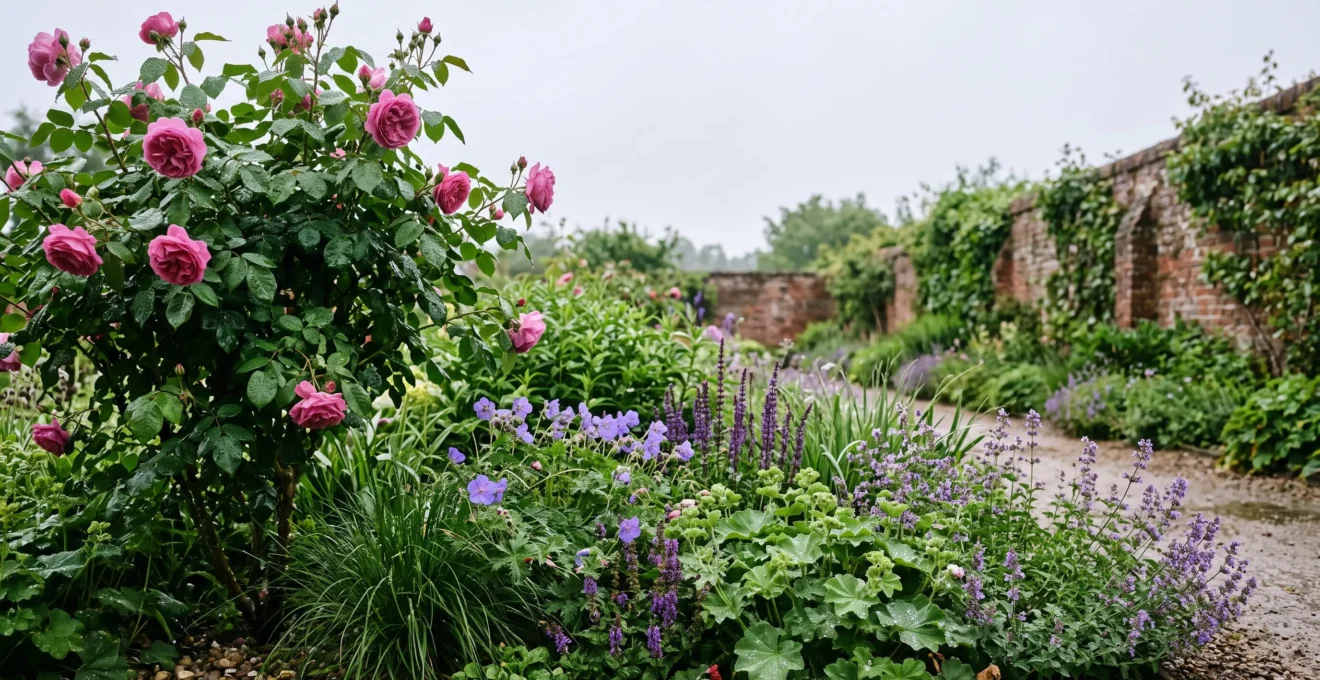
The well-structured border above demonstrates how creating visible gaps between plant clumps facilitates essential air movement, a core principle of preventative disease management.
Your Action Plan for Better Airflow
- Plant in Sunny Locations: Maximise sun exposure to speed up the drying of foliage.
- Ensure Proper Spacing: Check the final spread of your plants and provide adequate room for them to grow without their canopies interlocking.
- Prune for Openness: Selectively remove excess or crossing stems from the centre of shrubs and perennials to improve light and air penetration.
- Fertilise Moderately: Avoid excessive nitrogen, which encourages dense, weak foliage that is more susceptible to disease.
Copper or Sulphur: When to Apply Organic Fungicides Effectively?
When faced with a persistent fungal issue, many gardeners turn to traditional “organic” fungicides like copper or sulphur-based sprays. While these are permitted in organic systems, they are not a silver bullet and their use should be carefully considered. Firstly, as the RHS strongly advises, it’s best to avoid fungicides altogether, as they can reduce biodiversity in the garden. These treatments are broad-spectrum, meaning they can harm beneficial fungi and other microorganisms that contribute to a healthy garden ecosystem.
More profoundly, repeated use of these substances can have long-term negative consequences for soil health. For instance, copper is a heavy metal that accumulates in the soil over time. A study on vineyard soils demonstrated that high copper concentrations negatively impact the performance of beneficial arbuscular mycorrhizal fungi (AMF). This research, which evaluated the benefits of AMF inoculation on grapevines in copper-rich soil, shows how our interventions can disrupt the very symbiotic relationships that support robust plant health. Instead of relying on these sprays as a primary defence, they should be viewed as an absolute last resort. The focus must remain on cultural controls that build a resilient system, rather than on chemical interventions that can degrade it over time.
To Compost or Burn: Handling Infected Foliage Without Spreading Spores?
A critical step in managing spore pressure is meticulous garden hygiene. But what should be done with the infected leaves and stems you remove? The answer is unequivocal for the average home gardener: do not compost them. Fungal spores, particularly from stubborn diseases like black spot, rust, and fire blight, are incredibly resilient. A typical home compost pile, often managed passively, simply does not reach the consistent high temperatures required to reliably kill these pathogens. Adding infected material to your heap is a sure-fire way to reintroduce the inoculum back into your garden when you spread the finished compost.
To effectively sterilise diseased plant matter, a hot composting system must be rigorously managed. Official composting standards recommend that to kill pathogens, you must maintain temperatures above 130°F (55°C) for at least three consecutive days, with regular turning to ensure all material is exposed to the hot core. For particularly tough fungal spores, protocols suggest holding temperatures even higher, between 140°F (60°C) and 165°F (74°C), for at least ten days. Since achieving this is difficult and labour-intensive for most, the safest and most effective disposal method is to bag the material and place it in your municipal waste, or to burn it where local regulations permit. This removes the pathogen from your garden’s ecosystem completely.
Solid Fences vs Trellis: Which Causes More Air Stagnation?
Garden boundaries play a surprisingly significant role in microclimate engineering. A solid wooden fence or a dense, clipped hedge acts like a dam, creating a zone of still, stagnant air on its leeward side. This is precisely the condition that promotes fungal disease. Plants placed too close to these solid barriers will sit in a pocket of high humidity, their leaves remaining wet for much longer after rainfall. This is why you often see the worst powdery mildew infections on plants crammed against a back fence.
In contrast, a more permeable boundary like a trellis, a wire fence, or a mixed, unclipped hedge allows for gentle air movement. It breaks the force of the wind without stopping airflow entirely, preventing stagnation. As experts at Garden Design advise, maintaining “adequate spacing between plants and keep[ing] them far enough away from walls and fences” is a cornerstone of good air circulation. When designing or planting near a boundary, always consider its permeability. If you have a solid fence, ensure you leave a generous gap (at least 60-90cm) between it and your plants. If you are installing a new boundary in a disease-prone area, opt for a structure that breathes, such as a trellis, which can then be clothed with climbers to provide privacy without sacrificing vital airflow.
The ‘Leave it All’ Mistake That Harbours Black Spot Spores
One of the most impactful actions a gardener can take is also one of the simplest: rigorous autumn and in-season cleanup. The “leave the leaves” approach, often promoted for wildlife, is a catastrophic mistake when dealing with fungal diseases like black spot. The pathogen overwinters on fallen foliage, creating a reservoir of inoculum ready to explode the following spring. Field observations in UK gardens consistently show that the single most effective control measure is a thorough autumn clearance, collecting and disposing of all fallen leaves from susceptible plants. This single act removes the primary source of the next year’s infection.
This sanitation protocol must also be practiced vigilantly throughout the growing season. The moment a spotted leaf is seen, it should be picked off and binned. Don’t wait for it to fall. This removes a spore-producing factory before it can infect its neighbours. Furthermore, applying a thick layer of mulch in early spring is a powerful secondary tactic. A 7-8cm layer of bark or composted woodchip over the soil acts as a physical barrier. Trials indicate that such a mulch layer can suppress 70-80% of overwintering spores from splashing back up onto new leaves during spring rains. This combination of removal and suppression dramatically reduces the initial spore pressure, making the entire season much more manageable.
Key Takeaways
- Airflow is the Best Fungicide: The primary goal is to promote constant, gentle air movement through plant canopies to dry leaves quickly.
- Dry Foliage is Safe Foliage: The duration of leaf wetness is the single most critical factor for spore germination. All cultural practices should aim to minimise this window.
- Sanitation is Non-Negotiable: Rigorously removing infected material and overwintering spores is the most effective way to reduce disease pressure year-on-year.
Improving Canopy Air Circulation to Stop Powdery Mildew in Roses?
We have established that airflow is a cornerstone of disease prevention. The most direct way a gardener can influence this within a plant’s own canopy is through skilled, purposeful pruning. For roses and many other shrubs, this means abandoning haphazard trimming and adopting a strategy to create an open, vase-like or “goblet” structure. This involves removing any branches that are growing inwards towards the centre of the plant, as well as any that are weak, spindly, or crossing over another branch.
The goal is to create a structure where air and light can penetrate freely into the heart of the plant. This not only helps leaves dry more quickly but also makes for a stronger, more vigorous plant overall. As the Clemson Home & Garden Information Center states, the most important prevention strategy is a combination of maintaining good air circulation, avoiding overhead irrigation, and removing infected material. Pruning is your most powerful tool for achieving that first point. This isn’t just a winter job; a light “summer prune” to thin out overly dense growth after the first flush of flowers can be invaluable in maintaining airflow during the peak disease months of late summer.
By adopting a preventative mindset, every pruning cut becomes a strategic decision to improve the plant’s health and resilience, turning a routine chore into a proactive defence against disease.
Embracing these cultural practices transforms gardening from a reactive battle into a proactive partnership with your environment. By focusing on creating a healthy, resilient ecosystem, you can enjoy beautiful, disease-free plants that thrive naturally, even in the most challenging of UK climates.