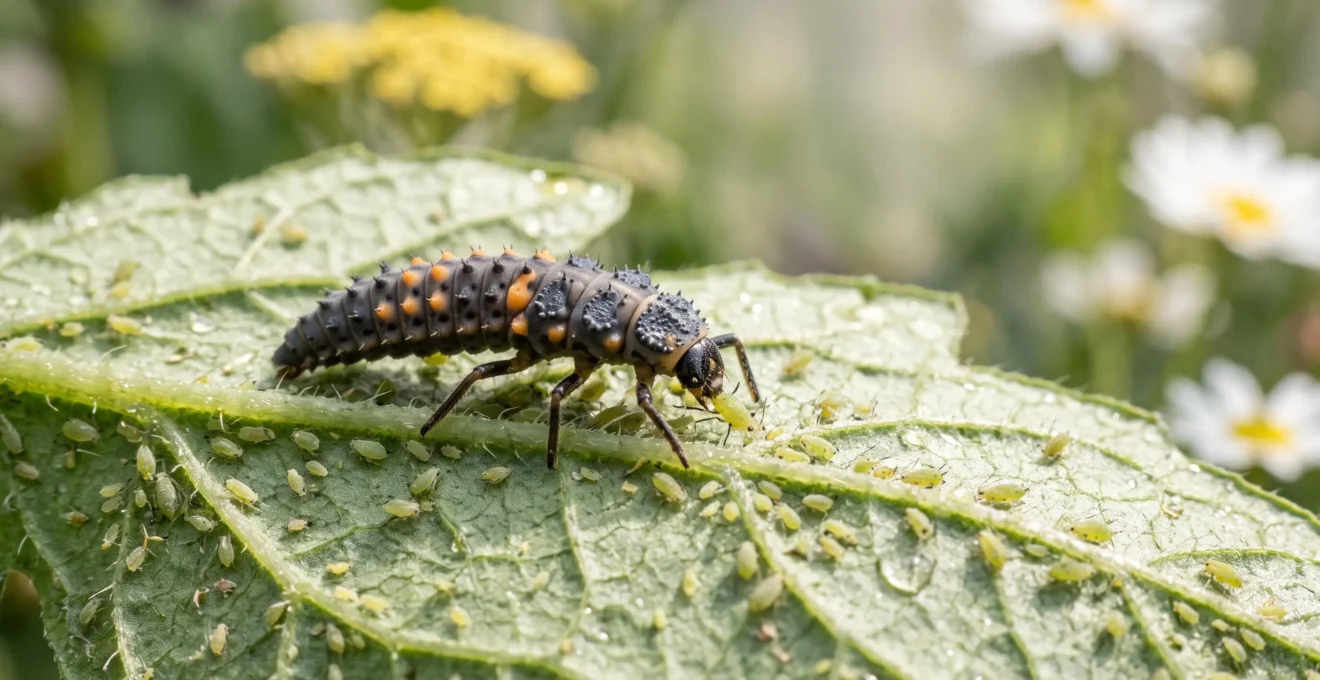
Tackling an aphid infestation isn’t about finding the right spray; it’s about becoming a strategic ecosystem manager. Instead of reacting to pests, the most effective long-term solution is to proactively build a garden that recruits and sustains a permanent army of predatory insects. This involves providing the correct food, shelter, and life-cycle support through all seasons, turning your garden into a self-regulating system where beneficials handle pest control for you.
Watching a tide of aphids overwhelm a prize rose or a row of tender vegetables is a familiar frustration for any gardener. The conventional response is often to reach for a spray bottle, whether it’s a chemical pesticide or a seemingly benign soap solution. This approach offers a moment of satisfaction but treats only the symptom, not the cause. It’s a reactive cycle that ignores a powerful, self-sustaining solution already present in nature: a dedicated workforce of predatory insects.
The common advice is to “plant flowers for beneficials” or “avoid pesticides.” While true, these platitudes barely scratch the surface. They fail to address the critical questions of timing, predator life cycles, and habitat engineering. The real key to unlocking natural pest control isn’t just adding a few “good” plants; it’s about fundamentally shifting your perspective. It requires moving from a mindset of pest eradication to one of ecosystem management. It means understanding that a small, controlled aphid population is not a failure but a food source—a crucial cog in a resilient garden machine.
But what if the true strategy wasn’t about reacting to pests at all, but about proactively engineering a system where they rarely become a problem? This guide abandons the quick-fix mentality and instead focuses on the strategic principles of Integrated Pest Management (IPM). We will explore how to identify and protect predator larvae, build effective long-term shelter, close the seasonal “nectar gap” that starves your allies, and even deploy sophisticated techniques like banker plants. The goal is to build a garden that doesn’t just tolerate beneficial insects, but actively recruits, feeds, and shelters them, creating a permanent, in-house security force.
This article will guide you through the strategic layers of building a resilient garden ecosystem. By understanding the specific needs of your predatory allies, you can create a system where they do the vast majority of pest control work for you, ensuring your plants thrive.
Summary: A Strategic Guide to Natural Aphid Control
- Larvae vs Adult: Recognizing a Ladybird Larva Before You Squish It?
- Log Piles or Bug Hotels: Which Actually Works for Lacewings?
- The Nectar Gap: Why Double Flowers Starve Beneficial Insects?
- Sacrificial Plants: Growing Nasturtiums to Lure Aphids Away?
- February to November: Keeping Predators Fed in the Shoulder Seasons?
- The 2-Week Rule: When to Wait for Ladybirds Instead of Spraying?
- Which Seed Heads Provide the Most Calories for Winter Birds?
- Controlling Aphid Infestations: Water Jets vs Soap Sprays?
Larvae vs Adult: Recognizing a Ladybird Larva Before You Squish It?
The first step in effective ecosystem management is recognizing your allies, and the most common mistake gardeners make is accidentally eliminating their most powerful aphid predator: the ladybird larva. While the adult ladybird is a celebrated garden hero, its larval stage is an unfamiliar, spiky creature often mistaken for a pest and squished on sight. This is a critical error, as a single ladybird larva can consume hundreds of aphids before it pupates. They are wingless, stationary hunters deployed exactly where you need them most.
These larvae look nothing like their adult counterparts. Generally, they are elongated, segmented, and almost alligator-shaped, often dark grey or black with orange or yellow spots. With over 50 species in the UK alone, their size can vary but they can grow up to 12mm long before transforming. The two-spot ladybird larva, for instance, is dark with distinct orange flecks. Learning to identify these juvenile forms is non-negotiable for any gardener serious about biological control. Before you wipe down a leaf or spray a colony, inspect it for these tiny predators.
While adult ladybirds are also predators, their mobility can be a drawback; they often fly away after being released. Larvae, by contrast, are voracious and stay put. A USDA review of greenhouse trials found aphid reduction exceeded 50% in most studies using ladybirds. However, their efficiency depends on the absence of ants, which will defend aphids. Protecting these larval stages is the foundation of a successful IPM strategy. By learning to recognize and preserve them, you are safeguarding the most effective and stationary part of your predator army.
Log Piles or Bug Hotels: Which Actually Works for Lacewings?
Once you’ve learned to protect your predators, the next strategic step is providing effective year-round shelter. The popular “bug hotel” is often sold as a one-size-fits-all solution, but for many key predators like lacewings, it’s far from optimal. The common green lacewing is another voracious aphid predator, especially in its larval stage (known as the “aphid lion”). However, to keep a healthy population in your garden, you must understand their specific overwintering needs.
Many commercial bug hotels are placed at ground level, where they accumulate dampness. This is the opposite of what lacewings seek. A revealing German study across three winters found that lacewings overwhelmingly preferred to hibernate in dry, elevated, sheltered structures like wooden trellis poles, rather than in ground-level log piles or forest margins. This tells us that to effectively shelter lacewings, we need to think less about a single “hotel” and more about creating a layered habitat with the right conditions.
Instead of a bug hotel, focus on creating a more natural and effective habitat corner. This involves combining several elements to offer a range of microclimates for different species. A simple log pile provides shelter for ground beetles, a thick layer of leaf litter protects overwintering queen bumblebees and other insects, and standing deadwood or a dense, untrimmed hedge offers the dry, elevated shelter that lacewings and ladybirds prefer.
As the illustration shows, this kind of multi-layered habitat is far more valuable than a tidy box stuffed with bamboo. It’s about resisting the urge to clear every corner of the garden to bare soil. By simply leaving leaves under shrubs, allowing a patch of perennials to stand through winter, and maintaining a small pile of logs or branches, you are building a resilient, year-round home for your entire predator workforce.
The Nectar Gap: Why Double Flowers Starve Beneficial Insects?
Effective shelter is only half the battle; your predator army needs a reliable food source. Adult predators like ladybirds, lacewings, and especially hoverflies do not primarily eat aphids. They feed on nectar and pollen. If these resources aren’t available, they won’t stay in your garden to lay the eggs that produce the aphid-eating larvae. This is where many gardeners unknowingly create a “nectar gap” by choosing the wrong types of flowers.
The problem often lies in modern plant breeding, which favors showy, “double” flowers. These cultivars have been bred for extra petals, which look spectacular to the human eye but are a food desert for insects. The additional petals physically block access to the nectaries and pollen, rendering the flower useless as a food source. In contrast, single, open-faced flowers are a lifeline for beneficials. Their structure provides an exposed floral disk, like a landing pad, offering easy access to the energy-rich nectar and protein-rich pollen that adult predators need to survive and reproduce.
The difference in value is stark, and choosing the right flower shape is a strategic decision that directly impacts your garden’s pest resilience.
| Flower Type | Nectar/Pollen Accessibility | Value for Beneficial Insects |
|---|---|---|
| Single/open flowers (e.g. Echinacea, Veronica) | High — open floral disk exposes nectar and pollen | Attracts hoverflies, ladybirds, and predatory wasps |
| Double-flower hybrids | Low — extra petals block access to nectaries | Little to no value for pollinators or predators |
| Composite/daisy-family blooms | Very high — hundreds of tiny disc flowers per bloom | Sustained nectar source across a full season |
To support your predators, prioritize planting flowers with small, flat, or easily accessible blooms. Think of plants in the carrot family (Apiaceae) like dill, fennel, and coriander, or those in the daisy family (Asteraceae) like cosmos, sunflowers, and yarrow. Low-growing flowers such as sweet alyssum are also invaluable, acting as a living mulch that provides a constant food source. By intentionally planting these flowers throughout your garden, you are building a food infrastructure that sustains your beneficial insect population all season long.
Sacrificial Plants: Growing Nasturtiums to Lure Aphids Away?
While providing nectar for adults is crucial, the most advanced strategy involves actively farming food for their young. The common idea of a “sacrificial plant” or “trap crop,” like growing nasturtiums to lure aphids away from beans, is a step in the right direction. However, professional growers use a far more sophisticated and reliable version of this concept known as a “banker plant” system. This is the pinnacle of proactive pest management, transforming the gardener from a passive host into a true ecosystem engineer.
A banker plant system isn’t about luring pests away; it’s about creating a dedicated, on-site nursery for your predators. The process involves three players:
- The Banker Plant: A non-crop plant, typically a cereal grass like barley or oats, that will not host pests harmful to your main crops.
- The Alternative Prey: A specific aphid, like the bird cherry-oat aphid, that feeds *only* on the cereal grass and won’t move to your vegetables or flowers.
- The Predator: The beneficial insect you want to raise, such as a parasitoid wasp (Aphidius colemani) or ladybirds.
The system works by intentionally introducing the “safe” aphids onto the banker plants. Once this aphid population is established, you release your predators onto the banker plant. The predators now have a reliable food source and begin to reproduce in large numbers. As their population booms, they will naturally disperse from the banker plant throughout the garden or greenhouse, actively seeking out any pest aphids on your valuable crops.
This isn’t just theory; it’s a practical, low-cost method used by commercial growers. The key is to start the system *before* you see pest aphids, creating a standing army ready to be deployed at a moment’s notice.
Action Plan: Running an Aphid Banker Plant System
- Raise a non-crop cereal grass (barley, wheat, or oats) and introduce bird cherry-oat aphid — a pest that does not attack most garden or greenhouse plants — onto it first.
- Wait until the cereal aphid population is high enough to sustain a parasitoid or predator population before releasing beneficials onto the banker plant.
- Distribute mature banker plants throughout the growing area so predators can disperse naturally into the main crop in search of pest aphids.
- Continuously produce fresh banker plants rather than waiting for the first pest aphid sighting on your main crop, since the system needs lead time to establish.
Case Study: A Grower’s Real-World Banker Plant System
To control aphids in her greenhouse, one grower implemented her own banker plant system. She purchased barley seed and grew the plants in pots. Once the barley was 4–5 inches tall, she introduced bird cherry-oat aphids and allowed their population to build for about three weeks. After this establishment period, she simply distributed the pots of aphid-covered barley throughout her greenhouse. This created a continuous supply of predators that spread to her main crops, all for a minimal cost of approximately $15–$20 per tray of 16 banker plants, as documented by the University of Maryland Extension.
February to November: Keeping Predators Fed in the Shoulder Seasons?
A truly resilient garden ecosystem doesn’t just function in the peak of summer; it operates from early spring to late autumn. Your role as an ecosystem manager is to ensure your predators have the resources they need during the critical “shoulder seasons”—the cooler months of early spring and late fall. This is when pest populations can get a head start or have a final boom before winter. Supporting your allies during these periods is key to preventing major outbreaks.
Shelter is paramount. As discussed, leaving plant debris, dead leaves, and standing perennial stems provides crucial overwintering habitat. When predators emerge in spring, they are hungry. The first to appear are often not the ones we think of. Research from Washington State University shows that brown lacewings are among the first predators to emerge, active even at low temperatures. They are followed by certain species of green lacewings, which appear earlier in the season than others. This staggered emergence highlights the importance of having a diverse predator population.
To feed these early risers, you need early-blooming sources of nectar and pollen. Plants like willows (Salix), crocuses, and early-blooming fruit trees are vital. In the autumn, late-blooming flowers like asters, sedums, and goldenrod provide a final meal before predators go into hibernation. This season-long floral availability bridges the nectar gaps. It ensures that when the first aphids appear on your tender spring shoots, a population of predators is already awake, fed, and ready to get to work. Without this forethought, you are always playing catch-up.
This strategy requires you to think of your garden on a year-long timescale. Assess what’s blooming in March and what’s still providing food in October. By consciously planting to fill these gaps, you ensure your beneficial insect army is never without provisions, making them a permanent and reliable fixture in your garden’s defense system.
The 2-Week Rule: When to Wait for Ladybirds Instead of Spraying?
One of the hardest moments for a gardener is seeing an aphid population begin to explode. The instinct is to panic and intervene immediately. However, an experienced IPM strategist knows that patience is a powerful tool. A key principle is the “2-Week Rule”: when you spot a burgeoning aphid colony, wait. Give nature two weeks to respond before you even consider spraying. This is often enough time for local predators to find the infestation and bring it under control.
This isn’t wishful thinking; it’s based on complex chemical communication. When aphids feed, they cause the plant to release specific airborne chemical signals called herbivore-induced plant volatiles (HIPVs). These volatiles act as an “S.O.S.” call, advertising the presence of a meal to any predators in the area. A fascinating 2024 study on sorghum found that aphid feeding triggered higher emissions of methyl salicylate, a key volatile that attracts natural enemies. This chemical signal is precisely how ladybirds and lacewings find aphid colonies from a distance. If you spray immediately, you eliminate the “bait” before the rescuers can arrive.
While you wait, you are not helpless. You can take several supportive actions to manage the situation without disrupting the ecosystem:
- Clip and Crush: If the infestation is concentrated on a few stems, simply clip off the most affected parts and dispose of them. Crushing a few aphids by hand also releases alarm pheromones that can disrupt the colony.
- Use a Water Jet: A strong spray of water from a hose can physically dislodge many aphids from sturdy plants without harming the foliage or killing beneficials.
- Focus on Plant Health: Ensure your plants are well-watered and fed with compost. A healthy, resilient plant can tolerate a moderate level of aphid damage while it waits for reinforcements.
By practicing this strategic patience, you allow your garden’s natural defense systems to function as intended. You are giving your predator army the time it needs to mobilize and respond, strengthening the entire ecosystem in the process.
Which Seed Heads Provide the Most Calories for Winter Birds?
The final layer of ecosystem management extends beyond insects and into the coldest months of the year. By supporting the birds that overwinter in or visit your garden, you are indirectly managing pest populations for the following season. Many small garden birds like tits, finches, and sparrows are invaluable allies. Not only do they eat a vast number of insects during the breeding season, but they also spend the winter foraging for insect eggs, larvae, and hibernating adults hidden in bark crevices and under leaves.
To keep these birds in your garden, you need to provide a high-calorie winter food source. While bird feeders are helpful, a more natural and integrated approach is to leave seed heads standing on your perennial plants. This practice, often associated with creating winter interest in the garden, is a vital component of IPM. The key is to choose plants that produce energy-dense seeds and have sturdy structures that hold up through wind and snow.
Among the most valuable are:
- Sunflowers (Helianthus): The large, oil-rich seeds are a favorite of many bird species. Leave the giant heads standing for as long as possible.
- Coneflowers (Echinacea and Rudbeckia): Their tightly packed, conical seed heads provide a long-lasting food source for goldfinches and other small birds.
- Teasels (Dipsacus): The architectural seed heads hold their seeds well into winter, offering a reliable feast.
- Ornamental Grasses (e.g., Panicum, Miscanthus): Their tiny seeds provide crucial sustenance for smaller finches and sparrows.
By refusing to “tidy up” in the autumn and instead leaving these structures in place, you are creating a natural, self-stocking bird feeder. This ensures a resident population of birds is on patrol all winter, cleaning up overwintering pests and reducing the number of problems you’ll face when spring arrives.
Key Takeaways
- Recognize and protect predator larvae; they are often more effective than adults.
- Create layered, natural habitats (leaf litter, log piles) instead of relying solely on generic bug hotels.
- Choose single, open-faced flowers to provide nectar and pollen for adult predators, avoiding “double” varieties.
Controlling Aphid Infestations: Water Jets vs Soap Sprays?
Even in a well-managed ecosystem, there may be times when an aphid population gets out of hand and direct intervention feels necessary. While a jet of water is the least harmful option, many gardeners turn to insecticidal soap sprays. Though considered “organic,” these sprays are non-selective. They will kill any soft-bodied insect they contact, including the ladybird larvae and aphid lions you’ve worked so hard to attract. Before you resort to any spray, there is one crucial, often-overlooked factor you must address first: ants.
Ants and aphids have a symbiotic relationship. Aphids excrete a sugary substance called honeydew, which is a primary food source for ants. In return, the ants act as bodyguards, actively “farming” the aphids and protecting them from predators. They will viciously attack and drive away ladybirds, lacewing larvae, and any other beneficial that tries to eat their “livestock.” If you see a trail of ants marching up the stem of an infested plant, your biological control program has been neutralized.
Releasing a thousand ladybirds into an ant-protected aphid colony is a complete waste of time and money. The ants will simply chase them off. Therefore, ant management is a prerequisite for success. Before any other action, you must break this protective barrier. This can be done without sprays by using physical barriers like sticky bands around the trunks of trees or the sturdy stems of shrubs. Pruning any “bridges”—branches touching walls, fences, or other plants—that ants can use to bypass the barriers is also essential.
Only once you have excluded the ants can your predators do their job effectively. As a comprehensive USDA-affiliated literature review concluded, the success of ladybirds as aphid predators is directly tied to this factor. The review explicitly stated that for biological control to succeed, encounters with aphid-tending ants must be reduced. This confirms that managing ants isn’t an optional step; it’s the fundamental first move before you can rely on your beneficial insects or even consider a spray as a last resort.
By shifting from reactive spraying to proactive ecosystem engineering, you can build a truly resilient and productive garden. The next logical step is to audit your own garden’s resources and begin implementing these strategies, starting with identifying the predator allies you already have.