The most effective organic pest control isn’t a product; it’s a calendar that synchronizes your gardening activities with the natural life cycles of plants, pests, and predators.
- Young plants are chemically vulnerable, making them prime targets for pests.
- Beneficial insects need a consistent food supply, timed to their emergence.
- Letting a single weed go to seed can create a “pest debt” in your soil for decades.
Recommendation: Shift your focus from reacting to infestations with sprays to proactively managing your garden’s timing to build a self-regulating ecosystem.
There are few things more frustrating for a gardener than nurturing a seedling indoors, transplanting it with care, and returning the next morning to find it chewed to a nub. The immediate instinct is often to declare war. We reach for spray bottles, whether they contain homemade soap solutions or stronger chemical pesticides, in a desperate attempt to fight back against an invisible enemy. Many well-intentioned organic gardeners will even order boxes of ladybirds online, releasing them into the garden like a tiny cavalry, only to see them fly away within a day.
These reactive measures, while common, fundamentally miss the point. They treat the symptoms—the aphids on the roses, the caterpillars on the kale—without addressing the root cause of the imbalance in the garden’s ecosystem. But what if the most powerful pest control tool wasn’t in a bottle, but in understanding time itself? The true secret to a resilient, low-intervention garden lies in a deeper knowledge of life cycles. It’s about shifting from a mindset of “fighting pests” to one of “ecological synchronization,” where we proactively manage our garden’s clock.
By understanding the predictable stages of plant development, pest vulnerability, and predator needs, you can orchestrate a garden that largely polices itself. This guide will explore how to leverage the life cycles of your plants—from seedling to flowering to seed—to create an environment that naturally discourages pests and welcomes their predators. We will deconstruct why pests target certain plants at certain times, how to build a permanent habitat for beneficial insects, and how a single weeding mistake can echo for twenty years.
This article provides a complete roadmap for using nature’s own schedule as your primary defense. Explore the sections below to learn how to time your actions for maximum impact and minimal chemical intervention.
Table of Contents: A Gardener’s Guide to Life Cycle Pest Management
- Why Pests Target Seedlings and How to Protect Them Naturally?
- How to Time Your Flowering to Feed Pollinators When They Emerge?
- Biennials vs Perennials: Why Your Foxgloves Didn’t Flower This Year?
- The Seeding Error That Multiplies Weeds by 1000% Next Season
- When to Harvest Herbs: The Chemical Peak for Maximum Flavour
- Larvae vs Adult: Recognizing a Ladybird Larva Before You Squish It?
- The 2-Week Rule: When to Wait for Ladybirds Instead of Spraying?
- How to Attract Beneficial Insects to Eat 90% of Your Aphids?
Why Pests Target Seedlings and How to Protect Them Naturally?
A young seedling is the plant equivalent of an open buffet for pests like slugs, snails, and cutworms. This isn’t a coincidence; it’s a matter of plant chemistry and resource allocation. During their initial growth spurt, seedlings pour all their energy into developing primary structures: roots, stems, and the first true leaves. They prioritize rapid growth over self-defense. This means they haven’t yet produced significant amounts of the complex secondary metabolites—the bitter, toxic, or repellent compounds—that protect mature plants from being eaten. In essence, they are tender, nutritious, and utterly defenseless.
According to research on plant secondary metabolites, these defensive compounds are not directly involved in growth, so their production is delayed until the plant is more established. This creates a critical window of temporal vulnerability. Pests have evolved to exploit this window. As noted by the NC State Extension Gardener Handbook, many pest and disease issues that cause major damage later in the season often originate when plants are in this vulnerable seedling stage, with problems from the greenhouse compounding once transplanted into the garden. Protecting them isn’t just about saving one plant; it’s about preventing a cascade of future problems.
Natural protection, therefore, focuses on physical barriers and disrupting pest access during this phase. Using cloches, floating row covers, or simple collars made from cardboard tubes around the base of stems can physically block access. Delaying the removal of mulch-free zones around seedlings until their stems have toughened up can also deter pests that travel along the soil surface. The goal is to shield the plant just long enough for it to start producing its own chemical defenses.
How to Time Your Flowering to Feed Pollinators When They Emerge?
Attracting beneficial insects is a cornerstone of organic pest control, but simply planting a few marigolds is not enough. The key is to create a reliable, season-long food supply that aligns with the life cycles of predators like ladybirds, lacewings, and hoverflies. These insects have different needs at different stages. While their larvae are voracious predators of pests, the adults often rely on pollen and nectar as their primary food source to fuel reproduction. If they emerge from hibernation in early spring and find no food, they will simply leave your garden in search of it elsewhere, long before the first aphids appear.
The strategy, therefore, is to plan for successional blooming. This means planting a diverse range of flowers that bloom at different times, from early spring to late autumn, ensuring there is always something on the menu. This provides the ecological scaffolding necessary to build and sustain a resident population of beneficials, so they are present and ready to lay eggs the moment a pest population begins to emerge. An effective “insectary” planting scheme includes:
- Early-season bloomers like Alyssum and cilantro to feed emerging beneficials.
- Mid-season powerhouses like dill, fennel, yarrow, and coneflowers, which are particularly attractive to a wide range of predators.
- Late-season flowers like cosmos and asters to support the last generation of beneficials before winter.
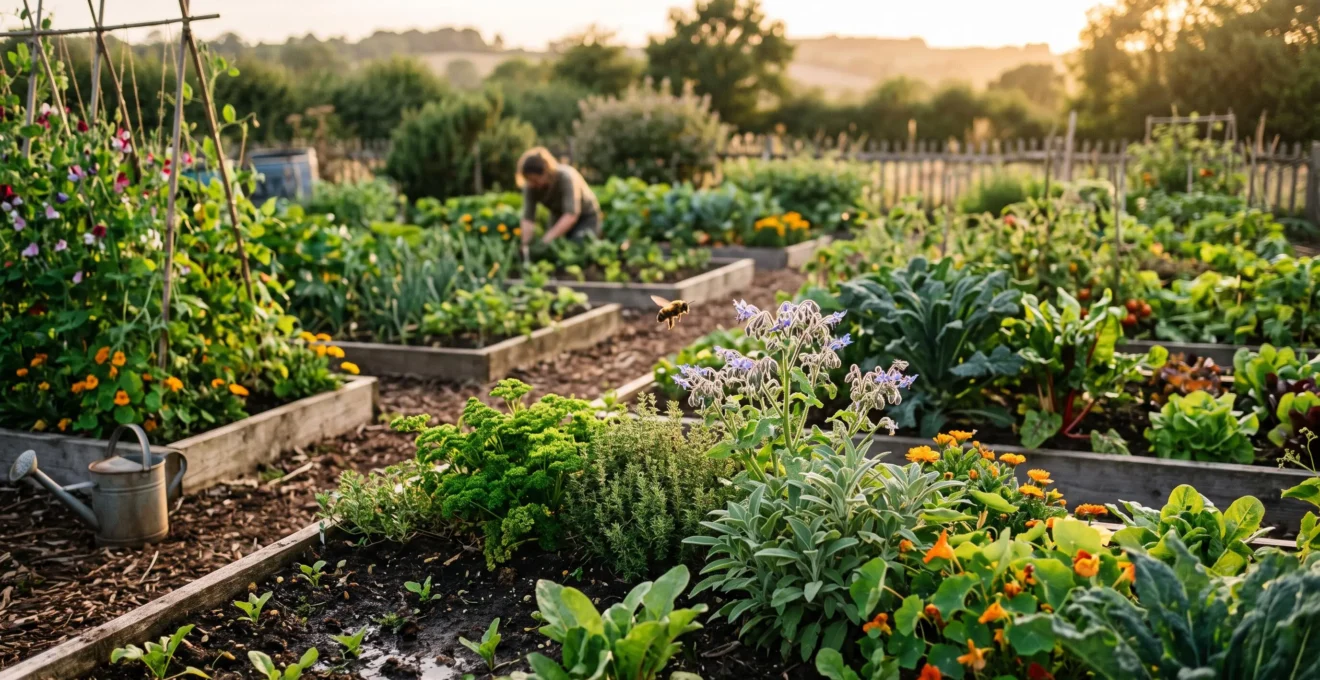
As this border illustrates, integrating flowers directly into or around vegetable beds is far more effective than having a separate flower garden. It puts the food source for adult predators right next to the hunting ground for their pest-eating larvae. Prioritise plants with small, clustered flowers, as their nectar is more accessible to the tiny mouthparts of many beneficial insects. This turns your garden into a permanent habitat, not just a temporary stop.
Biennials vs Perennials: Why Your Foxgloves Didn’t Flower This Year?
A common source of confusion for gardeners is when a plant fails to flower as expected. You may have planted a beautiful foxglove (Digitalis) or a healthy-looking parsley plant, only to see it produce a lush rosette of leaves in its first year and nothing more. This is often not a failure on the gardener’s part, but a fundamental misunderstanding of the plant’s life cycle. The issue lies in the difference between biennials and perennials.
A perennial is a plant that lives for more than two years, typically flowering annually once it reaches maturity. A biennial, however, has a strict two-year life cycle.
- Year One: Vegetative Growth. In its first year, a biennial focuses all its energy on establishing a strong root system and a rosette of leaves. It is building up the energy reserves it will need to reproduce. It will not flower. This is the stage your non-blooming foxglove is in.
- Year Two: Reproductive Growth. After overwintering, the plant uses its stored energy in the second year to bolt—sending up a flower stalk, producing flowers and seeds, and then dying.
Understanding this cycle is crucial for garden planning and pest management. For culinary biennials like parsley and carrots, we harvest them in their first year when their leaves and roots are at their best. If left until the second year, the leaves turn bitter and the root becomes tough and woody as the plant diverts its resources to flowering. For ornamental biennials like foxgloves, Sweet William, and hollyhocks, patience is key. You must plan for their two-year timeline, knowing that the floral display you want will only arrive in the second season. This knowledge prevents you from mistakenly pulling up a “non-performing” plant that is simply following its natural, two-year schedule.
The Seeding Error That Multiplies Weeds by 1000% Next Season
Every gardener battles weeds, but few appreciate the catastrophic, long-term consequences of letting just one or two go to seed. The mistake isn’t just aesthetic; it’s an act of plunging your garden into decades of “seed bank debt.” A single, seemingly harmless weed isn’t just one plant—it’s a factory for future infestations. For instance, weed science research confirms that a single redroot pigweed plant can produce over 250,000 seeds in a season. Allowing that plant to complete its life cycle is equivalent to intentionally scattering a quarter-million weed starters across your beds.
These seeds don’t all germinate at once. They enter the soil’s “seed bank,” where they can lie dormant for years, waiting for the right conditions of light and disturbance to sprout. This is why you can meticulously weed a bed one year, only to see the same weeds reappear the next. You aren’t fighting new invaders; you are fighting the ghosts of weeding mistakes past. The persistence of this debt is staggering. According to data from Michigan State University Extension, it takes roughly three years for a pigweed seed bank to decline by just 50%, and about twenty years to deplete it by 99%.
The single most important principle of weed management, therefore, is preventing seed production at all costs. This means shifting the focus from simply removing visible weeds to interrupting their life cycle *before* they can flower and set seed. This can be done through timely hoeing, hand-pulling, or mulching. It’s a race against the plant’s reproductive clock. Winning this race doesn’t just mean a cleaner garden this year; it means less work and fewer problems for the next two decades.
When to Harvest Herbs: The Chemical Peak for Maximum Flavour
For gardeners growing culinary herbs, timing the harvest is everything. The flavour and aroma of herbs like basil, rosemary, and oregano come from a complex cocktail of volatile organic compounds (VOCs), also known as essential oils. These are the very same secondary metabolites that plants use for defense and communication. The concentration of these oils in the plant’s leaves is not constant; it ebbs and flows throughout the plant’s life cycle, reaching a distinct peak that savvy gardeners can learn to anticipate.
The universal rule is that most herbs reach their absolute peak of flavour and aromatic intensity just before they begin to flower. At this stage, the plant has accumulated the maximum amount of energy and is preparing to divert it into reproduction. It floods its leaves with these powerful chemical compounds as a final defensive push to protect the forthcoming flowers and seeds from pests. Once the plant actually begins to form flowers, it starts redirecting its energy away from the leaves and into the blooms. As a result, the oil concentration in the leaves begins to decline, and the flavour can become weaker or even bitter.
Therefore, the optimal harvest strategy is to monitor your herbs closely as they approach maturity. When you see the first tiny flower buds starting to form, but before they open, it’s time to act. This is the moment of peak chemical potency. Harvesting at this time, preferably in the morning after the dew has dried but before the sun’s heat has begun to dissipate the volatile oils, will ensure you capture the most intense flavour for your kitchen or for drying and preserving.
Larvae vs Adult: Recognizing a Ladybird Larva Before You Squish It?
Every gardener celebrates the sight of a familiar red-and-black ladybird, knowing it’s a sign of a healthy garden. Yet, many of these same gardeners will unknowingly crush the most valuable member of the ladybird family: its larva. The larval stage is the true workhorse of aphid control. While an adult ladybird eats aphids, its primary job is to disperse and reproduce. The larva, on the other hand, does nothing but eat. Looking like a spiny, black, six-legged “miniature alligator,” it is an eating machine, and BBC Gardeners’ World Magazine notes that a single larva can consume up to 100 aphids per day—far more than an adult.
Mistaking this crucial predator for a pest is one of the most common and costly errors in organic gardening. Learning to identify them is a non-negotiable skill. Ladybird larvae are typically elongated, segmented, and often have orange or yellow markings on their dark, bumpy bodies. They are active crawlers, patrolling stems and the undersides of leaves precisely where aphids congregate.
It’s also important to distinguish them from other beneficial larvae, like those of the green lacewing. While both are voracious predators, they have different appearances. A field guide from Cesar Australia highlights a key behavioral clue: lacewing larvae are known for carrying the shrivelled skins of their victims on their backs as a form of camouflage, a habit not seen in ladybird larvae. By learning to recognize these juvenile predators, you protect the most effective pest-control army your garden can have, ensuring a generation of defenders is always on patrol.
The 2-Week Rule: When to Wait for Ladybirds Instead of Spraying?
When you discover an aphid outbreak, the urge to immediately spray—even with an organic solution—can be overwhelming. However, this reactive impulse often does more harm than good. It can wipe out the emerging beneficial insects that were just arriving to handle the problem for you. A more effective, holistic approach is to adopt the “2-Week Rule”: a patience threshold where you tolerate minor pest damage to give natural predators a chance to arrive and establish control.
Pest populations almost always grow faster than predator populations. There’s a natural lag time. The aphids appear first, and their presence is the chemical signal that tells predators like ladybirds and hoverflies, “There is food here; it’s time to lay eggs.” It can take a week or two for those eggs to hatch and for the predatory larvae to start making a noticeable impact on the pest population. If you spray during that lag time, you eliminate the pests, but you also eliminate the food source, causing the adult beneficials to leave. You’ve effectively reset the system to zero, ensuring you’ll have to spray again during the next outbreak.
The Pennsylvania Horticultural Society provides a perfect example of this patience threshold: a single tomato hornworm that has only eaten one branch should be left alone, as it may be a host for beneficial parasitoid wasps. Waiting allows the wasp population to thrive. Deciding when to act versus when to wait requires careful observation. It’s a judgment call based on the health of the plant and the scale of the infestation.
Your 5-Step Pest Assessment Framework
- Familiarize yourself with your garden and the common pests that target your crops so you can spot abnormalities early.
- Learn to recognize the eggs, larvae, pupae, and adult stages to correctly identify pests and beneficials at each point in their life cycle.
- Know when pests typically cause their worst damage during the year and what that specific damage looks like on your plants.
- Positively identify beneficial insects to avoid mistakenly killing them, as they can look very different—and sometimes threatening—as juveniles.
- Combine cultural, physical, and biological methods first, reserving sprays (even organic ones) as an absolute last resort in your integrated approach.
By using this framework, you move from being a firefighter to a strategic observer, allowing the garden’s own immune system to do the heavy lifting.
Key Takeaways
- Effective pest control is proactive, not reactive. It’s about synchronizing your garden’s clock with nature’s cycles.
- Learn to identify all life stages of both pests and beneficial insects; the most valuable predators often look nothing like their adult forms.
- Your primary goal is to build a resilient habitat that provides year-round food and shelter for natural enemies, making your garden a no-go zone for pests.
How to Attract Beneficial Insects to Eat 90% of Your Aphids?
Building a garden that is truly resilient to pests is not about attracting beneficial insects; it’s about *keeping* them there. This requires creating a permanent, self-sustaining habitat that provides for all their life-cycle needs. This approach, known as building an “insectary” or “predator scaffolding,” ensures a standing army of natural enemies is always present, ready to tackle pest outbreaks before they can take hold. The goal is to establish a system so effective that it can naturally manage up to 90% of a pest like aphids without any intervention from you.
This strategy mirrors professional biological control systems. The Royal Horticultural Society (RHS) notes that commercial greenhouses introduce a range of predators like midges, wasps, and lacewing larvae to manage pests. In a home garden, you can achieve the same effect by providing two key resources: alternative food sources and year-round shelter. Predators need pollen and nectar when pests are scarce, and they need safe places like perennial grasses or leaf litter to overwinter. A sterile, hyper-manicured garden offers neither.
To build this habitat, you must plant a diversity of flowers with accessible nectar, especially those with umbrella-shaped clusters (like dill and yarrow) or daisy-like blooms. Bordering your vegetable garden with these flowers provides a continuous food supply right where it’s needed. More advanced strategies include “banker plants,” where you intentionally introduce a non-pest insect (and its specific host plant) that serves as an alternative food source for your predators, keeping their populations high even before the target pests arrive. By thinking like an ecosystem architect, you are creating a garden that is not just productive, but alive with its own defenses.
Start observing your garden’s natural rhythms today. By shifting your perspective from reactive spraying to proactive, ecological partnership, you can cultivate a truly resilient and abundant space that works with nature, not against it.