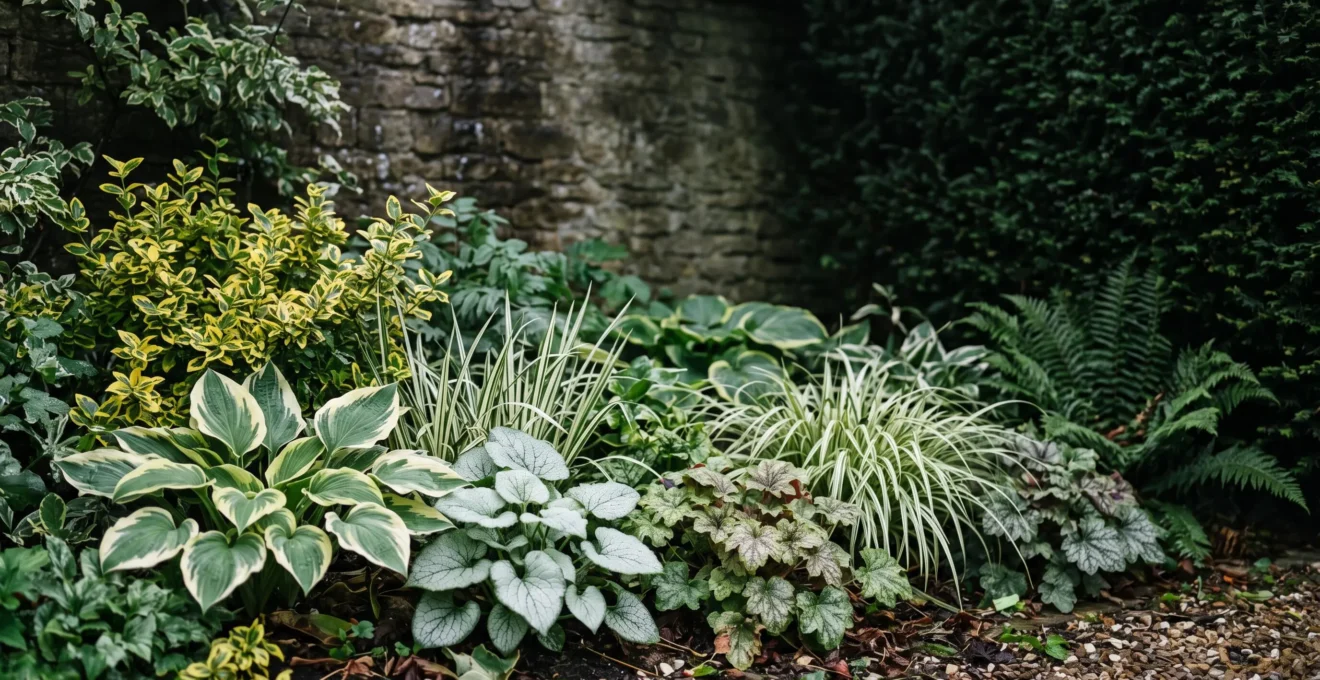
The common struggle with dark, north-facing gardens isn’t a lack of flowering options, but a misunderstanding of how to manipulate light. Instead of just planting what survives, this guide reveals the science behind variegation. By understanding the photosynthetic trade-offs, how different colours reflect light, and the genetic stability of patterns, you can strategically use foliage to not just brighten, but truly illuminate your shadiest corners with purpose and lasting effect.
For gardeners blessed with mature trees or cursed with a north-facing wall, the battle for brightness is a familiar one. We’re often told the solution lies in a handful of shade-loving perennials, leading to gardens that feel more like a collection of survivors than a deliberate design. The conventional wisdom is simple: where flowers fail, use interesting leaves. But this advice barely scratches the surface of a far more powerful concept.
What if the key wasn’t just finding plants that tolerate shade, but selecting plants that actively manipulate and reflect the low light they receive? This is the true potential of variegated foliage. It’s a tool for painting with light itself. The splashes, stripes, and margins of white, cream, yellow, and silver on a leaf are more than just decoration; they are areas where the plant has sacrificed its energy-producing chlorophyll. This creates a fascinating paradox: plants that are less efficient at photosynthesis are often our greatest allies in the quest for visual brightness.
This article moves beyond a simple list of “good shade plants.” Instead, we will explore the science that makes variegated foliage work. We will delve into why some colours appear to glow at dusk, why that coveted white edge is prone to sunburn, and how to choose plants whose beautiful patterns won’t simply revert to plain green after a single season. By understanding these principles, you can transform your shady spots from problems to be solved into canvases for sophisticated, light-filled design.
To navigate this journey from dim corners to luminous landscapes, we’ve structured this guide to build your expertise from the ground up. Discover the core principles and practical applications that will change how you see your shade garden forever.
Summary: Using Vibrant Variegated Foliage to Light Up North-Facing Gardens
- Why Variegated Plants Need More Light Than Green Ones (Usually)?
- White or Gold: Which Variegation Stands Out Best in Twilight?
- The Sunburn Risk: Why White Variegation Burns in Midday Sun?
- Euonymus vs Dogwood: Which Variegated Shrub Keeps Its Pattern Best?
- Nitrogen Levels: Can High Feeding Reduce Variegation Intensity?
- Ferns or Hostas: Which Species Photosynthesizes Better in Deep Shade?
- Black Grasses and Silver Foliage: The Ultimate Modern Contrast?
- Creating High Visual Contrast: The ‘Thriller, Filler, Spiller’ Rule for Borders
Why Variegated Plants Need More Light Than Green Ones (Usually)?
The core of variegation lies in a fascinating biological trade-off. The green in a leaf comes from chlorophyll, the pigment that powers photosynthesis. The white, cream, or yellow parts of a variegated leaf are beautiful precisely because they lack this pigment. This creates what can be called a photosynthetic compromise. With less chlorophyll, the plant has a smaller “engine” to convert sunlight into energy. This has several direct consequences for the gardener.
Because of this reduced capacity for energy production, variegated plants are often less vigorous than their all-green counterparts. As Mike, a plant expert at Costa Farms, explains, “They have less chlorophyll so they need higher indirect sunlight and longer periods of the same light.” This is the crux of the paradox: to compensate for their inefficiency, they need more exposure to gentle light. An all-green plant can thrive in deeper shade because every square centimetre of its leaves is working at peak efficiency. A variegated plant in that same deep shade may struggle or even die.
This slower, more challenging growth cycle is also why variegated plants are often more expensive. Their propagation can be slower and less reliable. In fact, research suggests that due to this non-photosynthetic tissue, a variegated plant typically grows at only half to a third of the rate of its all-green counterpart. Understanding this energy deficit is the first step to providing the right care and placement.
White or Gold: Which Variegation Stands Out Best in Twilight?
In the low, ambient light of a shady garden, not all colours are equal. While a golden-variegated Hosta might look spectacular at noon, it can seem to vanish into the gloom at dusk, while a silver-leafed Brunnera next to it begins to glow with an ethereal light. This isn’t an illusion; it’s a well-documented optical phenomenon known as the Purkinje effect. This effect describes how the human eye’s sensitivity shifts towards the blue end of the spectrum in low-light conditions.
As evening approaches, our colour-perceiving cone cells become less effective, and our more light-sensitive rod cells take over. These rod cells see the world in monochrome and are most sensitive to blue-green light. Consequently, as a scientific source from Britannica explains, in dim light, blue and green objects appear brighter than they do in full daylight, while reds and yellows appear much darker and less distinct. For the gardener, this means that foliage with silver, white, or blue-toned variegation will be far more effective at “lighting up” the garden during the twilight hours of morning and evening—precisely when a shade garden is most often viewed.
This is the secret to creating a “moon garden”—a space designed to be at its most beautiful in low light. Plants with silvery or white foliage, like Brunnera ‘Jack Frost’ or Pulmonaria, reflect what little blue-toned ambient light is available, appearing to luminesce against the darkening backdrop.
As you can see in the image, the silvery-white leaves catch the fading light, creating points of high contrast that draw the eye. Golden or chartreuse foliage, while wonderful for brightening shady spots in the middle of the day, simply cannot compete with this twilight performance. For maximum impact, a strategic combination of both can provide interest throughout the day.
The Sunburn Risk: Why White Variegation Burns in Midday Sun?
While variegated plants need more light to compensate for their lack of chlorophyll, there is a fine line between bright shade and scorching sun. The very tissues that make a plant beautifully variegated—the white, cream, or yellow sections—are its Achilles’ heel. These areas lack the protective pigment of chlorophyll and are essentially “naked” to the sun’s intense rays. This makes them extremely susceptible to leaf scorch or sunburn.
Think of chlorophyll as the plant’s built-in sunblock. It not only captures light for energy but also helps dissipate excess radiation. Without it, the delicate cells in the variegated sections are easily damaged by the combination of intense light and heat. As the team at Folia Collective notes, “Short periods of direct sun in the earlier parts of the day are usually fine for variegated plants, but too many hours of it… can be too much for that sensitive white tissue.” This is why the ideal location for most variegated plants is one that receives gentle morning sun and is protected from the harsh, direct sun of the afternoon.
A plant suffering from sun scorch will develop brown, dry, or crispy patches on the lightest parts of its leaves. This damage is irreversible for the affected leaf and is a clear sign that the plant needs to be moved to a more sheltered location. Managing this balance of light is crucial for keeping variegated plants looking their best.
Action Plan: Keep Variegated Shrubs Looking Fresh
- Site Wisely: Avoid harsh afternoon sun. Choose a location with access to morning sun and shade during the hottest part of the day.
- Fertilize with Care: Use a balanced, slow-release fertilizer. Too much nitrogen can reduce variegation by encouraging green growth.
- Prune Green Reversions: Promptly cut back any solid green shoots that appear to maintain the plant’s variegated patterns.
- Conserve Soil Moisture: Apply a layer of arborist mulch around the base to help keep the soil cool and retain water, reducing overall stress.
- Reduce Environmental Stress: Plant in sheltered areas to prevent fading and damage from strong wind, drought, or extreme heat.
Euonymus vs Dogwood: Which Variegated Shrub Keeps Its Pattern Best?
One of the most common frustrations for gardeners who invest in variegated plants is “reversion”—the tendency for a plant to produce all-green shoots. Suddenly, your beautifully patterned shrub has an aggressive, solid green branch taking over. This isn’t the plant being difficult; it’s a battle for survival at a genetic level. The all-green growth, with its full complement of chlorophyll, is more vigorous and can quickly outcompete the less efficient variegated parts. As the HGTV editorial team warns, “if left unchecked, it may eventually outcompete the variegated branches and overtake the shrub.”
The tendency to revert is linked to a plant’s genetic stability. Many variegated plants are “chimeras,” meaning they are composed of two or more genetically distinct types of tissue. If the more vigorous, all-green tissue is allowed to grow, it will dominate. The key is to prune these reversions out immediately, tracing them back to their origin point and cutting them off completely. However, some plants are simply more stable than others.
When choosing a shrub for a key location, understanding its propensity for reversion is crucial. A highly unstable plant may require constant maintenance to keep its pattern, while a stable one offers reliable colour with minimal fuss. The Royal Horticultural Society provides a useful framework for understanding this stability.
| Stability Category | Example Cultivar | Reversion Risk | Key Trait |
|---|---|---|---|
| Highly stable | Euonymus fortunei ‘Emerald ‘n’ Gold’ | Low | Evergreen, dense, reliable margin variegation |
| Moderately stable | Cornus alba ‘Elegantissima’ | Moderate | Deciduous; needs regular inspection for green shoots |
| Prone to reversion | Some variegated Acer palmatum selections | High | Chimeral variegation, frequent green sporting |
As this comparative analysis from the RHS shows, a classic like Euonymus ‘Emerald ‘n’ Gold’ is a low-maintenance workhorse, while a variegated Dogwood like ‘Elegantissima’ requires a more watchful eye. Understanding this before you buy can save a lot of future disappointment and pruning work.
Black Grasses and Silver Foliage: The Ultimate Modern Contrast?
Once you master the use of variegated foliage to add light, the next level of garden design is to use it to create powerful contrast. Nothing makes a bright object appear brighter than placing it next to something dark. This is where the dramatic, deep tones of black or near-black plants come into play. Pairing them with shimmering silver or white variegated foliage creates a visual dynamism that is both modern and incredibly striking.
The dark foliage of a plant like Black Mondo Grass (Ophiopogon planiscapus ‘Nigrescens’) acts as a “visual sink,” absorbing light and creating a void of colour. When a silver-leafed plant like Brunnera macrophylla ‘Jack Frost’ or the fuzzy leaves of Stachys byzantina (Lamb’s Ear) is planted nearby, the effect is electric. The silver leaves seem to leap out from the composition, their brightness amplified by the darkness of their companion. This isn’t just about colour; it’s about playing with light and shadow on a micro-level.
This high-contrast strategy is particularly effective in shady areas, where the muted light can cause less distinct colour combinations to merge into a green blur. The stark opposition of black and silver provides clarity and a strong focal point. It’s a technique that also emphasizes form and texture.
As this close-up view demonstrates, the contrast is not just in colour but also in texture and form. The fine, linear blades of the grass are a perfect foil for the broad, soft texture of the silver leaf. This multi-sensory contrast adds a layer of sophistication and interest that holds up even on close inspection, proving that a garden without flowers can still be rich with detail and visual excitement.
Ferns or Hostas: Which Species Photosynthesizes Better in Deep Shade?
When we venture into the deepest, darkest corners of the garden, the conversation shifts from variegation to pure survival. Here, plants employ different strategies to capture every last photon of light. Two champions of the deep shade, ferns and hostas, exemplify these different approaches. Declaring one “better” than the other is less useful than understanding their distinct survival toolkits.
Ferns are ancient masters of the low-light world. Many species, like the Japanese Painted Fern (Athyrium niponicum), have incredibly thin fronds. This structure minimizes the amount of energy and resources needed to build the leaf, allowing the plant to create a large surface area for light capture with minimal investment. Their complex, dissected fronds are perfectly designed to catch light filtering down from multiple angles through a forest canopy. Some deep-shade ferns also possess a higher concentration of chlorophyll b, a type of chlorophyll that is particularly efficient at absorbing the blue-green wavelengths of light that dominate in heavily shaded environments.
Hostas, on the other hand, often employ a different strategy: the broad leaf. Varieties like Hosta ‘Sum and Substance’ can produce enormous leaves that act like giant solar panels, maximizing the area available to catch any dappled light that breaks through. Blue-leafed hostas take this a step further with a waxy, glaucous coating that can help reflect excessive UV radiation while manipulating the light that reaches the leaf cells. Furthermore, research into plant pigments shows that even subtle changes can have a big impact; a 2023 study on variegated leaves found that the accumulation of other pigments is linked to measurable changes in electron transport efficiency, showcasing how a plant’s entire energy system adapts to its available light.
Nitrogen Levels: Can High Feeding Reduce Variegation Intensity?
You’ve found the perfect variegated plant, sited it beautifully, and want to give it the best care possible. A common impulse is to feed it generously to encourage lush growth. However, this can be counterproductive. One of the most common reasons a healthy variegated plant begins to lose its distinct patterning and become “muddy” or more green is over-fertilization, specifically with high-nitrogen feeds.
Nitrogen is the primary nutrient that fuels leafy, green growth. When a plant receives an abundance of nitrogen, its internal programming kicks in to take full advantage of it. It prioritizes creating the most efficient photosynthetic tissue possible—which is solid green tissue. The plant’s “energy budget” shifts. It diverts resources away from maintaining the less-efficient, genetically complex variegated sections and pours them into producing simple, fast-growing green leaves. In essence, you are telling the plant that it’s a time for rapid growth, not for maintaining its fancy patterns.
As the experts at Foliage Factory point out, a key cause of reversion is “Overfeeding: strong nitrogen-heavy feeding can encourage fast green growth rather than balanced colour.” To maintain crisp, clear variegation, a more restrained approach is needed. Opt for a balanced, slow-release fertilizer rather than a liquid, high-nitrogen one. This provides a steady, gentle supply of all necessary nutrients without sending the plant into a green-growth frenzy. Often, amending the soil with good quality compost once a year is all that’s required.
Key Takeaways
- The Photosynthetic Compromise: Variegated plants trade energy-producing chlorophyll for visual pattern, making them slower growing and requiring more indirect light than their green counterparts.
- The Power of the Purkinje Effect: For gardens viewed at dawn or dusk, silver and white-variegated foliage will appear to glow, while yellow and gold tones will fade into the gloom.
- Managing Genetic Stability: Many variegated plants are prone to “reversion.” Choose stable cultivars and be prepared to promptly prune out any all-green shoots to maintain the plant’s pattern.
Creating High Visual Contrast: The ‘Thriller, Filler, Spiller’ Rule for Borders
Now that we’ve explored the science of light, colour, and genetics, it’s time to bring these elements together into a cohesive design. One of the most effective and time-tested methods for designing a garden border or container is the “Thriller, Filler, Spiller” rule. This simple framework helps create arrangements with balance, rhythm, and a clear focal point, and it works exceptionally well when using the diverse forms of variegated foliage.
The components are straightforward:
- The Thriller: This is the main event—a tall, upright, and attention-grabbing plant that provides a strong vertical accent. In a variegated shade garden, this could be a tall, upright grass like Calamagrostis x acutiflora ‘Overdam’ or a structurally elegant shrub like a variegated Pieris.
- The Filler: These are mounding plants that surround the thriller and fill out the middle ground. Their job is to make the composition feel full and lush. This is the perfect role for the vast world of variegated Hostas, Brunnera, or Heuchera, which provide a mass of colourful foliage.
- The Spiller: These are low-growing, trailing plants that spill over the edge of the border or container, softening the edges and connecting the design to the ground. Variegated Lamium, Vinca minor, or Lysimachia nummularia ‘Aurea’ (Creeping Jenny) are excellent choices for this role.
By applying this rule, you move beyond simply dotting plants around and start creating intentional, structured vignettes. Imagine a large pot for a shady patio: a variegated Dogwood (Thriller) rising from the centre, surrounded by the broad, patterned leaves of a Hosta (Filler), with the golden chains of Creeping Jenny (Spiller) trailing over the side. This simple recipe creates a complete, professional-looking composition that provides interest in colour, form, and habit.
Look at your shady spots not as problems, but as canvases. Armed with an understanding of light, genetics, and design, you can transform them into the most sophisticated and visually compelling part of your garden. The next step is to go outside, observe your light, and begin painting.