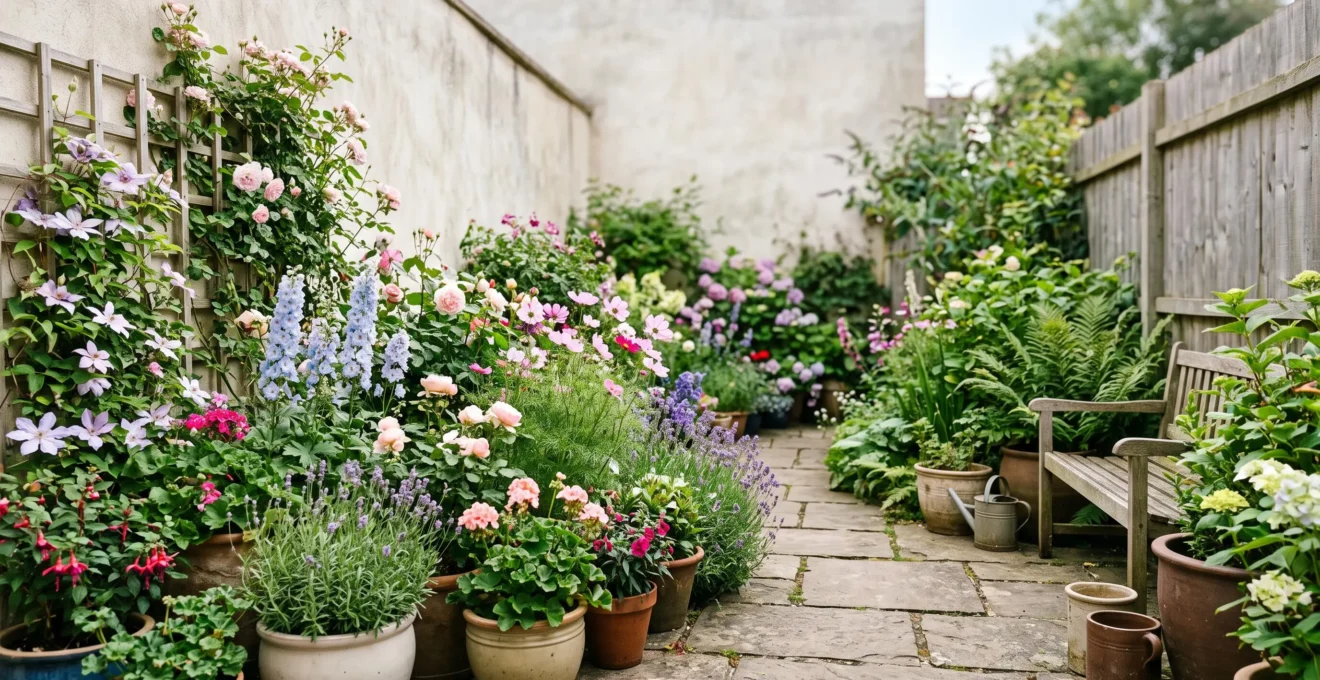
The secret to a six-month floral display isn’t a list of ‘magic’ plants, but understanding the hidden genetic traits that guarantee superior performance.
- Sterile cultivars redirect their energy from seed production into non-stop flowering, providing colour for months.
- Stable variegated plants and correctly pruned climbers ensure visual interest and flowers at eye-level, crucial for small spaces.
Recommendation: Look beyond the flower colour on the plant label and investigate a cultivar’s stability, sterility, and structural habit before you buy.
For the owner of a small UK courtyard, every plant must justify its existence. With space at a premium, there’s no room for fleeting performers or botanical disappointments. The common advice is to seek out long-flowering perennials, and you’ll often be handed a list of the usual suspects: Geraniums, Salvias, and Penstemons. While these are excellent starting points, this approach barely scratches the surface. It’s like recommending “a red car” to someone who needs a high-performance vehicle for a specific track; the make, model, and engine are what truly matter.
The real art of the plant hunter lies in looking deeper, beyond the simple species name, to the specific cultivar. It’s about understanding the horticultural engineering that separates a plant that blooms for six weeks from one that performs for six months. Many gardeners rely on logos like the RHS Award of Garden Merit (AGM) as a shortcut to quality, but even this isn’t the whole story. True garden value comes from understanding a plant’s hidden engine: its genetic predisposition for extended blooming, its stability, and its growth habit.
This isn’t about finding a secret list of plants. It’s about learning a new way to see them. Instead of merely choosing plants, we will deconstruct them. We will explore the critical, often invisible, traits that define a truly hard-working cultivar. This guide will equip you with the knowledge to look past the pretty flower and assess the core performance metrics of a plant, from the science of sterility to the structural integrity of a climber. By understanding these principles, you can curate a small garden that delivers an unbroken spectacle of colour and form, not just for a season, but for the better part of the year.
This article provides a framework for selecting exceptional plants. The following sections break down the key concepts that empower you to make curated, intelligent choices for your garden.
Summary: Decoding High-Performance Cultivars for Non-Stop Colour
- RHS AGM: Does the Logo Really Guarantee Better Performance?
- Why Sterile Cultivars Bloom Longer Than Fertile Ones?
- Variegated Reversion: Why Your Cultivar is Turning Green Again?
- Patio Clematis vs Climbers: Which Cultivar Actually Flowers at Eye Level?
- When to Buy: Getting the Best Cultivars Before Nurseries Sell Out?
- Sequencing Your Planting: How to Hide Dying Foliage With New Growth
- Pot Size Matters: When to Buy Mature Specimens for Instant Softening?
- Herbaceous Species or Shrubs: Which Offers Better Value for Small Borders?
RHS AGM: Does the Logo Really Guarantee Better Performance?
The Royal Horticultural Society’s Award of Garden Merit (AGM) is the UK’s most recognised indicator of a reliable garden plant. For many, seeing the familiar trophy symbol on a plant label is an instant seal of approval. The award signifies that a plant has been judged by experts to have a good constitution, stability, and excellent performance for general garden use. The RHS runs extensive, side-by-side trials to assess plants against a strict set of criteria, ensuring that an AGM plant is reasonably pest-resistant and widely available to buy. This process provides a fantastic baseline for quality.
However, the discerning plant hunter knows this is a starting point, not a conclusion. The award is a filter, not a guarantee of suitability for your specific, unique space. Specialist nurseries are quick to point out the limitations of the system. As experts at Frank P Matthews note, “These trials are undertaken with a limited range of plants, chosen for comparative purposes, and not necessarily conducted on a wide range of site and soil situations.” An AGM-winning plant that thrived in the loamy soil of RHS Garden Wisley might not perform as well in a windy, north-facing London courtyard in a container.
Therefore, the AGM should be seen as the first step in your curation process. It tells you a plant is not a dud. It confirms its genetic stability and general vigour. But it doesn’t tell you if its growth habit will overwhelm your small border, if its colour will clash with your brickwork, or if its flowering height is right for your sightlines. The AGM gets you in the door, but you still need to inspect the room. It’s a tool for eliminating poor choices, leaving you free to apply a more personal and site-specific level of scrutiny.
Why Sterile Cultivars Bloom Longer Than Fertile Ones?
One of the most powerful engines for a long flowering season is a trait you can’t see on a label: sterility. A fertile plant’s primary biological goal is to reproduce. It flowers, gets pollinated, and then immediately diverts its energy into producing seeds. Once that mission is complete, the flowering impulse often wanes or stops entirely. A sterile cultivar, however, is a plant trapped in a beautiful loop of frustration. It cannot produce viable seed, so it keeps on flowering in a relentless attempt to achieve its reproductive goal. This “glitch” in its genetic programming is a huge boon for gardeners, resulting in a floral display that can last for months on end.
The classic example is Geranium ‘Rozanne’, an AGM winner famous for blooming from June to the first frosts. Its secret is its sterility. It never sets seed, so it pours all its resources into making more and more of its vibrant violet-blue flowers. This is the genetic engine behind many of the longest-blooming perennials. While some gardeners worry that sterile plants offer nothing to pollinators, this isn’t always the case. A multi-year study on bee-plant interactions found that some sterile cultivars are still highly attractive because they produce nectar, even if they can’t produce pollen or seed. An extended nectar supply from sterile plants can provide a valuable, long-lasting food source for bees, especially later in the season.
However, not all sterile flowers are created equal. The plant hunter must distinguish between beneficial single-flowered sterility and problematic double-flowered forms. As the Xerces Society notes:
If it has double blooms it’s an absolute no-no as they prohibit pollinators from accessing the pollen or nectar, and are almost always sterile.
– Xerces Society, Picking Plants for Pollinators: The Cultivar Conundrum
These highly-bred “double” flowers have so many petals that bees and other insects simply can’t access any nectar that might be present. For a small, wildlife-friendly courtyard, the ideal long-blooming plant is a single-flowered sterile cultivar—one that offers a marathon of colour for you and a reliable food source for pollinators.
Variegated Reversion: Why Your Cultivar is Turning Green Again?
Variegated plants, with their patterned leaves of green, cream, white, or yellow, are invaluable in small gardens. They provide light, texture, and interest even when not in flower. However, these beautiful cultivars often carry a genetic instability known as a chimera. A variegated plant is essentially two different sets of genetic tissue—one that can produce chlorophyll (the green part) and one that cannot (the white or yellow part)—growing together in one plant. The green tissue is always more vigorous because it can photosynthesise more effectively.
This is why many variegated plants have a tendency to ‘revert’. Under stress, or sometimes just by chance, the stronger green tissue can take over, producing all-green shoots. If left unchecked, these reverted shoots will outcompete the more delicate variegated growth, and your beautifully patterned plant will eventually become a plain green one, losing the very quality you chose it for. This is a common fate for prized plants like variegated Euonymus, Cornus, and Pittosporum.
Managing this is a crucial skill for maintaining your investment. The key is vigilance and swift action. As the RHS advises, you must remove this growth immediately and decisively. They make it clear that half-measures are not enough:
Shoots that have reverted are much more vigorous than the variegated one and should be pruned out completely or cut back into wood containing variegated foliage.
– RHS (Royal Horticultural Society), Reversion in Plants — RHS Advice
This isn’t just a tidy-up; it’s essential surgery to preserve the plant’s unique character. By consistently removing the dominant green growth, you ensure the variegated parts have the light and resources they need to thrive. For any owner of a variegated shrub or perennial, this regular inspection and pruning is non-negotiable.
Action Plan: How to Prune Out Reverted Green Growth
- Inspect Regularly: Check your variegated plants for any shoots that have turned fully solid green, with no pattern remaining.
- Prune Early: Cut out these fully green shoots as soon as you see them, before the reversion spreads further down the stem.
- Cut Back Hard: Trace the green shoot back to its origin and cut it back to a node that is still producing balanced, variegated growth.
- Avoid High Nitrogen: Be cautious with fertilisers high in nitrogen, as they can encourage vigorous, leafy growth that favours the stronger green tissue.
- Maintain Stable Conditions: Drastic changes in water, light, or temperature can stress the plant, prompting it to rely on its most vigorous green growth for survival.
Patio Clematis vs Climbers: Which Cultivar Actually Flowers at Eye Level?
In a small courtyard, vertical space is a precious asset. Clematis are often the go-to choice for clothing walls and fences with colour. However, many gardeners are disappointed when their vigorous climber produces a glorious cloud of flowers 10 feet up, leaving a tangle of bare, woody stems at eye level. This “bare legs” phenomenon is common with certain types of Clematis, particularly the larger-flowered hybrids from Pruning Group 2. These varieties flower primarily on the previous year’s mature wood, meaning the display gets higher and further away each season.
For a small space where every inch counts, the key is to select a cultivar that flowers on new growth, ensuring the blooms are produced from the base of the plant upwards, right where you can appreciate them. This is the domain of Pruning Group 3 Clematis. These varieties are cut back hard almost to the ground each late winter. They then produce all their flowers on the fresh shoots that grow in the current season. This annual reset keeps the plant compact and guarantees flowers at a lower, more human scale.
Many modern breeding programmes have focused specifically on developing compact, Group 3 cultivars marketed as “Patio Clematis.” These are not a distinct botanical group but rather a selection of naturally less vigorous varieties perfect for pots and small obelisks. They offer the flower power of their larger cousins but in a manageable package, ensuring colour is delivered at eye level, not two storeys up.
Understanding the different pruning groups is therefore less about maintenance and more about predicting a plant’s structural behaviour. For a small courtyard, choosing a Group 3 or dedicated patio cultivar is a strategic decision that guarantees a high-impact display in a confined space. This following comparison, based on established horticultural principles, clarifies the differences.
| Pruning Group | When It Flowers | Wood Type | Typical Pruning Need | Risk of ‘Bare Legs’ |
|---|---|---|---|---|
| Group 1 | Early spring | Previous season’s wood | Minimal — remove dead wood only | Low, but can get leggy over years |
| Group 2 | Mid/late spring, light rebloom in summer | Previous year’s wood, then new growth | Light tidying, deadwood removal | High — flowers cluster on old upper wood |
| Group 3 | Mid-summer through fall | Entirely new wood (current season) | Hard cut-back nearly to the ground each year | Low — new growth from the base flowers at lower heights |
When to Buy: Getting the Best Cultivars Before Nurseries Sell Out?
The search for superior cultivars is also a matter of timing. The most common way to buy plants is to visit a garden centre in May, enticed by benches groaning with colourful, flowering specimens. This is, paradoxically, often the worst time to find the best plants. By late spring, general garden centres have stocked up on mass-produced, common varieties that look good in a 2-litre pot. The more unusual, highly sought-after cultivars from specialist nurseries are often long gone, having been sold as small, non-flowering plugs or bare-root plants months earlier.
The dedicated plant hunter operates on a different calendar. The work begins in the depths of winter. This is the time to browse the catalogues and websites of specialist nurseries—those that focus on a particular plant type like Hostas, Hemerocallis, or grasses. Many of these growers offer pre-orders for delivery in early spring. By ordering in January or February, you secure access to a far wider and more interesting range of plants before they sell out to the wider public. You may receive a small, dormant plant, but it will be the exact, superior cultivar you sought.
Another key strategy is to visit gardens that hold a National Plant Collection. These are living libraries of specific plant groups, impeccably curated and labelled. Seeing a mature specimen of a cultivar in a real garden setting gives you a far better sense of its true size, habit, and presence than a photo in a catalogue ever could. It allows you to assess its performance metrics first-hand. Many of these gardens sell small plants propagated from their collection, offering a direct route to obtaining a proven, high-quality specimen. Acting like a hunter means doing your reconnaissance and securing your prize before the crowds descend.
Sequencing Your Planting: How to Hide Dying Foliage With New Growth
In a small border, there is no “back” to hide in. Every plant is in the front row. This presents a challenge with certain high-impact plants, particularly spring bulbs and some early-flowering perennials. Alliums, for example, produce magnificent spherical blooms in May and June, but their foliage starts to yellow and die back unattractively just as the flowers reach their peak. Similarly, the glorious Oriental Poppies (Papaver orientale) put on a spectacular, brief show before their large leaves collapse into a messy heap, leaving a conspicuous gap in your planting scheme.
The solution is not to avoid these plants, but to employ a technique called succession planting. This involves strategically placing later-emerging plants next to the early performers. The new growth of the “successor” plant rises up just in time to mask the decaying foliage of its predecessor. It’s a carefully choreographed relay race where one plant hands the baton of interest to the next. For instance, planting a clump of a late-starting ornamental grass like Hakonechloa macra or a sturdy perennial like Sedum ‘Herbstfreude’ in front of your Alliums will ensure their fresh foliage grows up to hide the Alliums’ unsightly leaves.
Another effective pairing is to plant a robust, mound-forming perennial like Geranium ‘Rozanne’ or Alchemilla mollis around the base of Oriental Poppies. As the poppy foliage begins to fail, the geranium’s sprawling growth will surge forward to cover the gap. This isn’t just about hiding ugliness; it’s about creating a dynamic, evolving display that offers layers of interest throughout the seasons. It transforms a potential eyesore into a seamless transition, ensuring your small border looks intentional and lush from spring through to autumn. This level of planning is what elevates a simple collection of plants into a cohesive and hard-working garden.
Pot Size Matters: When to Buy Mature Specimens for Instant Softening?
When creating a garden in a small courtyard, you are often dealing with an abundance of hard surfaces: brick walls, stone paving, and wooden fences. One of the primary roles of plants in this context is to “soften” these hard lines and provide an immediate sense of lushness and life. This is where the strategic purchase of a few mature specimens can have a transformative impact. While buying small, young plants in 9cm or 1-litre pots is the most economical approach, it can take several seasons for them to reach a size where they make a real visual statement.
For instant impact, investing in a few larger plants in 5, 10, or even 20-litre pots is a sound strategy. A single, well-placed, mature evergreen shrub like a Pittosporum tenuifolium ‘Tom Thumb’ or a large, architectural fern like Dryopteris wallichiana can immediately anchor a corner and provide year-round structure. The effect is instantaneous. The cost is significantly higher, but you are essentially buying time. When your goal is to quickly soften a harsh new patio or screen an unsightly view, the value of a mature plant is measured not just in its price, but in the immediate quality of life it brings to the space.
However, the plant hunter is wary. When buying large specimens, it is crucial to check that the plant is not pot-bound. Slide the plant partially out of its container to inspect the rootball. A healthy root system will show plenty of white, active roots, but they should not be a solid, congested mass circling the bottom of the pot. A severely pot-bound plant will struggle to establish itself once planted out, negating the benefit of its mature size. The choice of pot size is therefore a calculated trade-off between budget, patience, and the urgent need for a softening effect. A balanced approach often works best: invest in one or two large “hero” plants for instant structure and fill in around them with smaller, more economical plants that will mature over time.
Key Takeaways
- The RHS AGM logo is a reliable starting filter for quality, but not a guarantee of suitability for your specific microclimate.
- Sterile, single-flowered cultivars are genetic powerhouses, blooming for months because they cannot set seed.
- Active management, such as pruning reverted green shoots on variegated plants and choosing the correct pruning group for climbers, is essential for long-term performance.
Herbaceous Species or Shrubs: Which Offers Better Value for Small Borders?
The final strategic decision for a small border comes down to the fundamental choice between the two main types of plants: herbaceous perennials and shrubs. Each offers a different kind of value, and the right balance is crucial for a space that needs to perform year-round. Shrubs, both deciduous and evergreen, are the “bones” of the garden. They provide permanent structure, height, and form. An evergreen shrub like Sarcococca confusa offers glossy leaves all year and highly scented winter flowers, while a deciduous Hydrangea paniculata provides a robust framework even in winter, plus massive summer blooms.
Herbaceous perennials, on the other hand, are the source of seasonal dynamism and explosive colour. They emerge in spring, reach a crescendo of flowers in summer, and then die back to the ground in autumn. They are the thrilling theatre of the garden, but they leave a void in winter. Relying solely on perennials can leave a small courtyard feeling empty and bare for almost half the year. Conversely, a garden composed only of shrubs can feel static and lack the vibrant, changing display that makes a garden feel alive.
For a small border, the best value comes not from choosing one over the other, but from integrating them. The most effective approach is to use a matrix of structural shrubs to create a permanent framework of interest. This might be a low hedge of Hebe, a few clipped box balls, or a single specimen evergreen. Then, you weave the herbaceous perennials through this matrix. The shrubs provide a backdrop for the perennials’ summer show and, crucially, maintain visual interest in winter when the perennials are dormant. This combination offers the best of both worlds: the steadfast presence of shrubs and the ephemeral magic of perennials, ensuring your small border delivers value in every season.
By moving beyond simple plant lists and learning to decode the performance traits of individual cultivars, you can assemble a collection of plants that work tirelessly for you. The next logical step is to start building your own curated list, using these principles to vet candidates for your unique space.