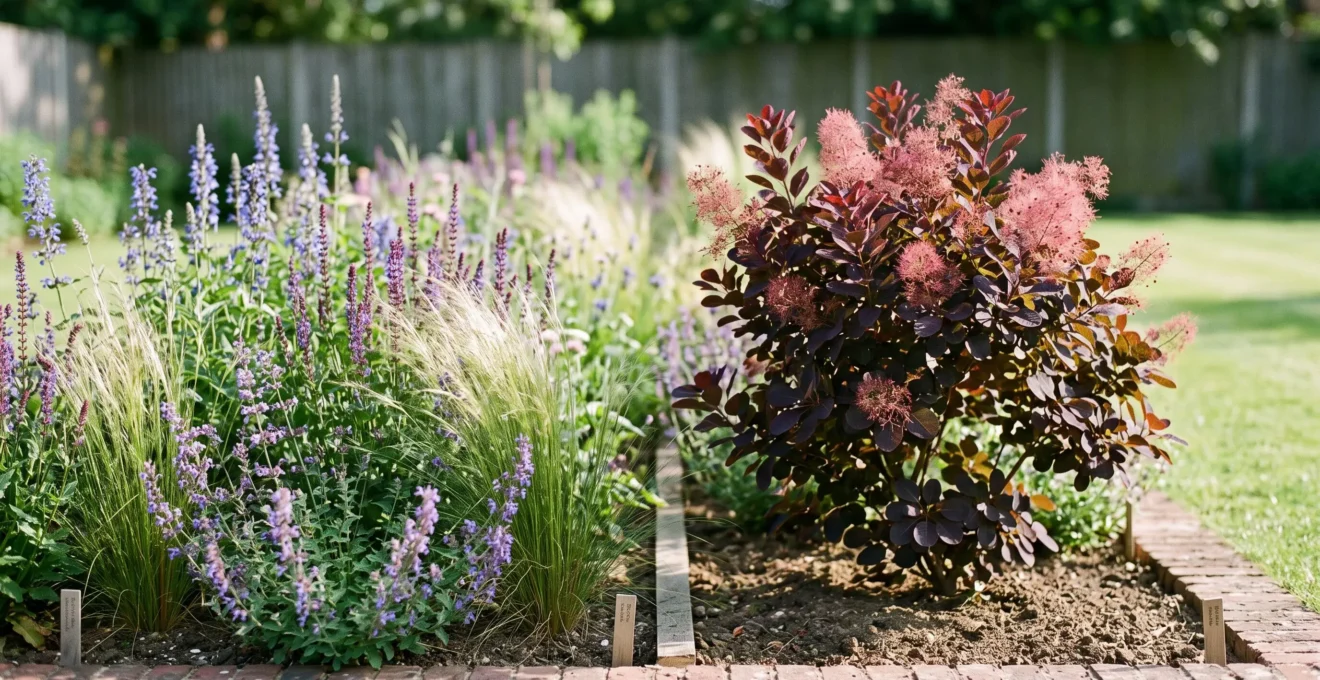
The belief that shrubs offer superior ‘value’ through permanent structure in small gardens is a costly misconception.
- Herbaceous perennials actively build healthy soil through their annual cycle of growth and decay, a crucial benefit for poor-quality new-build soil.
- Their dynamic nature allows for sophisticated layering of textures and sequential flowering, creating greater visual density and interest than static shrubs.
Recommendation: Prioritise herbaceous plants as the primary ‘engine’ of your small border design for faster impact, better soil health, and more adaptable, long-term value.
For owners of new-build homes, the challenge of a small garden is often compounded by poor soil and a desire for immediate impact on a pragmatic budget. The default advice often presents a stark choice: shrubs for “year-round structure” or herbaceous perennials for “seasonal colour.” This dichotomy is a common platitude that, while simple, overlooks the most critical factor for a thriving small space: creating a living, dynamic system. Choosing between a woody shrub and a soft-stemmed perennial isn’t just an aesthetic decision; it’s a strategic one that determines the long-term health and perceived size of your garden.
While the appeal of an evergreen shrub’s constant presence is understandable, it represents a static solution to a dynamic challenge. The real secret to maximising value in a small border lies in rethinking the role of herbaceous plants. What if their annual collapse wasn’t a flaw to be tidied away, but the very engine of your garden’s success? This guide will demonstrate that by embracing the life cycle of herbaceous perennials—their collapse, their textures, their sequential growth—you can achieve a far richer, more valuable, and ecologically sound garden than by simply planting a few static shrubs.
We will explore how the ‘programmed collapse’ of perennials feeds the soil, how to manage their vigour for a natural look, and how to layer them to create visual density that makes small spaces feel larger. This is about moving from simple plant selection to intelligent garden design.
Summary: A Designer’s Case for Herbaceous Plants in Compact Gardens
- Why Herbaceous Stems Collapse and How It Feeds the Soil?
- How to Stake Delphiniums Without Ruining the Natural Look?
- Velvet vs Glossy: Pairing Leaf Textures in Herbaceous Borders
- The Spacing Mistake That Causes Mildew in Herbaceous Borders
- Sequencing Your Planting: How to Hide Dying Foliage With New Growth
- Why Trailing Plants Make Small Concrete Spaces Feel Larger?
- Patio Clematis vs Climbers: Which Cultivar Actually Flowers at Eye Level?
- Softscape Vegetation to Soften Harsh Concrete Lines in Modern Builds
Why Herbaceous Stems Collapse and How It Feeds the Soil?
The annual die-back of herbaceous perennials is often seen as a maintenance chore, but it’s the most valuable feature for a new-build garden. This “programmed collapse” is a powerful soil engine. Unlike shrubs, which lock up carbon in woody structures, perennials have a dynamic root system. Each year, a significant portion of their roots dies off, adding organic matter directly into the soil structure. This process improves drainage, aeration, and nutrient availability in the compacted, often poor-quality soil typical of new developments.
This isn’t just a marginal benefit. Field comparisons show perennial grasses have significantly higher annual fine root production than shrubs. Furthermore, detailed research shows that in these fast-cycling root systems, 60%–81% of the total annual root turnover contributes directly to soil organic carbon. By choosing herbaceous plants, you are essentially employing a small army of soil conditioners that work for free every single year, turning your border from a sterile plot into a living ecosystem.
The collapsed stems and seed heads also provide a winter mulch, protecting the soil surface and offering shelter for beneficial insects. This visual guidepost of decomposition is a sign of a healthy, functioning system. The image below captures this exact moment of transition, where last season’s structure becomes this season’s nourishment.
Viewing this cycle not as decay but as a deposit into your garden’s “soil bank” is the first step toward understanding the superior value of herbaceous plants. You are not just buying a plant; you are investing in a self-sustaining system that improves your primary asset—the soil itself.
How to Stake Delphiniums Without Ruining the Natural Look?
Embracing the dynamic nature of herbaceous plants doesn’t mean accepting a chaotic mess. For tall, spectacular perennials like Delphiniums, which are prone to collapsing prematurely under the weight of their blooms or in wind, support is essential. However, the goal is to provide that support invisibly, maintaining the naturalistic aesthetic that makes these plants so appealing. The mistake many gardeners make is staking too late and too obviously, resulting in a plant that looks constricted and unnatural.
The key is proactive, subtle intervention. The most effective method is to create a ‘cat’s cradle’ or string web before the plant has put on significant growth. This allows the stems to grow up *through* the support system, effectively hiding it within their own foliage. A single, conspicuous stake tied tightly to a mature stem will always look jarring. A web of stakes and twine, on the other hand, provides a diffuse, structural matrix that becomes part of the plant’s internal architecture.
This technique turns staking from a remedial action into a planned part of the plant’s development. It respects the plant’s natural form while providing the necessary reinforcement against the elements. It’s a pragmatic solution that honours the wild elegance of tall perennials.
Action plan: The Invisible String-Web Method
- Insert your stakes at planting time or early in spring to avoid damaging the mature root system later on. Bamboo canes are ideal.
- Place three or four stakes evenly around the perimeter of the plant clump, pushing them firmly into the ground.
- Weave garden twine between the stakes to create a grid-like network, much like a spider web, inside the stake perimeter.
- Ensure your string web is built to a height of at least 3 feet for taller Delphinium varieties to provide adequate support as they grow.
- As the stems grow, they will pass through the openings in your web, which will support them discreetly from all sides.
Velvet vs Glossy: Pairing Leaf Textures in Herbaceous Borders
Once you move past the simple “shrubs for structure, perennials for colour” mindset, you can unlock a far more sophisticated design tool: texture. In a small border, creating visual density is key to making the space feel lush and expansive, and texture does more work than colour in this regard. A border planted only with fine-leaved plants can feel busy and insubstantial, while one with only large, bold leaves can seem clumsy. The magic happens when you pair contrasting leaf textures.
Think of it as composing a visual tapestry. The goal is to create points of contrast that catch the eye and add depth. Pair the fuzzy, silver, velvet leaves of Stachys byzantina (Lamb’s Ear) next to the glossy, almost plastic-like leaves of a Bergenia (Elephant’s Ears). The contrast in how they reflect light—one absorbing it, the other bouncing it back—creates immediate interest, even when neither plant is in flower.
Other powerful combinations include the feathery, soft fronds of ferns like Dryopteris against the broad, paddle-like leaves of a Hosta, or the spiky, architectural foliage of an Eryngium (Sea Holly) next to the soft mounds of a grass like Hakonechloa macra. These pairings create a rhythm and complexity that tricks the eye into seeing more depth and substance than is physically there. This is a far more budget-friendly and impactful way to create “year-round interest” than relying on a few static evergreen shrubs.
The Spacing Mistake That Causes Mildew in Herbaceous Borders
A common temptation in a new garden is to plant herbaceous perennials as close as possible for an instant “full” look. This is the single biggest spacing mistake and the primary cause of fungal issues like powdery mildew. While it may look good for a few weeks, this overcrowding creates a stagnant, humid microclimate at the base of the plants, which is the perfect breeding ground for fungal spores. Plants need to breathe, and proper spacing is what allows them to do so.
The science is clear: air movement is a critical factor in preventing fungal diseases. Powdery mildew spores are opportunistic, and they thrive in still air. In fact, a peer-reviewed plant pathology study confirms that the release of spores is greatly influenced by airflow disturbances. When plants are packed too tightly, even a gentle breeze cannot penetrate the dense canopy of leaves to dry them after rain or morning dew. This trapped moisture allows mildew to take hold and spread rapidly, turning a lush border into a sad, grey-dusted display.
Always plant according to the mature spread indicated on the plant label, even if it leaves bare patches of soil initially. These gaps may seem stark in the first season, but they are an investment in the long-term health and beauty of your border. They ensure each plant has the resources—light, water, and especially air circulation—that it needs to thrive. You can use annuals or mulch to cover the bare ground in the first year, but resisting the urge to overcrowd is a discipline that pays huge dividends in plant health and reduced maintenance.
Sequencing Your Planting: How to Hide Dying Foliage With New Growth
One of the most advanced and satisfying techniques in herbaceous border design is orchestrating the succession of growth. This is about managing the “in-between” moments—hiding the declining foliage of early-season stars like oriental poppies or alliums as they enter dormancy. A well-sequenced border is a continuous performance, with new actors stepping into the spotlight just as others are gracefully exiting.
A key technique to control this sequence is the ‘Chelsea Chop’. This pruning method, typically done in late May (around the time of the RHS Chelsea Flower Show), involves cutting back certain late-flowering perennials. This has two effects: it creates a sturdier, more compact plant that is less likely to flop, and it delays its flowering. As an expert from the New York Botanical Garden notes:
The main reason to do this on specific herbaceous perennials is to make them more compact to maintain a better shape throughout the season… Essentially, you’re taking heading cuts which encourages the axillary buds to emerge laterally, which translates to more flowers.
– Colin Kirk, Marjorie G. Rosen Manager of Outdoor Gardens, New York Botanical Garden, AOL Gardening
You can use this delay strategically. For example, you can plant a clump of Geranium ‘Rozanne’ in front of an Oriental Poppy. The poppy provides spectacular early-season bloom, and just as its foliage begins to look untidy and die back, the Geranium, which you’ve allowed to grow unchecked, will surge forward to cover the gap. Similarly, you can perform the Chelsea Chop on half of a clump of Sedum ‘Autumn Joy’. The un-chopped half will flower earlier, and the chopped half will provide a later flush of colour, extending the display. According to BBC Gardeners’ World Magazine, this simple cut can delay flowering by a useful four to six weeks, giving you precise control over your garden’s timeline.
Why Trailing Plants Make Small Concrete Spaces Feel Larger?
New-build gardens are often defined by hard, vertical lines: boundary walls, raised concrete planters, and stark patio edges. One of the most effective ways to counteract this harshness and create an illusion of space is to use trailing plants. These plants work by blurring the lines between the horizontal and vertical planes. When a plant spills over the edge of a pot or a wall, it breaks up the rigid geometry of the space.
This effect is a form of visual trickery. A hard 90-degree angle created by a patio and a wall is a visual full stop; it clearly defines the boundary of the space. However, when a cascade of Erigeron karvinskianus (Mexican Fleabane) or the lime-green foliage of Lysimachia nummularia ‘Aurea’ (Golden Creeping Jenny) tumbles over that edge, the eye no longer sees a harsh line. Instead, it follows the soft, downward curve of the foliage, which creates a sense of flow and movement. This makes the boundary feel less abrupt and the space feel more integrated and expansive.
In a small concrete courtyard or on a balcony, this technique is invaluable. It draws the eye downward and outward, away from the feeling of being “boxed in.” The greenery spilling over the edges softens the entire composition, making the concrete feel less like a container and more like a textured backdrop for the planting. This is a classic designer’s trick to add grace and a sense of generosity to a constrained space.
Using trailing plants is not just about filling space; it’s about actively reshaping the perception of that space. They are a powerful tool for adding a layer of softness and visual depth that makes a small, hardscaped area feel like a genuine garden.
Patio Clematis vs Climbers: Which Cultivar Actually Flowers at Eye Level?
The dream of a wall covered in Clematis flowers often meets a disappointing reality in a small garden: a tangle of bare stems at the bottom with all the flowers blooming out of sight at the top. The key to getting flowers at eye level is not choosing a “patio” variety, but understanding the plant’s fundamental pruning group, which dictates where and when it blooms.
Clematis are divided into three pruning groups. Getting this wrong is the most common reason for poor floral displays. For example, leaving a Group 3 Clematis (which flowers on new growth) unpruned results in a tangled mass that flowers well above eye level. Conversely, hard-pruning a Group 1 (which flowers on old wood) means you cut off all the flower buds for the year. As the University of Illinois Extension advises, a formative hard prune is vital in the first years to encourage low branching: “Prune to 12 inches the first two years (only the first year for Group 1), and after that prune according to group.”
The table below, based on RHS guidance, clarifies how each group behaves and why it matters for achieving an eye-level display.
| Pruning Group | Flowers on | Pruning timing | Result if left unpruned |
|---|---|---|---|
| Group 1 | Previous season’s growth (old wood) | Light trim after flowering, spring | Flowers remain high on the plant, little eye-level bloom |
| Group 2 | Short shoots from last year’s growth, some rebloom on new growth | Late winter/early spring, then after first flush | Long bare stems with flowers produced only at the very top |
| Group 3 | Current season’s new growth | Hard prune to lowest healthy buds in February | Tangled mass of growth, bare base, flowering well above eye level |
To get flowers at eye level, especially with vigorous climbers, the secret is not just pruning, but also horizontal training. By gently guiding the stems sideways along low wires or trellis, you encourage lateral shoots to break all along the stem. These laterals are what will produce the flowers, placing them exactly where you want to see them. This turns the plant’s vertical ambition into a horizontal tapestry of bloom.
Key Takeaways
- The annual die-back of herbaceous perennials is not a flaw; it’s a feature that actively builds soil health, which is critical in new-build gardens.
- Creating ‘visual density’ with contrasting leaf textures provides more year-round interest in a small space than relying on colour or static shrubs.
- Proper spacing to ensure good air circulation is the most effective preventative measure against common fungal diseases like powdery mildew.
Softscape Vegetation to Soften Harsh Concrete Lines in Modern Builds
The ultimate goal in a small new-build garden is to transform it from a collection of hard surfaces into a cohesive, inviting space. Herbaceous plants, or “softscape,” are your primary tool for achieving this. Their value lies in their ability to introduce movement, texture, and seasonal change that directly counteracts the static, rigid nature of concrete patios, block walls, and minimalist planters. They are the solution to softening the harsh lines of modern construction.
By applying the principles we’ve discussed, you create a garden that works on multiple levels. You use the “soil engine” of perennial root systems to improve your ground from the bottom up. You deploy contrasting textures—velvet, glossy, spiky, and feathery—to create a sense of lushness and depth, or visual density, that makes the garden feel larger. You use trailing and spilling plants to blur the hard edges where patio meets wall, transforming abrupt stops into graceful transitions.
This approach creates a form of dynamic structure. It’s a structure not of permanent, unchanging woody stems, but of a carefully orchestrated sequence of growth, flowering, and decay. It’s the gentle sway of ornamental grasses, the architectural skeletons of winter seed heads, and the seasonal ebb and flow of foliage. This is what breathes life into a sterile space and makes a house feel like a home. It provides far greater value, both visually and ecologically, than a simplistic layout of turf and a few token shrubs.
By choosing herbaceous plants not just for their flowers but for their systemic function, you are making the single best long-term investment for your small garden. Begin by assessing your space not for what you can fit in it, but for how you can use softscape vegetation to transform it.