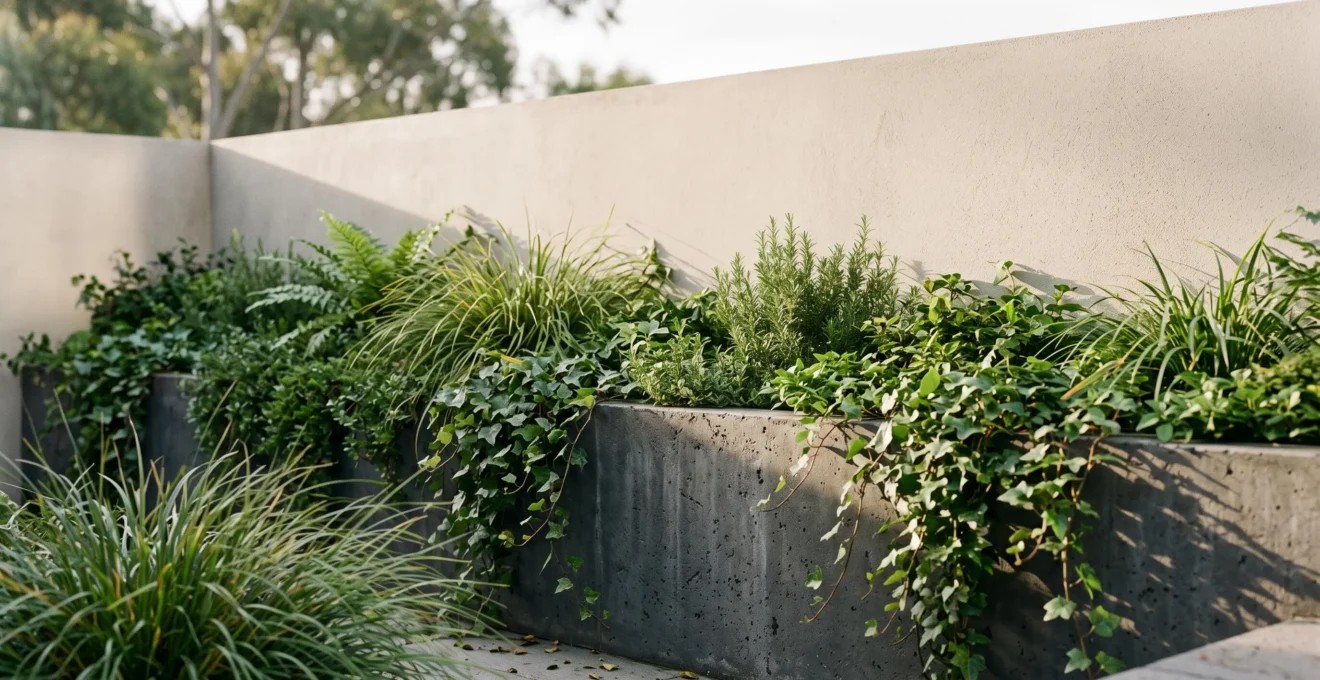
The stark beauty of modern architecture often comes at the cost of feeling harsh and sterile; the solution is to treat plants not as a decorative afterthought, but as a final architectural layer.
- Foliage is a tool to manipulate space through ‘forced perspective’ and to provide ‘textural counterpoint’ to smooth surfaces.
- Correct plant choices (e.g., non-damaging climbers, contained bamboo) and pruning techniques are crucial to maintaining a clean, architectural look.
Recommendation: Start by identifying one specific architectural problem in your space—be it noise, harsh lines, or poor flow—and select a plant-based solution designed to solve it.
That new extension is finally complete. The vast panes of glass, the clean render, the sharp concrete lines—it’s the minimalist dream realised. Yet, standing in the space, something feels off. It’s loud; every sound echoes. The lines, once admired on the blueprint, now feel severe, even unwelcoming. The immediate impulse for many is to “add some plants,” perhaps a few generic shrubs in pots or a hopeful-looking climber at the base of a wall. This approach treats planting as a decorative bandage, a green appliqué stuck onto the architecture.
The common advice to simply “plant climbers” or “use grasses for movement” misses the fundamental point. These are not just aesthetic choices; they are architectural interventions. The true potential is unlocked when you stop thinking like a traditional gardener and start thinking like a spatial designer who uses foliage as a medium. This isn’t about hiding the concrete, but about engaging with it, creating a dialogue between the built form and the living material.
The key is to shift your perspective. What if the primary role of your planting wasn’t to be pretty, but to solve an architectural problem? What if foliage could be used to manipulate the perception of space, dampen sound, and provide a deliberate textural counterpoint that makes the concrete feel even more refined? This is the core principle of contemporary garden design: using plants as an architectural tool.
This guide will deconstruct that principle into actionable strategies. We will explore how to use trailing plants to alter a space’s acoustic and visual volume, select climbers that respect your expensive render, and deploy grasses for targeted movement. We will also cover the critical pruning and planting decisions that ensure your softscape enhances, rather than overwhelms, the architectural integrity of your home.
This article provides a structured approach to integrating softscape into modern design. Explore the key concepts below to transform your space with intention.
Summary: A Designer’s Guide to Softening Modern Architecture with Plants
- Why Trailing Plants Make Small Concrete Spaces Feel Larger?
- Climbers That Won’t Damage Your Expensive Rendered Walls
- Grasses vs Bamboo: Adding Movement to Static Modern Courtyards
- The Pruning Error That Turns Architectural Plants into Messy Bushes
- Pot Size Matters: When to Buy Mature Specimens for Instant Softening?
- Vertical Gardening: How to Green Walls Without Losing Floor Space?
- Patio Clematis vs Climbers: Which Cultivar Actually Flowers at Eye Level?
- Improving Spatial Flow in Narrow Terraced House Gardens
Why Trailing Plants Make Small Concrete Spaces Feel Larger?
In a compact, hard-surfaced space like a modern concrete courtyard, our perception of size is dictated by more than just visual cues. It’s also influenced by acoustics. The harsh, reflective surfaces of glass, render, and concrete create a brittle soundscape where every footstep and conversation echoes, making the area feel enclosed and smaller than it is. Trailing plants offer a powerful two-fold solution to this problem, addressing both the visual and the auditory confinement.
Visually, cascading foliage breaks the rigid geometry. A plant that spills over the edge of a raised bed or a tall planter blurs the hard line between the vertical wall and the horizontal floor. This ‘softening of the edges’ makes the boundaries of the space less defined and, therefore, less constricting. The eye follows the gentle curve of the plant, creating a sense of flow and generosity that counteracts the boxiness of the architecture.
More profoundly, foliage acts as a natural acoustic dampener. The complex surfaces of hundreds of individual leaves absorb and scatter sound waves, preventing them from bouncing back and forth. This “acoustic softening” is remarkably effective; a laboratory and field study on vegetation systems found that they can achieve up to 10 decibels of noise reduction. This subtle change dramatically alters the feeling of a space. By reducing echo and ambient noise, the courtyard becomes a calmer, more serene environment, which our brains interpret as being more expansive and open.
The strategy is to use trailing plants not just as decoration, but as a distributed network of sound-absorbing panels. Species like Dichondra ‘Silver Falls’, with its curtain of metallic leaves, or the robust ivy-leaf geranium (Pelargonium peltatum) are perfect for this, providing both visual softness and a tangible sense of tranquillity.
Climbers That Won’t Damage Your Expensive Rendered Walls
One of the biggest fears for owners of new-builds is that a beautiful climbing plant will end up destroying the pristine rendered or masonry walls it’s meant to adorn. The myth of ivy (Hedera) sending its roots deep into mortar and prising bricks apart is pervasive. While this can happen on old, poorly maintained walls with existing cracks, the reality for modern, sound construction is quite different. The key is to understand how different climbers attach themselves and to choose the right plant for the right situation.
Climbers can be grouped into two main types: self-clingers and those that require support. Self-clinging climbers, like Boston Ivy (Parthenocissus tricuspidata) and Virginia Creeper (Parthenocissus quinquefolia), are often the most feared. However, their method of attachment is misunderstood. They use small, sucker-like adhesive pads that stick to the surface of the wall. They do not, as a rule, penetrate sound mortar or render.
Case Study: The Truth About Wall-Damaging Climbers
Contrary to the long-held belief that self-clinging climbers structurally compromise masonry, horticultural analysis of vines like Boston ivy shows their adhesive pads grip only the outer surface. These pads do not root into or actively pull apart sound mortar, meaning they are generally safe for well-constructed modern walls. The primary risk comes from pre-existing structural issues, not the plant itself.
The second group of climbers includes those that twine (like Clematis or Wisteria), use tendrils (like Passion flowers), or scramble (like climbing roses). These plants have no inherent ability to grip a flat wall and require a support structure, such as a trellis, wires, or a mesh panel. This is often the safest and most architecturally considered approach. Installing a wire or mesh system a few inches away from the wall allows air to circulate, preventing moisture build-up, and gives you complete control over the plant’s shape and spread. It also makes wall maintenance possible without having to destroy the plant.
While masonry is generally safe, it’s crucial to be cautious with other materials. The Royal Horticultural Society offers a nuanced perspective, highlighting where the real risk lies. As the RHS points out, “Ivy can damage wooden fences if stems grow into gaps between slats or panels.” This is a key distinction; the damage comes from the plant’s stem physically expanding in a pre-existing gap, not from the roots or pads attacking a solid surface. For rendered walls, the primary consideration is the paint or surface finish, as removing adhesive pads can sometimes pull off flakes of paint.
Grasses vs Bamboo: Adding Movement to Static Modern Courtyards
A modern courtyard, with its emphasis on static, geometric forms, can often feel lifeless. The simplest way to counter this is by introducing movement, and the most effective tools for this are ornamental grasses and bamboo. Both catch the slightest breeze, creating a dynamic shimmer that brings the space to life. However, they offer very different aesthetic and practical experiences, creating a crucial design choice around the concept of textural counterpoint.
Ornamental grasses, like Miscanthus sinensis or Stipa tenuissima (‘Ponytails’), provide a soft, feathery texture. Their movement is fluid and gentle, a diffuse rustle and sway. They are the watercolour wash against the hard acrylic of concrete. They are generally clump-forming, meaning they stay where you plant them, expanding slowly outwards. This makes them a predictable and low-maintenance choice for adding fine-textured movement near patios and pathways.
Bamboo, on the other hand, is a bold, linear statement. Its movement is more distinct—a percussive clatter of culms and a rustle of leaves. It offers a strong vertical element that complements modern architecture. However, the critical distinction is between ‘clumping’ and ‘running’ varieties. Clumping bamboos (like Fargesia) behave like ornamental grasses, staying in a tight clump. They are the safe, architectural choice.
Running bamboos (like Phyllostachys) are a different proposition entirely. They are invasive and seek to conquer territory via underground stems called rhizomes. Guides on rhizome behaviour note that these can travel up to 20 feet from the original planting before surfacing, potentially damaging patios, driveways, or even foundations. Using running bamboo without containment is a common and costly garden design error. It requires a serious commitment to control, which can be achieved with a robust root barrier.
Action Plan: How to Safely Contain Running Bamboo
- Install a vertical HDPE rhizome barrier at least 24-36 inches deep around the entire planting area before the bamboo is established.
- Keep running bamboo species at least 10 feet from any foundation if no barrier is used, or closer only when a barrier is in place.
- Inspect the barrier line annually and sever any rhizome that has breached it before it reaches a patio, driveway, or wall.
The Pruning Error That Turns Architectural Plants into Messy Bushes
The goal of using plants in a modern setting is to achieve a look that is clean, intentional, and respects the surrounding architecture. An “architectural plant”—be it a clipped boxwood sphere, a structured Phormium, or a pleached tree—is defined by its strong silhouette. The single most common error that destroys this intention is improper pruning. Specifically, it’s the mistake of repeatedly shearing the outside of a plant into a tight shape.
When you only ever trim the outermost layer of leaves, you are creating a dense shell of foliage. Light can no longer penetrate into the centre of the plant. As a result, the inner branches and leaves die off, leaving a hollow, woody core surrounded by a thin green skin. This plant is fragile; one harsh winter, a patch of disease, or a single misguided cut can create a hole that reveals the dead interior and will never grow back properly. The plant loses its natural form and becomes a dense, featureless blob—the very opposite of an architectural statement.
The correct approach is to prune for structural integrity, not just for superficial shape. This involves a more thoughtful, selective process. Instead of shearing the outside, you should be reaching into the plant and thinning it out from the inside. This means identifying and removing specific branches: those that are crossing, rubbing, or growing inward; those that are weak or damaged; and those that are cluttering the overall form.
This technique, known as renewal or thinning pruning, achieves several things. It allows light and air to reach the centre of the plant, promoting healthy growth from the base and preventing the formation of a dead zone. It encourages the plant to maintain its natural, elegant form, just a cleaner and more defined version of it. Most importantly, it preserves the strong silhouette that makes the plant “architectural” in the first place. You are not imposing a shape on the plant; you are revealing the best version of its own inherent structure.
Pot Size Matters: When to Buy Mature Specimens for Instant Softening?
In the context of a new build, where the architecture is complete and the hardscaping is set, the planting phase is not the beginning of a long journey—it is the final step in realising a cohesive design vision. This is where the debate between buying small, young plants versus investing in larger, mature specimens becomes a crucial strategic decision. While traditional gardening often champions the virtue of nurturing a plant from a small size, contemporary design frequently demands instant impact.
The argument for buying mature specimens is fundamentally an architectural one. A large, well-proportioned plant in a statement pot is not just a plant; it is a piece of sculpture. It has immediate scale, presence, and mass. In a space defined by large, simple volumes of concrete and glass, a tiny plant in a large pot looks lost and out of proportion. A mature olive tree, a multi-stemmed birch, or a large, sculptural agave, on the other hand, can hold its own and enter into a meaningful dialogue with the scale of the building. It completes the picture from day one.
This is particularly true for container planting. The pot itself is an architectural element, and its size must be in proportion to both the plant it holds and the space it occupies. A common mistake is to choose a pot that is too small for the desired final size of the plant, leading to a visually top-heavy and unstable look. For instant softening, the strategy is to select the pot and the mature plant as a single, combined sculptural unit. You are buying a finished piece, not a work-in-progress.
Of course, this approach comes at a higher initial cost. However, in the overall budget of a new extension, the premium for a few key mature specimens is often a worthwhile investment. It allows you to immediately enjoy the softening effect and the finished design, rather than waiting three to five years for smaller plants to catch up—by which time the initial design intent may be lost. The decision is a trade-off between budget and time, but for achieving an instant, polished look, scale matters immediately.
Vertical Gardening: How to Green Walls Without Losing Floor Space?
In compact urban gardens and courtyards, floor space is the most precious commodity. The desire to soften a large, blank wall often conflicts with the need to preserve room for seating, circulation, or simply a sense of openness. Vertical gardening offers the ultimate solution, allowing you to create a lush, living wall of green without sacrificing a single square foot of usable ground area. This technique represents the most literal form of vertical dissolution, where a hard boundary is transformed into a soft, living texture.
There are two primary approaches: pre-fabricated living wall systems and simpler “green curtain” or trellis systems. Living wall systems, with their integrated irrigation and modular planting pockets, create an instant, uniform tapestry of green. While highly effective, they can be expensive to install and maintain. A more accessible and often more architecturally subtle approach is to use a system of tensioned stainless steel cables or a simple mesh trellis.
This “green curtain” method involves fixing a support structure a few inches off the wall and training climbing or twining plants to grow up it. This creates a semi-transparent screen of foliage that cloaks the wall behind it. The gap between the plant and the wall is crucial; it ensures good air circulation, preventing moisture damage to the render, and creates a fascinating play of light and shadow. The wall is not obliterated, but filtered, its harshness dissolving into a dappled, moving pattern.
Beyond the aesthetic and space-saving benefits, greening a facade has significant environmental advantages. The foliage provides a layer of insulation, and the process of evapotranspiration from the leaves actively cools the surrounding air. The effect is substantial; a systematic review of over 647 case studies found that green walls can lead to an up to 8°C (about 15°F) reduction in ambient temperatures in their immediate vicinity. This makes the courtyard a more comfortable place to be on a hot day, adding a functional benefit to the aesthetic improvement.
Patio Clematis vs Climbers: Which Cultivar Actually Flowers at Eye Level?
Clematis are a classic choice for softening walls and fences, but a common source of disappointment is planting a beautiful variety only to find that it produces all its flowers 15 feet up, at roof level, with nothing but bare stems visible from the patio. This happens because the fundamental nature of most traditional climbing Clematis is to seek the sun. They are woodland-edge plants programmed to scramble up through trees and shrubs to flower where the light is strongest. For a modern courtyard where the desired effect is a cascade of blooms at eye-level, this growth habit is a significant drawback.
This is precisely the problem that ‘Patio’ or ‘Boulevard’ Clematis cultivars were bred to solve. These are not a different species, but rather specific varieties of Clematis selected and bred for their compact, bushy growth habit. Unlike their vigorous cousins that can grow 20-30 feet, these cultivars typically stay within a more manageable 4-6 feet range. Crucially, they have the genetic predisposition to flower profusely all the way up their stems, from the base to the top.
This means you get what you wanted: a column of colour that is visible and enjoyable from your seating area. These plants are perfectly suited for growing in large pots and containers with a small obelisk or trellis for support. Varieties like Clematis ‘Bijou’ or the Garland series are designed specifically for this purpose. They will happily cover their support structure with flowers without ever threatening to disappear over the top of the fence.
Therefore, the choice is not just about colour or flower shape, but about understanding the plant’s ultimate size and flowering habit. If you want a climber to cover a large wall or pergola, a traditional vigorous variety is appropriate. But if the goal is to have a mass of flowers at eye level on a patio, balcony, or by a doorway, choosing a designated ‘Patio’ cultivar is essential. It is the difference between a plant that fulfills its genetic destiny far out of view and one that is designed to perform exactly where you want it to.
Key Takeaways
- Treat plants as an architectural tool to solve problems (noise, harshness, flow) rather than as mere decoration.
- The right plant choice is critical: understand climber types, bamboo habits, and pruning methods to maintain a clean, intentional look.
- Manipulate scale and perception by using mature specimens for instant impact and arranging foliage to create a false sense of depth.
Improving Spatial Flow in Narrow Terraced House Gardens
The narrow, corridor-like garden of a terraced house presents a unique design challenge. Often bookended by the house at one end and a high wall or fence at the other, these spaces can feel like a tunnel. The natural instinct is to plant borders down either side of a central path, which unfortunately only serves to accentuate the long, narrow “bowling alley” effect. Improving the spatial flow requires breaking this linear progression and using planting to cleverly manipulate the user’s perception of space.
The most powerful technique for this is creating a sense of forced perspective. This is an optical illusion borrowed from art and theatre design. To make the garden feel deeper and longer than it is, you place plants with large, bold leaves (like Hostas, Fatsia japonica, or ferns like Dryopteris) closer to the house. As you move down the garden, the foliage should become progressively smaller and finer-textured, using plants like grasses (Hakonechloa), Thyme, or delicate ferns (Asplenium). Your brain interprets this gradual reduction in scale as an increase in distance, tricking the eye into seeing a longer, more expansive space.
Another key strategy is to interrupt the straight line of sight. Instead of a straight path, create a gentle S-curve that meanders from side to side. This forces the visitor to slow down and prevents their eye from shooting directly to the back fence. The planting beds can then swell into the curves, partially obscuring the path ahead. This creates a sense of mystery and discovery; you have to move through the space to see what’s around the next corner. Using a few strategically placed tall, narrow plants or a small multi-stem tree as a partial screen can further enhance this effect.
By combining a meandering path with the clever use of forced perspective in the planting, you transform the space from a simple corridor into a journey. The flow is no longer a direct, hurried line from A to B, but a slower, more engaging experience. The garden feels wider, deeper, and infinitely more interesting, all through the thoughtful, architectural placement of foliage.
Start by identifying one harsh line, one problem area, or one awkward flow in your space. Then, choose one of these plant-based architectural solutions and apply it with intention. By moving beyond decoration and using plants as a true design material, you can transform your modern space from merely built to beautifully complete.