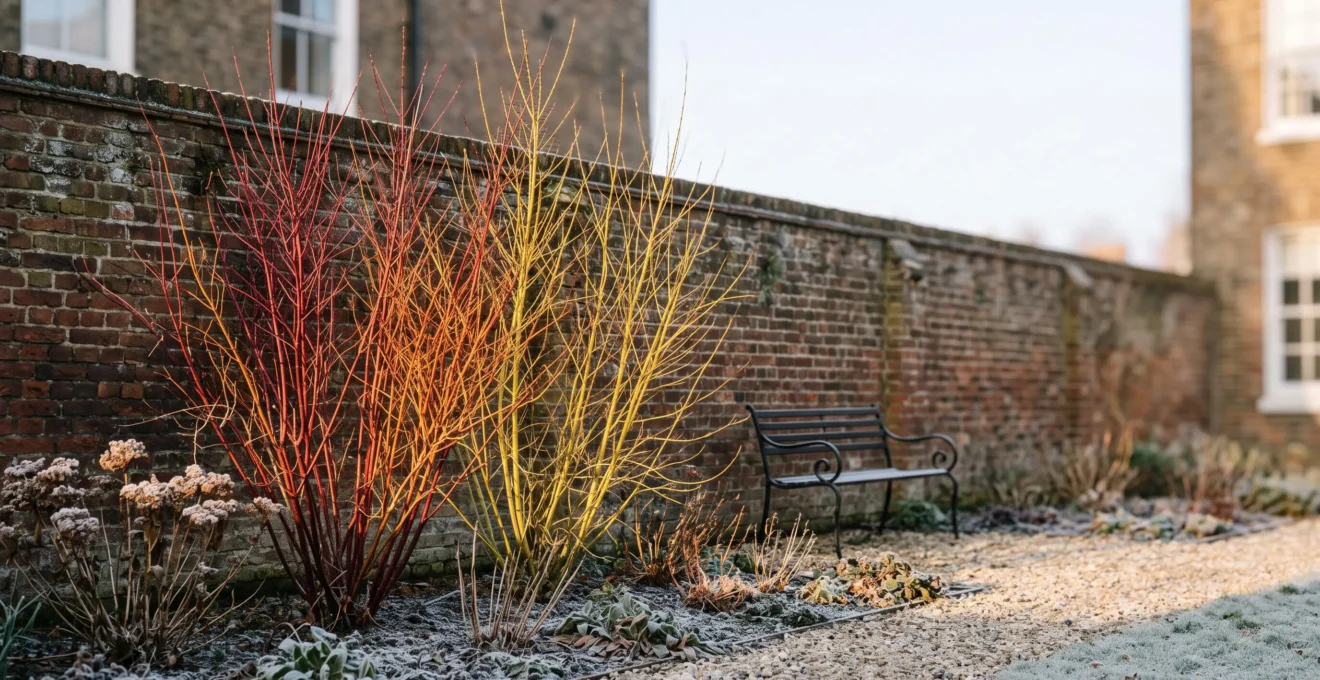
The secret to a stunning winter garden isn’t finding rare plants, but mastering the art of the ‘winter skeleton’—the beautiful, bare structure of common deciduous shrubs.
- Vibrant stem colour is achieved through specific pruning techniques like coppicing, not just plant choice.
- Strategic placement and pruning create ‘light corridors’ that channel low winter sun, transforming the space.
Recommendation: Stop thinking about ‘filling gaps’ and start thinking like a sculptor, using branches, shadows, and negative space to compose your garden’s winter masterpiece.
When the last of the autumn leaves have fallen, many gardeners resign themselves to a four-month view of bare soil and bleakness. The common solution is to pack gardens with evergreens, creating a static, unchanging landscape that can feel heavy and dark. This approach, while offering green, often misses the most profound beauty of the dormant season. It overlooks the quiet, architectural elegance of the plants that have shed their foliage, revealing their essential forms against the low winter light. This is the art of the winter garden: seeing beyond the lack of leaves and recognizing the potential for living sculpture.
The true mastery for a design-conscious gardener lies in appreciating the winter skeleton of a deciduous shrub. It’s a shift in perspective from mourning the loss of summer colour to celebrating the emergence of line, texture, and form. Instead of a void, the winter garden becomes a minimalist canvas, where every branch and twig contributes to a larger composition. This isn’t about fighting the season; it’s about collaborating with it, using the bareness to reveal a deeper, more subtle layer of design.
But what if the key to a breathtaking winter landscape was not in adding more, but in revealing what is already there? This guide moves beyond simple plant lists to explore the design principles of using deciduous shrubs as structural elements. We will delve into how to manipulate stem colour through pruning, how to sculpt with light and shadow, and how to find life in the quietest months. This is about turning your garden into a curated gallery of natural forms that looks just as intentional in January as it does in June.
This article provides a comprehensive look at the artistic principles behind creating a garden with winter interest. We’ll explore everything from the intense colour of coppiced stems to the delicate science of wind filtration, offering a designer’s perspective on transforming your space into a year-round masterpiece.
Summary: A Designer’s Guide to Structural Deciduous Shrubs
- Dogwood or Willow: Which Has the Brightest Winter Bark?
- How to Coppice Shrubs to Force Vibrant New Growth?
- Why Deciduous Hedges Filter Wind Better Than Solid Walls?
- The ‘Cute Shrub’ Mistake That Blocks Light After 3 Years
- When to Expect Leaf Drop: Planning Your Autumn Garden Clearance
- Why Trailing Plants Make Small Concrete Spaces Feel Larger?
- 3 Shrubs That Actually Flower in January in the UK
- Year-Round Seasonal Colour: Filling the November and February Gaps
Dogwood or Willow: Which Has the Brightest Winter Bark?
The flash of vibrant red, orange, or acid-green stems against a backdrop of frost or snow is one of the great joys of the winter garden. This dramatic effect is primarily delivered by two families of shrubs: Dogwoods (Cornus) and Willows (Salix). While both offer spectacular colour, a designer’s choice between them depends on the desired effect, the scale of the garden, and the commitment to maintenance. They are not interchangeable; they are different tools for different artistic outcomes.
The colour in these shrubs is most intense on new growth, typically stems that are only one or two years old. This is the key to unlocking their potential. A Dogwood, for example, tends to be a more compact, clump-forming shrub. Its colour palette is broad, ranging from deep maroon-red to fiery orange and bright yellow. A Willow is often more vigorous and aggressive, capable of putting on several feet of growth in a single season. Its colours lean towards brilliant yellows and orange-reds with a distinctive glossy sheen. This difference in texture—the matte finish of a Dogwood versus the polish of a Willow—is a subtle but crucial design detail.
The choice ultimately hinges on a principle of structural choreography. Do you want a controlled, multi-stemmed burst of colour at the front of a border, or a wilder, more imposing statement piece that requires aggressive annual cutting to keep in check? The following comparison breaks down the key characteristics to inform your design decision.
| Feature | Dogwood (Cornus) | Willow (Salix) |
|---|---|---|
| Pruning intensity | Remove roughly one-third of oldest stems annually | Requires severe, near-total annual cutting |
| Annual regrowth | Moderate new growth each season | Up to 6–8 feet of vigorous new growth per season |
| Color range | Red, orange, yellow, maroon, acid-green | Bright yellow to orange-red |
| Growth habit | Compact, clump-forming from the base | Large, aggressive; needs annual control to stay in scale |
Ultimately, both dogwoods and willows offer a powerful way to paint with colour during the winter. The decision rests on understanding their different energies and how they align with your garden’s overall composition and your willingness to engage in the annual pruning that keeps them vibrant.
How to Coppice Shrubs to Force Vibrant New Growth?
The secret to the most electrifying winter stem colour is not a fertiliser or a magic spray; it is a pair of sharp secateurs and a specific pruning technique known as coppicing. This ancient practice involves cutting shrubs down to a low framework, or ‘stool’, close to the ground. The plant responds by sending up a flush of vigorous, juvenile shoots, which carry the most intense pigmentation. For shrubs like Cornus and Salix, this is the essential act of renewal that transforms them from dull background plants into winter superstars.
Coppicing is a form of controlled stress that stimulates a powerful survival response. By removing the old, woody growth, you are telling the plant to invest all its energy into producing new stems. This is the core of the technique’s success. It’s a bold, almost brutal act that feels counter-intuitive, but the results are dramatic and swift. As professional gardener Garden Ninja notes, “few things in late winter gardening are as immediately satisfying as watching those blazing new shoots emerge after a good coppice.” It’s an act of faith that pays off with a spectacular display the following winter.
However, timing and technique are critical. You shouldn’t coppice a newly planted shrub; it needs time to establish a strong root system. The process is best done in late winter or early spring, just before the new growth begins. This allows the plant to heal from the cuts and channel its rising sap into the buds that will form the new, colourful stems. An alternative, less severe method is ‘rejuvenation pruning’, where about one-third of the oldest stems are removed each year, promoting a continuous cycle of new growth without taking the whole shrub down at once.
Action Plan: Coppicing Dogwood for Peak Winter Colour
- Establishment First: Only coppice shrubs that have been established for at least two years and are growing strongly. This ensures they have the root reserves to recover.
- The Hard Cut: According to RHS guidance on growing Cornus for its stems, once established, cut all shoots back to 5-7.5cm (2-3in) from the ground in late winter or early spring.
- Develop the Stool: Over years, a woody ‘stool’ will form at the base. After the main cut, tidy up this base by removing any damaged or dead sections to keep it healthy.
- Feed and Mulch: After cutting, apply a general-purpose fertiliser around the base and a thick layer of mulch to conserve moisture and suppress weeds, fueling the new growth.
- Annual Repetition: Mark it on your calendar. This is not a one-time task but an annual ritual required to maintain the vibrant display year after year.
By embracing coppicing, you shift from a passive observer to an active collaborator in your garden’s design. You are not just planting a shrub; you are sculpting it with purpose, conducting its energy to create a breathtaking seasonal performance.
Why Deciduous Hedges Filter Wind Better Than Solid Walls?
A common instinct for creating shelter in a garden is to build a solid barrier—a tall fence or a dense evergreen hedge. While these structures do block wind, they often create a new problem: turbulence. As wind hits an impenetrable surface, it is forced up and over, creating powerful eddies and downdrafts on the leeward side, which can be more damaging to delicate plants than the original, steady wind. A deciduous hedge in winter, with its intricate network of bare branches, behaves entirely differently. It doesn’t block the wind; it filters it.
This network of twigs and branches acts as a permeable screen. Instead of forcing the air mass over the top, it allows the wind to pass through, slowing it down and breaking up its force. The energy is dissipated gradually across the entire depth of the hedge. The result is a larger, more gentle area of shelter behind it, rather than the zone of turbulence created by a solid wall. In this sense, a bare deciduous hedge becomes a kinetic sculpture—an element that actively interacts with and tames the forces of nature.
This effect is more than just anecdotal; it’s a principle of fluid dynamics. A recent study using 3D laser-scanning and wind simulation confirmed that the porosity of a plant’s canopy is the critical factor in its ability to reduce wind velocity. The complex, multi-layered structure of a winter hedge is far more effective at creating a calm microclimate than a simple, solid barrier. This makes deciduous hedges of species like Hornbeam (Carpinus betulus) or Beech (Fagus sylvatica), which often retain some of their dry leaves, superior choices for creating usable, sheltered spaces within a garden.
Case Study: The Science of the Permeable Windbreak
In an effort to quantify the windbreak effect of vegetation, researchers combined field-measured wind data with detailed 3D canopy models created through terrestrial laser scanning. They ran computational fluid dynamics (CFD) simulations to visualize how air flowed through and around different vegetation structures. The study found that the “obstructive effect” on airflow varied dramatically based on the porosity and complexity of the branch structure. It scientifically validated the long-held belief of gardeners: a permeable barrier that filters wind is fundamentally different and often superior to a solid one that simply blocks it, confirming that the intricate ‘winter skeleton’ of a deciduous hedge is a highly effective piece of natural engineering.
Choosing a deciduous hedge is therefore a strategic design decision. It’s about creating effective shelter without sacrificing light, and about embracing a structure that works with the elements, turning a potential problem like wind into a dynamic, visible force that animates the winter garden.
The ‘Cute Shrub’ Mistake That Blocks Light After 3 Years
One of the most common and costly mistakes in garden design is underestimating a plant’s mature size. A small, “cute” shrub purchased in a two-litre pot can quickly become a dense, light-blocking behemoth within a few seasons. This is especially critical in winter, when the sun is low in the sky and every photon is precious. A poorly placed shrub can cast a permanent shadow over a seating area, a key border, or the windows of your home, creating a dark, gloomy space precisely when you crave light the most.
The solution lies in thinking like an architect and designing with “light corridors” in mind. A light corridor is a deliberate, planned gap in your planting that is designed to channel the low winter sun into a specific area. It requires you to know not just the mature height and spread of your shrubs, but also the arc of the sun across your garden in December and January. It means resisting the temptation to plant a solid, unbroken wall of shrubs and instead embracing the power of negative space.
This is a four-dimensional design process, considering not only width and height but also the passage of time—both through the seasons and over the years as plants grow. Before planting, use stakes to mark the future footprint of your chosen shrubs. Visit the spot on a sunny winter day and observe where the shadows fall. Is there a critical path, a favourite bench, or a kitchen window that needs that light? If so, your design must preserve a channel for it. This might mean spacing plants further apart than the label suggests, or choosing a variety with a more open, vase-like structure rather than a dense, rounded one.
Pruning also plays a crucial role in maintaining these corridors. ‘Lifting the crown’ of a shrub by removing its lowest branches can allow light to pass underneath, while selective thinning can open up views and light paths through the plant itself. This is not just maintenance; it is the active sculpting of light and shadow, the most fundamental elements of a winter garden’s atmosphere.
By planning for these light corridors from the outset, you transform from a simple planter into a true garden designer. You ensure that your garden’s structure serves its inhabitants, creating moments of warmth and brightness that make the space inviting even on the coldest days.
When to Expect Leaf Drop: Planning Your Autumn Garden Clearance
The transition from autumn to winter is marked by the fall of leaves, a process known as abscission. For the design-conscious gardener, this is not a messy inconvenience but a planned seasonal event. The timing of leaf drop varies by species, location, and weather conditions. An early, hard frost can trigger a sudden, dramatic shedding, while a mild autumn may lead to a more gradual decline. Understanding the typical behaviour of your chosen shrubs—does it drop its leaves all at once, or does it hold onto them until the winter winds finally tear them away?—is key to managing this transitional phase with grace.
The prevailing wisdom is to immediately rake up every fallen leaf to maintain a “tidy” garden. However, this approach is both ecologically damaging and a missed opportunity. A blanket of fallen leaves is nature’s own mulch, a vital habitat for countless beneficial insects, pollinators, and other invertebrates. Butterflies and moths overwinter in leaf litter as eggs, pupae, or even adults. Bumblebee queens nestle into the duff to survive the cold. By removing every leaf, we are effectively sterilizing the garden and destroying the very life we seek to attract in the spring.
The artistic challenge is to find a balance between ecological responsibility and a clean aesthetic. The “leave the leaves” movement doesn’t mean letting your garden descend into chaos. As the Xerces Society for Invertebrate Conservation advises, you can achieve a tidy look while still providing habitat. The key is strategic management:
- Relocate, Don’t Remove: Rake leaves from lawns and paths, where they can smother grass and become slippery, but move them into your garden beds, around the base of trees, or onto your compost pile.
- Create Designated Habitats: A couple of inches of leaf litter in a border mimics a natural forest floor and provides ample shelter for overwintering creatures.
- Shred for Soil Health: While whole leaves can form a dense, wet mat, running a lawnmower over them breaks them into smaller pieces. This shredded material is an excellent soil amendment that suppresses weeds, retains moisture, and adds nutrients as it decomposes.
By reframing leaf drop not as a chore but as the delivery of a valuable resource, you can save time, improve your soil, support wildlife, and create a garden that is truly in harmony with the natural cycles of the season.
Why Trailing Plants Make Small Concrete Spaces Feel Larger?
In small urban gardens, balconies, and courtyards, hard surfaces often dominate. Concrete patios, brick walls, and metal railings create a landscape of rigid lines and flat planes. While necessary for structure, these hardscapes can make a space feel confined, boxy, and sterile. One of the most effective design tools to counteract this is the use of trailing and cascading plants. Their function is not just to add greenery, but to fundamentally alter the perception of space.
Trailing plants work by softening hard edges. When a curtain of ivy, a trailing rosemary, or a cascading evergreen like Vinca minor spills over the side of a raised bed or a container, it blurs the sharp, geometric line between the horizontal and vertical planes. This simple act has a profound psychological effect. Our eyes no longer register a hard stop, a definite boundary. Instead, the transition is softened, creating a sense of flow and integration between the built and the natural.
This blurring of boundaries is a classic artistic technique for creating the illusion of depth and space. By breaking up the rigid geometry of a small area, you make its perimeter less defined and therefore less confining. The “green waterfall” effect draws the eye downwards, creating vertical interest and a feeling of lushness that distracts from the limited square footage. It introduces a sense of organic movement and life that directly counters the static, man-made nature of the concrete surroundings.
Choosing evergreen or semi-evergreen trailers is particularly important for winter structure. While deciduous shrubs provide the architectural ‘bones’, these trailing plants offer year-round softness and colour. They are the drapery that furnishes the room, ensuring that even in the depths of winter, the hard edges of the urban environment are softened, making the space feel more like a sanctuary and less like a cage.
In the compact urban garden, every plant must serve multiple functions. A trailing plant is not just a plant; it is a spatial manipulator, an edge-softener, and a tool for transforming a hard, enclosed area into a larger, more inviting green retreat.
3 Shrubs That Actually Flower in January in the UK
While the primary focus of a structural winter garden is form and line, the unexpected bonus of fragrance and flowers in the dead of winter is a moment of pure magic. It serves as a vital reminder that the garden is resting, not dead. In the UK, a select few hardy shrubs defy the season to put on a spectacular show, providing not only delight for the gardener but also a critical lifeline for early-foraging pollinators. These plants are essential components of a true four-season garden.
Choosing winter-flowering shrubs is about more than just a pretty bloom; it’s about scent, placement, and ecological value. The fragrance of these plants is often powerful, designed to travel on the cold air to attract the few insects that are active. Planting them near a doorway, along a path, or under a window ensures their scent can be appreciated daily. Mahonia, Sarcococca (Sweet Box), and Erica carnea (Winter Heather) are three of the most reliable performers for a January display.
Mahonia is an architectural shrub in its own right, with bold, spiky leaves. Its bright yellow, honey-scented flowers are a magnet for queen bumblebees emerging on mild winter days. In fact, pollinator data reveals its immense importance, with one recording society showing Mahonia can account for over 75% of bumblebee visits to flowers in deep winter. Sarcococca is more unassuming, but its tiny white flowers pack an intensely sweet fragrance that can fill an entire garden. Winter Heath provides a carpet of colour at ground level, offering early nectar for multiple bee species. The following table from an analysis on flowering shrubs for bees compares their key attributes.
| Shrub | Bloom period | Scent | Pollinator value |
|---|---|---|---|
| Mahonia | November–April | Fragrant, honey-like | Major nectar/pollen source for queen bumblebees |
| Sarcococca (Sweet Box) | January–February | Sweet, powerful, carries along paths | Pollen source for foraging honeybees on mild days |
| Erica carnea (Winter Heather) | January–April | Mild | Early nectar for bumblebees and honeybees |
Integrating these shrubs into your design provides a multisensory experience. They are not just visually appealing; they are fragrant, life-sustaining hubs of activity that bring a surprising and welcome vitality to the quiet stillness of the January garden.
Key Takeaways
- The ‘winter skeleton’ of a bare shrub is a primary design element, not a seasonal failure.
- Strategic pruning techniques like coppicing are essential for unlocking the most vibrant stem colour and controlling form.
- Thoughtful placement creates ‘light corridors’ and permeable windbreaks, actively shaping the garden’s microclimate and atmosphere.
Year-Round Seasonal Colour: Filling the November and February Gaps
A truly accomplished garden design offers points of interest not just in the four main seasons, but in the transitional “in-between” periods as well. November and February can be particularly challenging, often feeling like barren gaps between autumn’s finale and spring’s first overture. However, by layering the principles of structural form, stem colour, and late or early blooms, it is possible to create a garden that remains captivating throughout these quiet months. It is a process of ‘structural choreography’—arranging plants so that as one performance fades, another is already beginning.
As the botanist Charlotte notes on the BSBI News & Views blog, “Winter is a time for rest and preparation for the warmer seasons ahead in the UK, yet quiet pockets of pollinator activity persist.” Our role as garden designers is to cultivate these pockets of activity. November can be brightened by the lingering leaves of Beech hedges and the first emergence of colour on Cornus stems, while February sees the swelling buds of spring bulbs and the peak fragrance of Sarcococca. It’s about orchestrating these subtle shifts into a continuous, unfolding narrative.
This approach moves beyond a simple checklist of plants and into a deeper understanding of the garden’s rhythm. The goal is to create a dynamic composition where the stark, sculptural forms of coppiced willows are the backdrop for the delicate flowers of winter-blooming jasmine, and the rust-coloured leaves of a Hornbeam hedge provide a perfect frame for the first snowdrops. It’s a holistic view that appreciates the beauty in both the bold statement and the quiet detail, ensuring there is always something to draw the eye and lift the spirits.
The garden is far from dormant during this time. The annual New Year Plant Hunt in the UK consistently demonstrates the surprising resilience of plant life, with recent results showing over 600 species of plant in flower at the start of January. This hidden vitality is there to be discovered and celebrated, proving that a thoughtfully designed garden has no “off-season.”
By embracing the full cycle, from the stark beauty of a bare winter skeleton to the sudden surprise of a winter bloom, you create a space that is not just a collection of plants, but a living, breathing work of art that offers new discoveries every day of the year. Take a fresh look at your own garden space; see the potential for line, form, and shadow, and begin your own structural choreography.