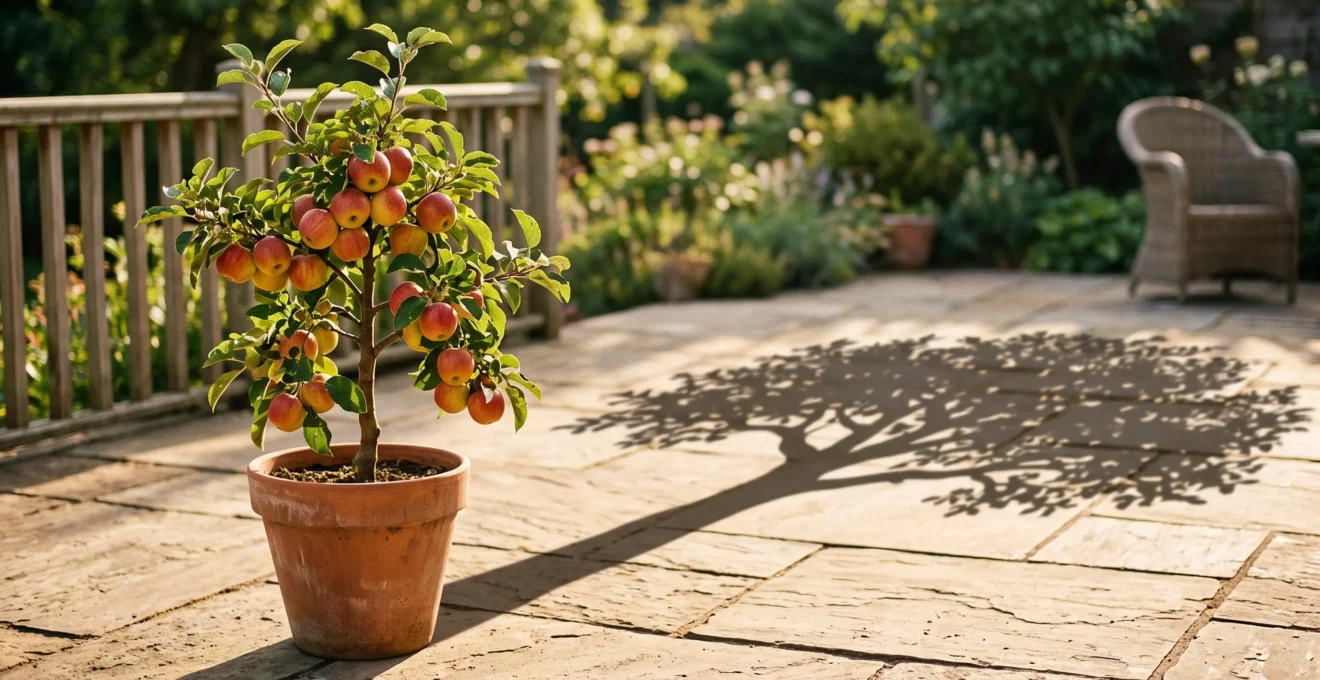
The common belief that patio fruit trees are more decorative than productive is wrong; the limiting factor isn’t space, it’s strategy.
- High yields come from technical choices like rootstock selection and branch engineering, not just sun and water.
- A single pot can be a productive micro-orchard by managing pollination and biennial bearing through precise interventions.
Recommendation: Shift your focus from passive gardening to active horticultural engineering—starting with choosing a rootstock that matches your container size and yield goals, not just your available space.
The dream of picking fresh apples or pears from your own balcony often collides with a disappointing reality: a few sparse fruits on a struggling tree. For urban dwellers, the challenge is always a trade-off between yield and space. We’re told to find a sunny spot, use a big pot, and water regularly. But this generic advice treats the tree like a houseplant, ignoring the productive potential locked within its genetics and biology.
This approach often leads to biennial bearing—a heavy crop one year, then almost nothing the next—or trees that grow leaves but few flowers. The frustration mounts, and the patio orchard feels more like a high-maintenance decoration than a source of food. The problem isn’t your “green thumb” or the size of your patio; it’s a failure to apply the right technical strategy.
What if the key to a heavy, consistent harvest wasn’t about more space, but about smarter engineering? The secret to a productive micro-orchard lies in understanding and manipulating the technical levers that control fruit production. This is about making deliberate choices in pollination, rootstock, nutrition, and even the physical shape of the branches to actively signal to your tree that its primary job is to produce fruit, not just grow tall.
This guide will walk you through the core principles of horticultural engineering for containerized fruit trees. We will dissect the critical decisions, from selecting the right genetic foundation (rootstock) to implementing advanced techniques that maximize your yield-per-square-foot. Get ready to transform your patio plant into a compact, efficient, fruit-producing machine.
To navigate these strategic choices, this article breaks down the essential components of planning and managing a high-yield patio orchard. Explore the topics below to build your expertise from the ground up.
Summary: A Strategic Guide to Your Patio Orchard
- Family Trees or Pairs: How to Ensure Pollination with Only One Pot?
- Pot Size: Can You Get Full-Sized Fruit from a 30L Container?
- The Thinning Mistake: Why Your Tree Only Fruits Every Other Year?
- Festooning: Bending Branches to Increase Fruit Buds in Small Spaces?
- When to Feed: The Critical Window for Fruit Set in Containers?
- What Does M27 Mean? Understanding Extremely Dwarf Rootstocks
- 2L/h or 4L/h: Matching Emitter Flow to Pot Volume?
- M9 or MM106: Which Grafted Rootstock Suits Your Garden Size?
Family Trees or Pairs: How to Ensure Pollination with Only One Pot?
The need for cross-pollination is a major hurdle for the space-constrained urban orchardist. Most apple and pear varieties are not self-fertile, meaning they need pollen from a different, compatible variety to produce fruit. The standard solution—planting two trees—is often a non-starter on a small balcony. However, there are two engineering solutions to this problem. The first is leveraging urban density; bees can travel significant distances, and if a compatible tree (like a crabapple or a neighbor’s pear) is blooming nearby, you may get lucky. Pollination partners should be within 100 feet, with 50 feet or less being ideal for success.
The more reliable, single-pot solution is the “family tree.” This is a marvel of horticultural engineering where multiple compatible varieties are grafted onto a single rootstock. For example, one tree might have branches of both ‘Gala’ and ‘Fuji’ apples. This creates a self-contained pollination ecosystem in one container. You get the benefit of two or even three different types of fruit and guaranteed pollination without needing a second pot. When buying a family tree, confirm the varieties are known pollination partners and that they bloom at the same time to ensure their flowering periods overlap effectively.
This single-pot strategy is the most efficient way to solve the pollination puzzle. It eliminates the guesswork of relying on neighborhood pollinators and doubles down on the principle of maximizing productivity within a minimal footprint. While some fruits like peaches are often self-pollinating, even they benefit from a second variety to boost fruit set and quality, making the family tree concept a superior choice across the board for patio growers.
Pot Size: Can You Get Full-Sized Fruit from a 30L Container?
A common mistake is underestimating the pot volume a productive fruit tree requires. A 30-liter (about 7-8 gallons) pot is simply too small to sustain a tree capable of producing a meaningful harvest of full-sized fruit. While the tree might survive, its root system will be too restricted to support vigorous fruit development, leading to small yields and stressed plants. For a truly productive dwarf apple or pear tree, you must think of the pot not just as a container, but as its entire world—the sole source of water, air, and nutrients.
The minimum recommended size for dwarf rootstocks like M9 or M27 is a 20-25 gallon (75-95 liter) pot. A larger volume provides more stability, a greater buffer against drying out, and more room for the robust root system needed to produce a significant crop. With an adequate root system in a large container, even an extremely dwarfing rootstock like M27 can be highly productive; orchard specialists note that you can expect 3-5kg of apples per M27 tree under good conditions. This is a respectable harvest from a tree that stays under 6 feet tall.
The material and soil are just as critical. Avoid dark-colored pots in hot climates as they can overheat and cook the roots. More importantly, never use garden soil. It compacts quickly in containers, choking roots and leading to poor drainage. A quality potting mix is essential. An effective and simple recipe is a blend of 60% high-quality potting mix and 40% compost to provide both structure and sustained nutrition. This turns your pot into a high-performance, closed-loop system.
The Thinning Mistake: Why Your Tree Only Fruits Every Other Year?
Biennial bearing—a heavy crop one year followed by a barren one the next—is one of the most frustrating problems for fruit growers. It’s often mistaken for a disease or a nutrient deficiency, but it’s actually a natural, hormone-driven survival mechanism. When a tree produces an overwhelmingly large crop, it expends all its energy on maturing the existing fruit. It has no resources left to form the flower buds for the *following* year’s crop. This creates a boom-and-bust cycle that can be hard to break.
The science behind this is clear and directly relates to the tree’s internal resource budget. As researchers have noted, “The negative relationship between fruit development and flower bud differentiation is one of the most investigated causes of flower set variability in apple.” Put simply, a tree can’t do both at once. The developing seeds in this year’s fruit produce hormones (gibberellins) that actively inhibit the formation of next year’s flower buds. By allowing the tree to over-crop, you are inadvertently programming it to fail next season.
The solution is a counter-intuitive but essential act of horticultural engineering: fruit thinning. In late spring, after the natural “June drop” when the tree sheds some of its own fruitlets, you must manually remove more. The goal is to leave one apple or pear per cluster, spaced about 4-6 inches apart along the branches. It feels painful to remove perfectly good potential fruit, but this intervention is critical. By reducing the current crop load, you are ensuring the tree has enough energy and the correct hormonal balance to develop flower buds for a consistent, reliable harvest year after year. Thinning is not about reducing your harvest; it’s about guaranteeing one for the future.
Festooning: Bending Branches to Increase Fruit Buds in Small Spaces?
Standard pruning is about size control, but advanced techniques like festooning are about actively engineering for higher yields. Festooning is the practice of bending young, flexible branches from a vertical or upward-angled position to a horizontal or downward-arcing one. This simple physical change triggers a profound hormonal response in the tree, shifting its energy from vegetative growth (leaves and wood) to reproductive growth (fruit buds).
The principle is rooted in the flow of plant hormones. A vertically growing branch is dominated by apical dominance, where hormones called auxins concentrate at the tip, encouraging it to grow taller and suppressing side branching and bud formation. By bending the branch horizontally, you disrupt this flow. The auxin is redistributed, and growth-promoting hormones like cytokinins, which encourage bud development, become more active along the length of the branch. The branch “thinks” it has reached its final destination and switches its priority from reaching for the sky to producing offspring (fruit).
This technique is perfectly suited for the patio orchardist. It encourages earlier fruiting on young trees and dramatically increases the number of fruit spurs on a given length of branch, maximizing your yield-per-square-foot. The process is simple: in early summer, while branches are still pliable, gently tie them down using soft string attached to a weight on the ground, the pot itself, or the tree’s main trunk. The branch should form a gentle arc, not a sharp angle that could cause it to snap. After a few months, the branch will have “learned” its new position, and the strings can be removed. It’s a low-effort, high-impact method for telling your tree exactly what you want it to do.
When to Feed: The Critical Window for Fruit Set in Containers?
In a container, you are the sole provider of nutrients. Unlike a tree in the ground, a potted tree has no ability to seek out food; it relies entirely on your “resource budgeting.” The timing and type of fertilizer you provide are therefore critical engineering inputs that dictate whether the tree produces leaves or fruit. A common error is to provide a balanced or nitrogen-heavy fertilizer all season long. While nitrogen is essential for green, leafy growth, too much of it at the wrong time will signal the tree to grow more branches at the expense of flowers and fruit.
The feeding strategy must change with the seasons. In early spring, as the tree breaks dormancy, a balanced feed or one slightly higher in nitrogen is appropriate to support the initial flush of growth. However, the moment you see flower buds begin to swell, it’s time to switch. This is the start of the critical window for fruit set. From this point through fruit development, the tree’s primary need shifts to phosphorus (P) and especially potassium (K). Phosphorus supports energy transfer and root health, while potassium is vital for flower formation, fruit quality, and overall hardiness.
Your goal is to apply a “bloom booster” or “fruit and flower” type fertilizer, often labeled with a lower first number (Nitrogen) and higher second and third numbers (P and K). A liquid feed, such as a tomato fertilizer, applied every 2-3 weeks during the growing season is an excellent choice for container trees as it’s readily available. Stop feeding in late summer to allow the tree to harden off its new growth in preparation for winter. Precise, timed nutrition is one of the most powerful levers you have to control the performance of your closed-loop patio system.
What Does M27 Mean? Understanding Extremely Dwarf Rootstocks
The single most important decision in planning a patio orchard happens before you even buy the tree: choosing the rootstock. A fruit tree is not one plant, but two, fused together. The top part, called the scion, determines the fruit variety (e.g., ‘Honeycrisp’ apple). The bottom part, the root system, is the rootstock, and it controls the tree’s ultimate size, vigor, and disease resistance. The label “M27” or “M9” refers to the specific type of rootstock used.
Understanding this is crucial because it defines the tree’s genetic potential for your space. An M27 is an “extremely dwarfing” apple rootstock. It creates the smallest possible apple tree, typically reaching only 4-6 feet in height, making it an ideal candidate for container life. Its diminutive nature is a result of decades of selective breeding. Trial data from rootstock evaluations shows that trees on M27 are about 30%-50% as large as trees on the next size up, the M9 dwarf rootstock. This compact size allows you to fit a productive tree into a very small footprint.
You can identify the rootstock’s presence by looking for the graft union—a slight bulge or scar on the lower trunk, a few inches above the soil line. This is where the scion was surgically joined to the rootstock in the nursery. When planting, it is absolutely critical to keep this graft union well above the soil level. If it gets buried, the scion part of the tree can grow its own roots, bypassing the dwarfing effect of the rootstock and growing into a full-sized tree that will quickly overwhelm your pot and patio. The rootstock is the unseen engine of your patio orchard; choosing the right one is the foundation of your success.
2L/h or 4L/h: Matching Emitter Flow to Pot Volume?
Watering is the most frequent task for a container orchardist, and getting it wrong leads to stress, poor growth, and no fruit. As expert gardener Shirley Bovshow states, “Drip irrigation is essential if you don’t want to be a slave to watering your tree.” A simple, automated drip system is not a luxury; it’s a vital piece of engineering for consistency and plant health. The key question then becomes: what flow rate should the emitters have?
The choice between a 2-liter-per-hour (L/h) or 4 L/h emitter depends on your pot size and soil mix. The goal is to water the entire root ball slowly and deeply, without creating runoff or waterlogged conditions. For a large 75-95L pot with a well-draining mix (like the 60/40 potting mix and compost blend), a lower flow rate is often better. Using two 2 L/h emitters placed on opposite sides of the trunk allows water to percolate slowly and evenly throughout the media, encouraging deep root growth. A single high-flow emitter can create a channel, leaving parts of the root zone dry.
In very hot climates or with a smaller pot that dries out extremely fast, a higher flow rate might be needed to replenish water quickly. However, the core principle remains: containers dry out much faster than ground soil, and the goal is consistent moisture, not cycles of flood and drought. Matching the emitter flow to your specific “closed-loop system” ensures the tree has the resources it needs, precisely when it needs them, without water waste or root suffocation. It’s a small technical detail with a massive impact on your final yield.
Action Plan: Auditing Your Container Watering System
- Assess Container Properties: Note your pot’s volume (in liters or gallons) and material. Remember that unglazed terracotta dries out faster than plastic, and dark pots get hotter.
- Check Soil Drainage: Water your pot thoroughly. Does water drain freely from the bottom within a minute, or does it pool on top? Poor drainage indicates compacted soil that needs replacing.
- Monitor Moisture Levels: Use a simple moisture meter or the “finger test” (sticking your finger 2 inches deep) to check moisture daily. Don’t just water on a schedule; water when the top layer is dry.
- Evaluate Your Method: If watering by hand, are you watering slowly until it drains, or giving a quick splash? If using drip, check that emitters aren’t clogged and are wetting the entire root zone, not just one spot.
- Plan for Adjustment: Your watering needs will change. A tree loaded with fruit in peak summer needs far more water than one in spring. Be prepared to adjust drip timer duration or watering frequency.
Key Takeaways
- Your patio orchard’s yield is determined by strategic engineering (rootstock, thinning, branch bending), not just basic care like sun and water.
- Biennial bearing (fruit every other year) is a hormonal issue solved by the counter-intuitive but essential practice of fruit thinning.
- The rootstock is the most critical choice, controlling tree size and container suitability. M27 and M9 are ideal for pots, while MM106 is too vigorous.
M9 or MM106: Which Grafted Rootstock Suits Your Garden Size?
Choosing between a dwarf rootstock like M9 and a semi-dwarf one like MM106 is a decision that dictates the entire scale of your operation. It is not a minor detail; it is the fundamental architectural choice for your patio orchard. While both are smaller than a standard tree, the difference in vigor and habit is immense, making one suitable for container life and the other completely inappropriate. An MM106 is a fantastic rootstock for a small backyard orchard but is far too vigorous for even the largest patio pot. It wants to grow into a 12-15 foot freestanding tree.
The M9, on the other hand, is a classic dwarf rootstock, purpose-bred for high-density planting and container suitability. Nursery guidance confirms that trees on M9 reach 6-10 feet tall and have the significant advantage of precocity, often starting to bear fruit in their second year. This rapid return on investment is a huge plus for the impatient urban gardener. However, this small size comes with a trade-off: M9 root systems are weak and brittle, requiring the tree to have a permanent stake for its entire life to prevent it from snapping or blowing over.
This comparative table clearly illustrates why M9 is the superior engineering choice for a patio, while MM106 is designed for in-ground planting.
| Criteria | M9 | MM106 |
|---|---|---|
| Mature Height | 6-10 ft | 12-15 ft |
| Container Suitability | Ideal for large pots with staking | Unsuitable for patio pots; needs in-ground or very large containers |
| Support Needed | Permanent stake for life (weak, brittle roots) | Free-standing once established in ground |
| Bearing Onset | Second year | Later, typically 3+ years |
For the urban orchardist focused on maximizing yield in minimal space, the choice is clear. The M9 rootstock offers the perfect balance of compact size, early fruiting, and high productivity when managed correctly in a large container. Accepting the need for permanent staking is a small price to pay for a tree that is genetically programmed to perform within the strict constraints of a patio.
By shifting your mindset from that of a passive gardener to an active horticultural engineer, you can transform a simple balcony into a productive, high-yield micro-orchard. Start by choosing the right genetic foundation with a rootstock like M9 or M27, and apply these strategic interventions to guide your tree toward consistent, abundant harvests.