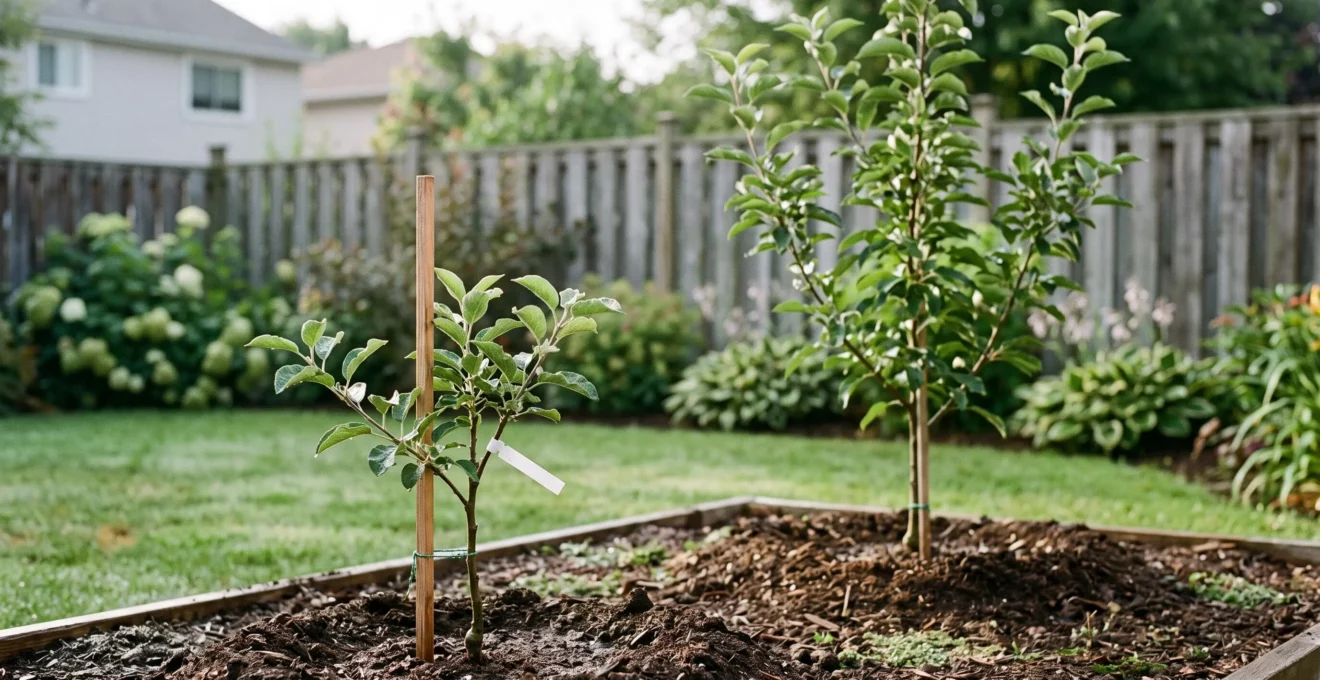
Choosing a fruit tree rootstock isn’t about picking a final size; it’s about understanding the lifelong contract of support and care you are signing up for.
- Extreme dwarfism (M27, M9) comes with a mechanical trade-off: brittle roots that demand permanent, lifelong staking.
- Soil tolerance is not a bonus feature but a genetic reality; MM106 is highly susceptible to root rot in wet clay, while M9 is more resistant.
Recommendation: Match the rootstock’s biological needs—staking, drainage, and sucker removal—to your garden’s specific conditions and your personal commitment to ongoing maintenance.
Staring at a fruit tree label can feel like trying to crack a secret code. You see the apple variety you want—’Honeycrisp’, ‘Granny Smith’—but it’s attached to a cryptic suffix: M9, MM106, G.41. Most gardeners know these codes relate to the tree’s ultimate size, a critical factor for any garden plan. The common advice is to simply pick the one that fits your available space, treating the rootstock as a simple volume control for your tree.
However, this perspective misses the most crucial part of the story. These codes aren’t just about height; they are a shorthand for a complex set of biological and mechanical trade-offs. The choice between a vigorous MM106 and a dwarfing M9 is a choice between a self-sufficient tree and one that may require a lifetime of support. It dictates susceptibility to disease, tolerance for your specific soil type, and even the amount of maintenance it will demand year after year.
But what if the real key wasn’t just matching size to space, but matching the rootstock’s entire life-support requirements to your garden and your gardening style? This guide moves beyond simple size charts to decode the hidden language of rootstocks. We will explore the underlying reasons for their behavior, from their cellular structure to their performance in challenging soils. By understanding the “why” behind the code, you can make a truly informed decision, ensuring your tree not only fits its space but thrives for decades to come.
This article will guide you through the critical considerations for selecting the right rootstock. We will delve into the characteristics of different types, their specific needs, and the common mistakes to avoid, equipping you with the expert knowledge to plant with confidence.
Contents: Decoding Apple Tree Rootstocks for Your Garden
- What Does M27 Mean? Understanding Extremely Dwarf Rootstocks
- Which Rootstock Handles Wet Clay Soil Without Rotting?
- The Planting Depth Error That Cancels Out the Rootstock Effect
- Sucker or Scion: How to Identify and Remove Rootstock Growth?
- Why M9 Rootstocks Need Permanent Staking for Life?
- Family Trees or Pairs: How to Ensure Pollination with Only One Pot?
- Patio Clematis vs Climbers: Which Cultivar Actually Flowers at Eye Level?
- Planning a Dwarf Fruit Tree Orchard on a Patio: Yield vs Space?
What Does M27 Mean? Understanding Extremely Dwarf Rootstocks
The M27 rootstock represents the absolute extreme of dwarfing, creating a tree so small it is often described as a “step-over” apple. It produces a mature tree of about 5-6 ft, making it an excellent candidate for container growing or tiny garden spaces. The key benefit is precocity; trees on M27 often begin fruiting in their very first year. However, this miniature size is not a free lunch; it comes with significant biological compromises that demand specific care from the gardener.
The dwarfing effect is not just about having smaller roots; it’s a fundamental metabolic shift. A detailed physiological study revealed that dwarfing rootstocks like M27 cause earlier shoot termination and have reduced overall mass. At a cellular level, genes promoting the biosynthesis of building blocks like amino acids and cell walls are suppressed, while genes that promote their breakdown are enhanced. In essence, the rootstock is metabolically programmed to be fragile and small, not just a miniature version of a larger tree. This explains why it is so precocious but also so needy.
This inherent fragility translates into non-negotiable care requirements. The small root system is inefficient at seeking out water, meaning it requires constant soil moisture and is highly intolerant of drought. Furthermore, competition from grass and weeds at its base can severely stunt its growth. While the unladen tree is small, a heavy crop of fruit can easily overwhelm its weak structure, meaning a permanent stake is often necessary to prevent damage. M27 is a high-performance system for small spaces, but it is not a low-maintenance one.
Which Rootstock Handles Wet Clay Soil Without Rotting?
One of the most critical environmental factors for a fruit tree is soil drainage. Heavy, wet clay soils are a death sentence for many rootstocks due to their susceptibility to Phytophthora, a water mold fungus that causes crown and root rot. Choosing the wrong rootstock for these conditions will lead to a slow decline and eventual death of the tree, regardless of how well you care for it otherwise. The genetic makeup of the rootstock is your primary line of defense.
Research and field experience have clearly identified which rootstocks stand a chance and which should be avoided. According to data from Cornell’s apple extension network, there are clear winners and losers: the popular semi-dwarf MM.106 is highly susceptible to Phytophthora, whereas the dwarf M.9 is considered relatively resistant. This single factor can be more important than size when choosing a tree for a site with known drainage issues.
The following table, synthesized from university extension data, provides a clear hierarchy of resistance, offering a “good, better, best” approach for gardeners facing heavy soil.
| Tier | Rootstock(s) | Clay/Wet Soil Behavior |
|---|---|---|
| Best | Geneva series (G.11, G.41, etc.), M.27, M.9, B.9 | Considered more resistant to Phytophthora fungus |
| Better | MM.111, M.7 | Moderately susceptible; usable on a raised, wide mound |
| Avoid | MM.106, MM.104, M.26, B.118 | Susceptible to highly susceptible; frequent failure in heavy, poorly drained soil |
If you suspect a tree is already suffering, you can perform a diagnosis. Waterlogged roots are often black and have a foul odor. With crown rot, the bark is killed in a band near the soil surface. Peeling back a small section of bark at the soil line will reveal the health of the tissue underneath; infected tissue appears reddish-brown, whereas healthy tissue is white or greenish-white. This diagnosis can confirm if soil conditions and rootstock choice are the source of the problem.
The Planting Depth Error That Cancels Out the Rootstock Effect
You can do everything right—select the perfect variety, choose the ideal rootstock for your soil and size needs—and negate it all with one simple mistake at planting time: setting the graft union too low. The graft union is the visible, often knobby, point on the trunk where the desired fruit variety (the scion) was joined to the rootstock. This point is the control center for the tree’s size, and its placement relative to the soil is non-negotiable.
If the graft union is buried below the soil or even covered by mulch, the scion variety can grow its own roots directly into the soil. This is called “scion rooting.” When this happens, the scion effectively bypasses the dwarfing influence of the rootstock it’s grafted onto. Your carefully chosen dwarf M9 tree will begin to grow on its own roots, transforming into a full-sized, vigorous tree that will quickly outgrow its intended space. All the benefits of the size-controlling rootstock are lost.
As you can see in the image, the change in bark texture is often the clearest visual cue for locating the graft union. The area below it is the rootstock, and the area above is the scion. Ensuring this junction remains well above the soil line is paramount. Conversely, planting the union too high can sometimes increase the dwarfing effect, resulting in an even smaller tree than desired. Getting the depth just right is a key skill for a successful orchardist.
Action Plan: Ensuring Correct Graft Union Depth
- Identify the Target: The rule of thumb for size-controlling rootstocks is to keep the bud union 3 to 6 inches above the final soil line.
- Account for Settling: Freshly dug soil will settle over time. Plant the tree slightly higher than the target depth to ensure settling doesn’t cause the union to become buried.
- Understand the Risk: Remember that if the union is covered, the scion can develop its own roots, and the benefits of the size-controlling rootstock will be completely lost.
- Avoid the Other Extreme: Planting the union too high can overly restrict the tree’s growth, leading to a smaller, less productive tree than you planned for.
- Maintain a Clear Zone: Keep mulch, soil, and weeds from ever piling up against the trunk and covering the union throughout the tree’s life.
Sucker or Scion: How to Identify and Remove Rootstock Growth?
Another way the rootstock can fight for dominance is by sending up “suckers.” These are vigorous, fast-growing shoots that emerge from the base of the tree, originating from the root system or the trunk below the graft union. These are not branches of your desired apple variety; they are shoots of the rootstock itself. If left to grow, they steal water and nutrients from the scion, weakening the main tree and reducing fruit production. In extreme cases, they can grow large enough to compete with and even overtake the grafted variety.
The tendency to produce suckers is another inherent trait that varies by rootstock. Some, like M.7, are notorious for producing a thicket of suckers, while others are much better behaved. This is a crucial maintenance consideration when selecting a rootstock, as some will require more diligent policing than others.
| Suckering Tendency | Rootstocks |
|---|---|
| High (frequent suckering) | M.7, M.9, G.202 |
| Low (minimal suckering) | B.9, G.11, G.16, M.26, M.27, MM.111, P.18 |
Removing suckers is a simple but essential task. The key is to remove them as cleanly as possible from their point of origin. You may need to move some soil away from the base of the tree to find where the sucker emerges from the root or lower trunk. Using sharp pruners, cut the sucker off flush with the trunk or root. Simply cutting them at ground level is ineffective, as it leaves the base intact and encourages even more vigorous regrowth from the remaining stub. However, care must be taken. As experts from Utah State University caution:
However, when suckers are mechanically removed multiple new shoots can arise from cutting a single sucker, making the problem worse.
– Intermountain Fruit Program, Utah State University Extension — Crown and Root Suckers
This highlights the importance of a clean, complete removal rather than a quick snip, which can exacerbate the problem. It is a recurring chore that is part of the contract you sign when choosing a sucker-prone rootstock.
Why M9 Rootstocks Need Permanent Staking for Life?
One of the most significant “hidden commitments” of dwarf rootstocks is their need for physical support. While a tree on a vigorous rootstock like MM111 will quickly anchor itself firmly in the ground, a tree on a dwarfing rootstock like M9 will never be fully self-supporting. Its root system is mechanically weak and brittle, a direct trade-off for its small size and precocity. Without support, a strong wind or a heavy fruit load can cause the tree to lean, rock in the soil (damaging roots), or even snap clean off at the graft union.
This is not a temporary requirement. Authoritative sources are unequivocal: the Royal Horticultural Society classifies M9 as requiring staking permanently for its entire life. This means a stake should be installed at the time of planting and maintained forever. This “lifetime support system” is a fundamental part of growing trees on M9, G.41, M27, and other rootstocks with poor anchorage. This is a critical factor to consider in your garden design and long-term maintenance plan.
The reason for this lies in the ratio of root types. Dwarf rootstocks have a high proportion of fine, fibrous feeding roots but a low proportion of thick, structural anchoring roots. This “brittle root timber” is simply not engineered for stability. The following table contrasts the needs of several common rootstocks.
| Rootstock | Anchorage/Staking Need |
|---|---|
| M27 | Brittle, small root system; needs staking especially in-ground |
| M9 | Brittle roots, poor anchorage; permanent staking required for life |
| G.41 | Very brittle; solid vertical permanent stake essential |
| M7 | Good anchorage; usually does not require permanent staking |
| MM106 | Reasonably self-supporting once established; susceptible to collar rot on wet sites |
To properly install a permanent stake, it should be driven into the ground on the windward side *before* you place the tree in the hole to avoid damaging the root ball. The trunk is then fastened to the stake using an adjustable rubber tree tie with a spacer, which prevents the bark from chafing against the stake as it grows.
Family Trees or Pairs: How to Ensure Pollination with Only One Pot?
Beyond the rootstock, the greatest challenge to getting fruit in a small space is pollination. Most apple varieties are not self-fertile, meaning they require pollen from a different, compatible apple variety to set fruit. For a gardener with only enough space for a single tree, this presents a major problem. Fortunately, nurseries have developed clever solutions to solve this exact issue, allowing for a successful harvest from just one pot or planting spot.
The first solution is the “family tree” or “combo” tree. This involves grafting multiple compatible varieties onto a single rootstock. For example, you might find a tree with branches of ‘Liberty’, ‘Honeycrisp’, and ‘Gala’ all growing from one trunk. As these different varieties flower at the same time, they cross-pollinate each other, ensuring a fruit set without needing a second tree nearby. This is an ingenious and highly efficient use of space, giving you both pollination and a variety of apples from a single plant.
The second option is to plant a “pair” of trees in the same container or planting hole. By selecting two different compatible varieties on a very dwarfing rootstock like M27, you can plant them just 18-24 inches apart. Their root systems will coexist, and their canopies can be pruned to grow together as if they were a single, multi-stemmed plant. This provides the necessary cross-pollination while maintaining a very small footprint. Both methods effectively turn the problem of pollination into an opportunity for greater variety in your small-space orchard.
Patio Clematis vs Climbers: Which Cultivar Actually Flowers at Eye Level?
The same principle of “decoding the label” applies to other plants marketed for small spaces, like clematis. Many gardeners buy a plant labeled “Patio Clematis” expecting a compact bush, only to find it sends out long, vining stems with flowers appearing 6-8 feet off the ground. The term “patio” can be misleading if you don’t understand the plant’s underlying growth habit, much like a rootstock code.
True patio clematis cultivars are specifically bred not just for a shorter ultimate height, but for a different flowering habit. They belong to pruning Group 3 and are characterized by their ability to flower prolifically on new growth, from the base of the plant upwards. Cultivars like ‘Bijou’ or ‘Filigree’ will start producing flowers just a foot or two from the soil, creating a column of color that is visible at eye level. This is because they are pruned hard back to a pair of buds near the ground each spring, forcing all new growth—and flowers—to emerge from low down.
In contrast, many other “compact” climbers belong to pruning Group 2. These varieties flower first on the previous year’s old wood. If you prune them hard to the ground, you will remove all the flowering wood from the previous season. Their nature is to climb to a certain height and then produce flowers. While they may not reach 20 feet, their flowers will still appear at the top of their growth, often well above a seated person’s eye level on a patio. Therefore, when choosing a clematis for a pot, the crucial question isn’t just “how tall does it get?” but “where on the vine do the flowers appear?”
Key Takeaways
- Rootstock codes (M9, MM106) dictate more than size; they define a tree’s lifelong needs for support, water, and disease management.
- Extreme dwarfism (M27, M9) is a mechanical trade-off requiring permanent staking due to brittle, weak root systems.
- Always plant a grafted tree with the graft union 3-6 inches above the soil line to prevent the scion from rooting and losing its size control.
Planning a Dwarf Fruit Tree Orchard on a Patio: Yield vs Space?
With an expert understanding of rootstocks, you can transform a patio, balcony, or small yard into a productive miniature orchard. The key is to shift your thinking from single, standalone trees to an integrated system where every element is chosen to maximize yield in a minimal footprint. This involves combining the right rootstocks with space-saving training techniques.
For container culture, extremely dwarfing rootstocks like M27 or M9 are ideal. Their confined root systems are well-suited to pots, but this also means they are entirely dependent on you for water and nutrients. You become the sole provider for their survival. The trade-off is a manageable tree that can be moved and fruits very quickly. For slightly more space, a rootstock like M26 offers a bit more vigor and a less demanding root system while still remaining compact.
The true art of the patio orchard, however, lies in training. Techniques like espalier or cordon allow you to grow trees flat against a wall or fence. An espaliered tree on a dwarf rootstock might take up 6-8 feet of horizontal wall space but only 18 inches of depth, turning an unused vertical surface into a productive fruiting zone. This method not only saves immense space but also improves sun exposure and air circulation, often leading to higher quality fruit. By combining a dwarfing rootstock with a high-density training system, the classic conflict between yield and space becomes a manageable design challenge rather than an insurmountable barrier.
By decoding the language of rootstocks, you move from a passive buyer to an active, informed grower. You are now equipped to choose a tree not just for the space it will fill, but for the life it will lead in your garden and the partnership it will require from you.