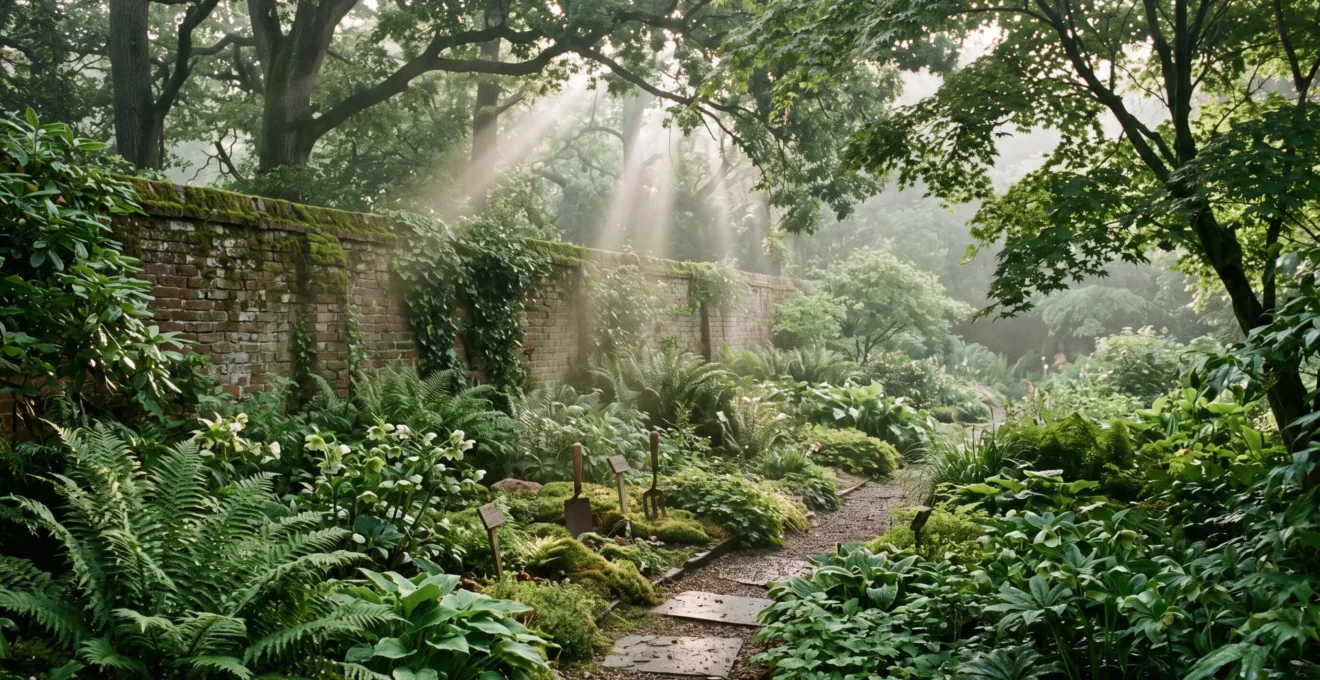
Contrary to popular belief, the key to a thriving UK shade garden isn’t just finding more light—it’s about systematically improving your plants’ ability to use the limited light they receive.
- Standard “bright” grow lights often fail because they don’t provide the correct light spectrum (PAR) that plants actually need for photosynthesis.
- Plant choice is critical; native shade-adapted species like certain ferns can photosynthesise in light conditions ten times lower than what a Hosta can tolerate.
- Over-fertilising, especially with nitrogen, is counterproductive in shade, causing weak growth that the plant’s limited energy engine cannot support.
Recommendation: Stop fighting the shade and start managing light as a precious resource by focusing on light quality, leaf health, and precise plant selection to maximise photosynthetic efficiency.
For many urban gardeners across the UK, the north-facing garden or overshadowed patio is a familiar challenge. It’s a space defined by limited direct sunlight, a persistent dampness, and the constant battle against the gloom. The common advice is to fill these areas with “shade-tolerant” plants, a well-meaning but often simplistic solution. We’re told to use grow lights to supplement the famously grey British weather or to simply accept a less vibrant display than our sun-drenched neighbours.
But what if the conventional wisdom is missing the point? What if the secret to a lush, thriving shade garden isn’t about desperately trying to add more light, but about making your plants dramatically better at using the scarce light they already have? This is the principle of light-use efficiency. From a botanical perspective, a shady spot is an environment where every single photon counts. Success depends not on brute force, but on a deep understanding of the plant’s photosynthetic machinery.
This article moves beyond the platitudes. We will not just list shade-loving plants; we will explore *why* some outperform others at a cellular level. We will deconstruct why your expensive grow light might be failing, reveal the common feeding mistake that harms shade plants, and provide you with the scientific tools to turn your challenging space into a case study of resilience and optimised growth. By understanding the science, you can become an efficiency expert for your garden.
To navigate these botanical principles, this guide is structured to build your expertise from the ground up. We will cover the quality of light itself, the health of the leaf, the crucial choice of species, and the precise techniques to map and manage the light you have. Explore the topics below to master the science of shade gardening.
Summary: A Scientific Guide to Boosting Photosynthesis in UK Shade
- Why Standard Grow Lights Fail During British Winters?
- How to Clean Leaves to Increase Light Absorption by 15%?
- Ferns or Hostas: Which Species Photosynthesizes Better in Deep Shade?
- The Nitrogen Mistake That Burns Plants in Low-Light Conditions
- Orienting Your Greenhouse: The Exact Angle for Winter Sun Capture
- How to Create a Sun Map of Your Garden in One Day?
- Why Variegated Plants Need More Light Than Green Ones (Usually)?
- How to Map Solar Exposure to Double Your Tomato Yield in the UK?
Why Standard Grow Lights Fail During British Winters?
The reflexive solution for a dark corner is often a grow light. However, many gardeners invest in supplemental lighting only to see lacklustre results, especially during the UK’s long, dark winters. The failure isn’t just about the cost, though with the average UK electricity price sitting at around 25.73 pence per kWh, running lights continuously becomes a significant expense. The primary failure is a misunderstanding of what constitutes “useful” light for a plant.
We perceive light in terms of brightness (lumens), but plants “see” light in terms of usable energy for photosynthesis, measured by Photosynthetically Active Radiation (PAR). A standard household LED or an old-fashioned bulb might seem intensely bright to our eyes but can be emitting wavelengths of light that are largely useless for driving photosynthesis. The crucial metric for a gardener is PPFD (Photosynthetic Photon Flux Density), which measures the amount of PAR light actually reaching the plant’s leaves. Without a sufficient PPFD level in the correct spectrum (typically blue and red wavelengths), a plant simply cannot produce enough energy, regardless of how “bright” the light appears to us.
This distinction is the difference between a plant surviving and a plant thriving. It explains why professional horticultural lighting is specified by its PAR output and PPFD, not its lumens.
| Metric | What It Measures | Relevance to Plant Growth | Typical Unit |
|---|---|---|---|
| Lumens / Lux | Brightness as perceived by the human eye | Not a reliable indicator of usable light for photosynthesis | lm / lux |
| PAR | Wavelength range (400–700nm) usable for photosynthesis | Defines whether the light spectrum can drive photosynthesis at all | nm range |
| PPF | Total photosynthetic photons emitted by a light source | Indicates the raw photosynthetic output of a fixture | µmol/s |
| PPFD | Photons actually reaching the plant canopy per second, per m² | The most accurate measure of usable light reaching your plants | µmol/m²/s |
The practical impact of choosing the right light spectrum is significant. As a controlled greenhouse trial demonstrates, it’s the quality, not just the presence of light, that drives results. In the study, tomato plants grown under a PAR-optimised LED fixture were significantly taller and produced a higher fruit yield (14%) than those under standard HPS lighting. For the UK gardener, this means investing in a cheap, bright light is often a false economy; a dedicated, full-spectrum horticultural LED, while more expensive initially, is the only way to effectively supplement the winter gloom.
How to Clean Leaves to Increase Light Absorption by 15%?
In a sun-drenched garden, a thin layer of dust on a leaf is a minor inconvenience. In a shade garden, it’s a critical barrier to survival. The “15% increase” is more than a catchy figure; it represents the huge potential gain from a simple act of maintenance. Every photon is precious in a low-light environment, and a layer of urban grime, dust, or mineral deposits from hard water can scatter or reflect a significant portion of this vital energy before it ever reaches the chlorophyll within the leaf.
The problem is twofold. Firstly, the physical barrier of dust reduces the amount of light hitting the leaf’s surface. Secondly, this grime can clog the plant’s stomata—the tiny pores on the leaf surface responsible for gas exchange. Blocked stomata mean the plant cannot efficiently take in the carbon dioxide it needs for photosynthesis, effectively suffocating it at a microscopic level. It’s a zero-cost, high-impact way to improve your plant’s light-use efficiency.
The cleaning process should be gentle to avoid damaging the leaf’s protective waxy cuticle. The best method is mechanical, not chemical. Forget leaf-shine products, which can clog stomata just as badly as dust. Simply take a soft, damp cloth (microfibre is ideal) and a bowl of tepid water—avoiding very cold or hot water, which can shock the plant. Support the leaf from underneath with one hand and gently wipe the top surface with the damp cloth. For delicate or hairy leaves, a soft-bristled brush or a gentle spray of water can be more appropriate. This simple task, performed every few weeks, is one of the most effective ways to maximise the photosynthetic potential of your shade-loving plants.
Ferns or Hostas: Which Species Photosynthesizes Better in Deep Shade?
The label “shade-tolerant” is a broad church, encompassing plants with vastly different capabilities. While both ferns and hostas are staples of the British shade garden, their strategies and ultimate efficiency in low light are not the same. The answer to which is “better” lies in understanding their evolutionary adaptations. As the RHS explains, shade-tolerant plants adapt structurally to low light, often developing broader, thinner leaves with a higher concentration of chlorophyll to maximise capture of scarce photons.
Hostas are a prime example of this first strategy: creating large, broad “solar panels” to catch as much light as possible. However, they are often less efficient in the very deepest, darkest corners. Many native UK ferns, on the other hand, are masters of a different strategy: extreme efficiency. They have a much lower light compensation point—the point at which the energy produced by photosynthesis is equal to the energy consumed by respiration. A plant with a lower light compensation point can survive, and even grow, in far deeper shade.
The Killarney fern (Trichomanes speciosum), a native to the British Isles, is an extreme example of this. A University of Manchester study found that these plants have optimal photosynthesis at light intensities of c. 5–10 µmol m⁻² s⁻¹, a level of light so low it’s considered deep gloom. For comparison, a moderately shady spot might receive 50-100 µmol m⁻² s⁻¹. This remarkable ability is due to a combination of an incredibly low metabolic rate and a highly efficient photosynthetic apparatus. While not all ferns are this extreme, many, like the Hart’s Tongue Fern (Asplenium scolopendrium), are far better equipped to truly thrive in the darkest parts of a garden where a Hosta would merely survive or decline.
The Nitrogen Mistake That Burns Plants in Low-Light Conditions
When a plant looks weak or pale, our instinct is often to feed it. In a sunny border, a dose of all-purpose fertiliser rich in nitrogen can provoke a flush of healthy green growth. In a shady garden, however, this same action can be counterproductive, even harmful. This is the common nitrogen mistake: trying to force growth that the plant’s energy budget cannot support.
In a low-light environment, the primary limiting factor for growth is not nutrients; it is the lack of light for photosynthesis. Think of photosynthesis as the plant’s engine. Nitrogen is the fuel that encourages it to build new leaves and stems. Pumping excess nitrogen into a shade-grown plant is like flooring the accelerator on a car with a tiny, sputtering engine. The plant is stimulated to produce new, lush, leafy growth, but it doesn’t have the photosynthetic capacity (the engine power) to support it. This results in etiolation—long, weak, floppy stems and pale leaves that are highly susceptible to pests like aphids and diseases like powdery mildew. The plant has spent its precious energy reserves on building weak structures it cannot sustain.
The correct strategy for fertilising in shade is to be far more conservative. The focus should shift away from nitrogen (N) and towards potassium (K), which supports overall plant health, disease resistance, and strong cellular structures without forcing unnecessary foliar growth. Use a balanced fertiliser at half-strength during the growing season only, or switch to a low-nitrogen, high-potassium formula often sold as an autumn feed. For plants in the deepest shade, minimal feeding is often the best approach. You are aiming for resilience and health, not rapid, unsustainable growth.
Orienting Your Greenhouse: The Exact Angle for Winter Sun Capture
For gardeners in the UK, a greenhouse is a gateway to extending the seasons, but its effectiveness during the low-light winter months is critically dependent on a single, permanent decision: its orientation. While it may seem like a minor detail, the angle of your greenhouse relative to the sun’s path can dramatically alter the amount of light and heat it captures, especially when the sun is low on the horizon.
In the Northern Hemisphere, the winter sun travels in a low arc across the southern sky. To maximise the capture of this limited resource, a greenhouse should be oriented with its longest side facing south. This presents the largest possible surface area (the roof and one long side) to the sun’s rays for the longest period of the day. This is known as an East-West orientation, as the ridge of the roof runs from east to west.
Conversely, a greenhouse with a North-South orientation (where the gable ends face east and west) will capture strong morning and evening sun in the summer but will present a much smaller profile to the low winter sun, remaining colder and darker. This might be desirable in hotter climates to prevent overheating, but for the UK gardener focused on winter protection and early spring propagation, the East-West axis is unequivocally superior.
This principle is most effective for standalone greenhouses. For a lean-to greenhouse, the ideal placement is against a south-facing wall, which not only guarantees maximum light exposure but also acts as a giant storage heater, absorbing warmth during the day and radiating it back into the greenhouse at night, further buffering against the cold.
How to Create a Sun Map of Your Garden in One Day?
Before you can optimise your garden for light, you must first understand exactly what you have. A “shady garden” is not a uniform state; it is a complex mosaic of deep shade, dappled light, morning sun, and afternoon sun, all influenced by trees, walls, and neighbouring buildings. Creating a sun map is the single most powerful diagnostic you can perform, transforming your assumptions into concrete data. It’s a simple, low-tech process that will pay dividends in every planting decision you make.
The goal is to track the movement of shadows throughout a single day. Choose a day with relatively consistent weather—ideally a sunny or at least a bright, overcast day—to get a clear picture. This process will reveal the “prime real estate” in your garden, as well as the truly challenging spots. Armed with this knowledge, you can site plants with a botanist’s precision, ensuring sun-lovers get the rays they need and shade-lovers are protected from scorching.
Your Garden’s Personal Light Audit: A 5-Step Plan
- Sketch Your Plot: Start with a simple, bird’s-eye view sketch of your garden. Mark key features like the house, fences, large trees, shrubs, and any existing beds. This doesn’t need to be art; it’s a working document.
- First Observation (e.g., 9 AM): Go into your garden and observe where the shadows fall. Using small stakes, flags, or even stones, mark the edge of the major shadows on the ground. On your sketch, draw a line corresponding to these shadow edges and lightly shade the area in shadow, labelling it “9 AM”.
- Midday Observation (e.g., 12 PM): Return at midday when the sun is at its highest (and shadows at their shortest). Repeat the process: mark the new shadow boundaries on the ground and transfer them to your map, using a different colour or pattern and labelling it “12 PM”.
- Final Observation (e.g., 3 PM): Make a final observation in the afternoon. Mark the now-lengthening shadows once more and record them on your map, labelling this layer “3 PM”.
- Analyse the Composite Map: You now have a map with overlapping shaded areas. The zones that were in shadow at all three observation times are your ‘deep shade’ areas. Areas shaded in the morning but sunny in the afternoon are your ‘afternoon sun’ spots, and so on. You can now clearly see which parts of your garden receive more than 6 hours of sun, 3-6 hours, or less than 3 hours.
This simple map is now your master plan. It allows you to move beyond generic advice and apply specific solutions to the unique microclimates within your own garden, ensuring every plant is positioned for optimal photosynthetic performance.
Why Variegated Plants Need More Light Than Green Ones (Usually)?
Variegated plants, with their beautiful splashes of white, cream, or yellow, are often coveted for brightening up shady corners. There is, however, a botanical irony at play: the very feature that makes them so attractive also makes them less efficient at photosynthesis, and therefore often more demanding of light than their plain green counterparts.
The white or cream sections of a variegated leaf lack chlorophyll, the green pigment that is essential for capturing light energy. These areas are, from a photosynthetic standpoint, completely non-productive. They are passengers being carried by the energy produced in the green parts of the leaf. A fully green leaf is a 100% efficient solar panel. A variegated leaf might only be 50-70% efficient, depending on the extent of its variegation. This means the plant has to work much harder to produce the same amount of energy.
This explains a common phenomenon known as reversion. When a variegated plant is placed in a low-light situation, its survival instincts kick in. It “realises” it isn’t generating enough energy to survive. In response, it starts producing more chlorophyll, and new growth will often emerge as solid green. These reverted green shoots are much more photosynthetically efficient and will quickly outcompete and take over the weaker, variegated parts of the plant. It’s not a disease; it’s a desperate survival strategy.
Managing these plants in a UK shade garden requires a delicate balance. They need a spot that is bright enough to maintain their variegation but shaded enough to prevent the delicate, non-pigmented tissues from scorching. Key management strategies include:
- Understanding the trigger: Low light is the primary cause for reversion, as the plant tries to maximise its chlorophyll production to survive.
- Strategic positioning: Place borderline variegated plants in the brightest part of a shade border, not the deepest gloom. Morning sun is often ideal.
- Prompt pruning: Cut out any fully green, reverted shoots as soon as they appear. This prevents them from dominating the plant.
- Acceptance: A small degree of seasonal greening in the winter is a natural response and can be accepted rather than treated as a failure.
Key takeaways
- Light quality (PAR/PPFD) is more important than perceived brightness (lumens) for plant growth.
- Improving light-use efficiency through simple acts like cleaning leaves can have a major impact in low-light conditions.
- Not all “shade-tolerant” plants are equal; understanding their specific adaptations and light compensation points is key to success in deep shade.
- In shade, over-fertilising, especially with nitrogen, is more harmful than under-fertilising.
How to Map Solar Exposure to Double Your Tomato Yield in the UK?
The promise of doubling your tomato yield in the UK might sound like hyperbole, but for many gardeners, it is a realistic outcome achievable through one strategic action: correctly siting the plants based on a solar map. Tomatoes are sun-worshipping plants, requiring a minimum of 6-8 hours of direct, intense sunlight per day to produce fruit effectively. In the varied light of a typical UK garden, they are often placed in spots that are merely “sunny” rather than optimally sun-drenched.
This is where the sun map you created becomes an invaluable tool. By analysing your map, you can identify the single hottest, sunniest piece of real estate in your entire garden—the spot that receives the longest duration of uninterrupted sunlight. For a sun-hungry crop like tomatoes, this is non-negotiable. Moving your tomato plants from a “pretty good” spot that gets 4-5 hours of sun to the “prime” spot that gets 7+ hours can genuinely be the difference between a meagre harvest and a bumper crop. The increase in photosynthetic potential is exponential.
Once you have identified this prime location, you can further enhance it. Siting the tomatoes against a south-facing wall or fence is a classic technique. The wall not only protects the plants from wind but also acts as a thermal mass, absorbing heat during the day and radiating it back at night. Painting that wall white or placing reflective panels behind the plants will bounce even more precious photons back onto the leaves, further boosting the available light and pushing the plants towards their maximum fruiting potential. Doubling the yield isn’t magic; it’s the logical result of moving a plant from a location where it is merely surviving to one where it is perfectly positioned to thrive.
Now that you understand the science, stop fighting the shade and start working with it. Use these botanical principles to audit your light, choose your plants with precision, and create a garden that doesn’t just survive, but truly thrives in the unique conditions of your space.