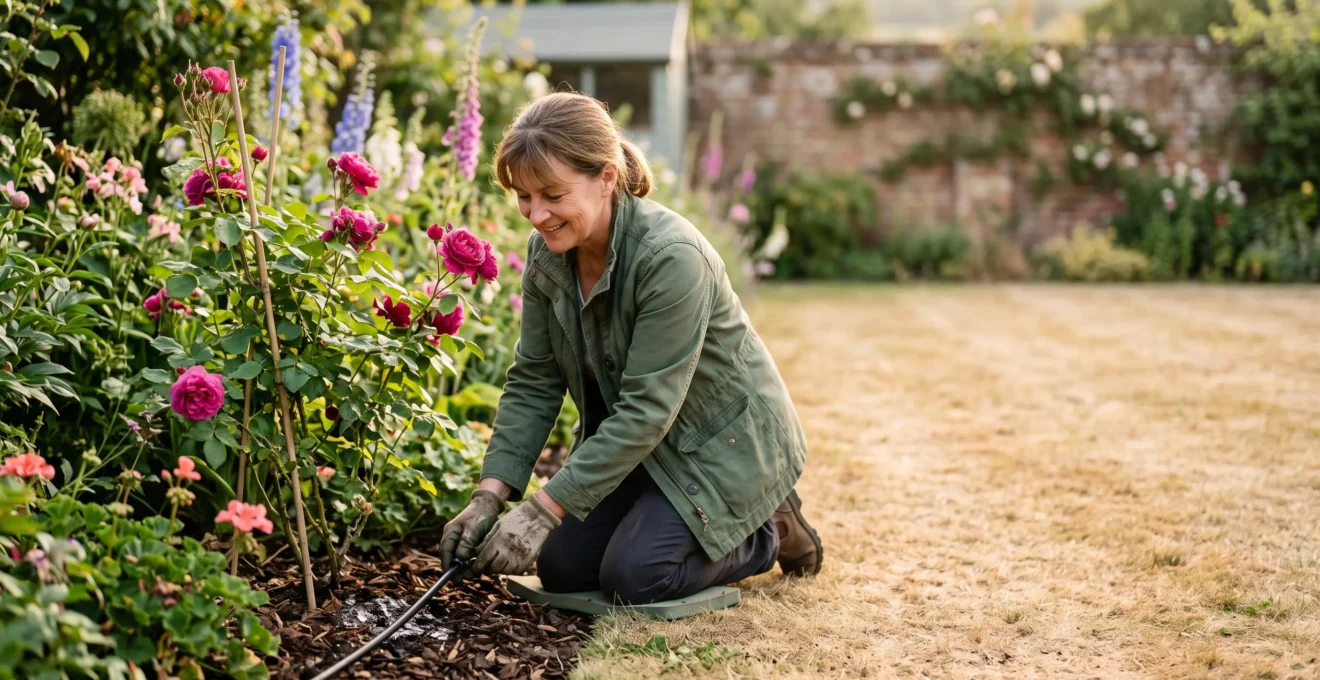
The key to surviving a hosepipe ban isn’t finding a loophole, but adopting a superior, precision-engineered watering strategy that makes your garden more resilient.
- Drip irrigation is legal during a ban because it’s not legally defined as a “hosepipe,” provided it uses a timer and pressure reducer to deliver water directly to the soil.
- Effective systems focus on deep, infrequent watering to encourage strong roots, avoiding the common mistakes that waste water and weaken plants.
Recommendation: Shift your mindset from “spraying” to “hydrating.” Test your soil’s drainage and invest in a properly designed drip system to build a truly drought-proof garden.
The familiar dread of a looming hosepipe ban sends a shiver down the spine of any dedicated gardener, especially in the increasingly dry South East. As lawns turn yellow and borders begin to crisp, the first instinct is to search for workarounds and loopholes. Many have heard the rumour that drip irrigation systems are somehow exempt, a secret weapon in the fight for summer survival. This is a common starting point, but it misses the bigger picture.
The usual advice often revolves around surface-level tactics: use watering cans, mulch your beds, and hope for the best. While these are valid water-saving measures, they are reactive, not strategic. They treat the symptom—a lack of water—without addressing the underlying health and efficiency of your garden’s hydration system. Thinking about more advanced techniques can feel overwhelming, but the principles are straightforward.
But what if the true path to a thriving garden during a drought wasn’t about simply finding a legal way to keep watering, but about fundamentally changing *how* you water? This is where the real power of drip irrigation lies. It’s not a clever trick to beat the system; it is the system, a method of precision engineering for your garden that delivers water more efficiently, effectively, and beneficially than a hosepipe ever could. It is about shifting focus from the leaves to the root zone, from quantity to quality.
This guide will deconstruct the science and strategy behind effective drip irrigation. We will explore why these systems are legally compliant, the critical difference between efficient and wasteful setups, and how to use this technology to build a more resilient, drought-proof garden for the long term. Forget loopholes; it’s time to embrace horticultural intelligence.
Summary: Strategic Drip Irrigation to Overcome Hosepipe Bans
- Are Drip Systems Legal During a Hosepipe Ban?
- Night or Morning: The Best Time to Run Drip Systems for Efficiency?
- Soaker Hose or Drippers: Which Wastes Less Water in Borders?
- The Drip Mistake That Creates Weak, Surface-Level Roots
- How to Ensure the Last Pot Gets as Much Water as the First?
- How to Establish a ‘Dry Garden’ Backbone in Chalky Soil?
- The Bucket Test: How Fast Should Water Drain for Lavender?
- How to Test for Well-Drained Soil Before Planting Expensive Herbs?
Are Drip Systems Legal During a Hosepipe Ban?
The short answer is yes, a correctly installed drip irrigation system is almost always legal during a hosepipe ban in the UK. This isn’t a loophole, but a matter of precise legal definition. The core of the legislation, the Water Industry Act 1991, targets a specific list of activities. As the UK Parliament’s text clarifies, the prohibition is on “watering a garden using a hosepipe”. A professionally designed drip system is not considered a hosepipe in this context.
A “hosepipe” is legally interpreted as a device you hold to spray water broadly. In contrast, a drip or trickle irrigation system is a fixed installation designed for precision delivery. The key qualifying components are a timer, which automates watering outside of peak hours, and a pressure-reducing valve (PRV). The PRV is non-negotiable; it slows the flow from mains pressure to a slow ‘drip’ that the soil can absorb without runoff or misting. Without it, your system is inefficient and likely non-compliant.
Water companies are aligned on this. They want customers to use water efficiently, and drip systems are a primary example of how to do this. They are not a “back door” way to use a hose; they are an officially-endorsed method of responsible water management. The crucial takeaway is that compliance is achieved through system design, not by hiding your watering activities.
This table, based on public statements from major suppliers, illustrates the general consensus. As guidance from water companies shows, the rules are built around the principles of automated, low-pressure, targeted delivery.
| Water Company | Drip/Trickle Irrigation Rule | Special Notes |
|---|---|---|
| Thames Water | Allowed if fitted with a pressure-reducing valve and timer, delivering water directly to the soil without runoff or misting | Same exemption covers newly planted trees/shrubs for a 3-year window |
| Southern Water | Approved drip or trickle system with PRV and timer is permitted | Treated as a legitimate way to keep using a hosepipe efficiently, not a loophole |
| Cambridge Water | Allowed only if the system is genuinely drip-fed; other irrigation types banned on mains | Rainwater/grey-water-fed irrigation is explicitly unrestricted |
| Affinity Water | General TUB rules apply under the Water Industry Act 1991 | Communal or care-home gardens are NOT exempt, even for Blue Badge residents |
Night or Morning: The Best Time to Run Drip Systems for Efficiency?
The age-old gardening wisdom dictates watering in the morning, and for general hosepipe use, this holds true. It allows water to reach the roots and foliage to dry before nightfall, reducing the risk of fungal diseases. However, with a drip irrigation system, the calculation changes. Because water is delivered directly and slowly to the root zone, the foliage never gets wet. This immediately reduces the risk of mildew and black spot, opening up more efficient watering windows.
Running your system in the very early morning, around 4 or 5 AM, remains the gold standard for water-use efficiency. At this time, ambient temperatures are at their lowest and wind is often minimal. This means virtually zero water is lost to evaporation from the soil surface, ensuring every drop is available for the plant’s roots. Watering at dawn also prepares the plant for the heat of the day ahead, fully hydrating it before transpiration rates increase.
Watering overnight is a close second. The key benefit is also near-zero evaporation. The primary downside is that the soil surface remains damp for a prolonged period, which can encourage slugs and, in very specific circumstances with poor drainage, could contribute to root rot. However, for free-draining soils, this risk is minimal. As the Royal Horticultural Society often advises, microclimates vary widely, so a windy coastal garden will benefit more from night watering to avoid evaporative loss than a sheltered, humid courtyard where morning might be safer. The worst time is the middle of the day or the evening, when both heat and wind can carry precious moisture away before it ever penetrates the soil.
Soaker Hose or Drippers: Which Wastes Less Water in Borders?
When designing a system for garden borders, the choice often comes down to two technologies: soaker hoses and drip lines with individual emitters. A soaker hose is a porous pipe that “weeps” water along its entire length, creating a continuously damp strip. A drip line uses solid tubing with precisely engineered emitters positioned at set intervals (or placed manually) to deliver water to specific points.
For a newly planted, dense herbaceous border or a hedge where plants are close together, a soaker hose can be an efficient way to establish a wide, moist zone. However, its effectiveness can degrade over time, particularly in the UK’s many hard-water areas. The tiny pores are highly susceptible to clogging from limescale, leading to uneven watering and dry patches. Furthermore, they require very low pressure (around 10 PSI), and without a reliable regulator, mains pressure can cause them to split or waste water through excessive output.
For targeted watering of individual shrubs, roses, perennials, or containers, a system with individual drippers is far superior in terms of precision and longevity. You place the water exactly where the roots are, with zero wastage between plants. If an emitter becomes clogged with limescale, it can be easily cleaned or replaced for a few pence without affecting the rest of the system. While the initial setup cost may be slightly higher, the long-term control and water efficiency are unmatched. This is the “precision engineering” approach to garden hydration.
This comparative table, drawing on data from suppliers like specialist irrigation retailers, clarifies the trade-offs involved in this key decision.
| Factor | Soaker Hose | Drip Line / Individual Drippers |
|---|---|---|
| Operating Pressure | 10–25 PSI; standard UK mains (50+ PSI) can split the hose without a regulator | Regulated via pressure-reducing valve; tolerates mains pressure with correct fittings |
| Max Practical Length | Around 30m per single line before uneven distribution | Extendable via multi-diameter main/branch tubing design |
| Typical Cost | £20–£35 for a 25m hose | From around £40 for a comparable kit |
| Hard-Water Maintenance | Tiny pores clog with limescale over time; needs seasonal flushing or vinegar soaking | Individual emitters can be cleaned or simply swapped out |
| Best Use | Dense, linear herbaceous borders and hedges | Targeted watering of specimen shrubs, roses and containers |
The Drip Mistake That Creates Weak, Surface-Level Roots
One of the most common and damaging mistakes made with any irrigation system is watering too little, too often. This is a particularly insidious problem with drip irrigation because its efficiency can create a false sense of security. Setting a timer to run for 10-15 minutes every day might seem like a good way to keep the soil moist, but it’s actively training your plants to be weak and vulnerable to drought.
Plants are opportunistic; their roots grow towards water. When you only provide a shallow layer of moisture at the soil’s surface, the roots have no incentive to grow downwards. They form a dense, shallow mat just below the emitters. This creates two significant problems. Firstly, these surface roots are the first to be exposed to extreme heat and drying winds, making the plant *more* dependent on daily watering. Secondly, the plant fails to develop the deep, anchoring roots necessary to find moisture further down in the soil profile during a prolonged dry spell. In essence, you are creating a coddled, high-maintenance plant.
The correct approach is deep and infrequent watering. Instead of 15 minutes daily, it is far better to run the system for a longer period (e.g., 60-90 minutes) just once or twice a week. This allows the water to percolate deep into the soil, encouraging roots to follow it downwards. A plant with deep roots has access to a much larger reservoir of soil moisture and is fundamentally more resilient and drought-tolerant. This is especially critical in the heavy clay soils common across Britain, where, as expert guides citing the RHS note, shallow watering can lead to compaction and poor soil structure rather than encouraging deep exploration.
How to Ensure the Last Pot Gets as Much Water as the First?
A frequent point of failure in DIY drip systems, especially for container gardens, is uneven water distribution. Gardeners set up a long line of pots, connect a single 4mm micro-tube, and discover that the first pot is waterlogged while the last pot remains bone dry. This is a classic problem of physics: friction and pressure loss. As water travels down a narrow tube, it loses pressure with every metre and every emitter it passes. This “pressure drop-off” is a primary systemic failure point.
The solution lies in proper system design, thinking like a water engineer, not just a gardener. The core principle is to use different pipe diameters for different jobs. Instead of running a single, long, narrow pipe, you should establish a wider “main line” or “backbone” using 13mm or 19mm supply tubing. This wider pipe can carry a much larger volume of water over a longer distance with minimal pressure loss.
From this main supply line, you then branch off with the narrower 4mm micro tubing to feed individual pots or emitters. This “main and branch” structure ensures that the pressure available at the start of the line is almost identical to the pressure at the end. Another advanced technique is to create a “looped circuit,” where the 13mm supply pipe runs to the end of the container row and then loops back to the start. Tapping into this loop from both directions effectively equalises the pressure across the entire system. This level of planning is what separates a frustrating, ineffective system from a reliable, precision-engineered one.
How to Establish a ‘Dry Garden’ Backbone in Chalky Soil?
True water efficiency extends beyond the irrigation hardware; it begins with the ground itself and the plants you choose. Establishing a “dry garden” backbone is about creating a resilient core of plants that are naturally adapted to your local conditions. For many gardeners in the South East, this means contending with chalky soil. Chalky soils are alkaline, thin, and extremely free-draining. They warm up quickly in spring but can become dust-dry in summer, and nutrients are often scarce.
Instead of fighting this reality by trying to grow thirsty, acid-loving plants, the strategic approach is to embrace it. The key is choosing plants that evolved in similar conditions, such as those from the Mediterranean. Think Lavender, Rosemary, Santolina, Cistus (Rock Rose), and ornamental grasses like Stipa. These plants thrive in lean, alkaline, free-draining environments. Their root systems are designed to seek out water deep in the subsoil, and their foliage, often silver or hairy, is adapted to reduce moisture loss.
When planting in chalk, the goal is not to create a rich, water-retentive loam. It is to improve the structure just enough for young plants to establish. The single most important amendment is coarse horticultural grit. Digging a generous amount of grit and organic matter (like peat-free compost) into the planting area helps to create air pockets and prevent the soil from compacting into a concrete-like state, but the fundamental free-draining nature should be preserved. A drip system can then be used sparingly during the first year to help these plants establish their deep root systems, after which they will require very little supplemental watering, forming the drought-proof spine of your garden.
The Bucket Test: How Fast Should Water Drain for Lavender?
Before you invest in expensive Mediterranean plants like Lavender, which are perfect for a dry garden backbone, it’s vital to confirm your soil has the sharp drainage they demand. Planting a lavender in heavy, waterlogged clay is a death sentence. The simple, effective way to assess this is the “bucket test,” a basic percolation test that measures how quickly water drains away.
To perform the test, dig a hole roughly the size of a spade’s depth and width (about 30cm x 30cm). Fill it to the brim with water from a bucket or watering can and let it drain completely. This first bucket saturates the surrounding soil. Immediately refill the hole with water and this time, measure how long it takes for the water level to drop. For a lavender-friendly spot, the hole should empty completely in well under an hour. If water is still standing in the hole after a few hours, your soil is too heavy and water-retentive for Mediterranean plants to thrive.
This result isn’t a failure; it’s crucial data. It tells you that you cannot simply plant in the ground. For these situations, you must create an artificial drainage environment. Don’t just add grit to the planting hole, as this can create a “sump” effect where water collects. The best solution is to build a mound or raised bed on top of the native soil, creating an elevated zone of free-draining, gritty compost where the plant’s roots can stay dry.
Action Plan: The Mound Solution for Heavy Soil
- If your soil is heavy, plant lavender on a 20–30cm mound, ridge, or in a raised bed so the roots will not sit in wet soil.
- Avoid simply adding grit to the planting hole alone — waterlogging displaces air from the soil, and roots can effectively drown unless adapted to those conditions.
- Remember that lavender will not thrive in heavy clay soil or any soil that becomes waterlogged, so the mound itself must be built from a free-draining, gritty mix.
Key Takeaways
- Drip irrigation is legal during a hosepipe ban if it uses a timer and pressure reducer, as it falls outside the legal definition of a “hosepipe”.
- Watering in the very early morning is most efficient, but the direct-to-soil nature of drip systems makes night watering a viable, low-evaporation alternative.
- True water efficiency comes from deep, infrequent watering cycles that encourage strong, drought-resilient root systems, not shallow daily sprinkling.
How to Test for Well-Drained Soil Before Planting Expensive Herbs?
The principle of testing your soil’s drainage is a universal strategy for successful, water-efficient gardening. It moves you from a position of hoping for the best to making data-driven decisions. This is especially true when planting any expensive specimen plants or herbs that have specific requirements, particularly those from Mediterranean climates like Thyme, Sage, and Rosemary, in addition to Lavender.
Understanding *why* drainage is so critical is key. As the Royal Horticultural Society explains, when soil is waterlogged, the water fills all the tiny air pockets between soil particles. Plant roots, just like the rest of the plant, require oxygen to live. Without these air pockets, the roots can literally suffocate and “drown,” leading to rot and rapid plant death. A simple percolation test (like the bucket test) is your window into this underground world, revealing whether your soil provides a healthy, oxygen-rich environment or a dangerous, anaerobic one.
This proactive step embodies the shift in mindset from a reactive gardener to a strategic one. Instead of losing a £20 plant to unsuitable conditions and then wondering why, you are investing ten minutes in diagnosis to guarantee success. This test becomes the foundational piece of data for your entire drought-proofing strategy. It dictates not only *if* you can plant in the ground, but *how* you must prepare the site, whether that involves incorporating vast amounts of grit, building raised mounds, or deciding that a particular plant is simply better suited to a container in your garden. This is the essence of working with nature, not against it.
By adopting these strategic principles—understanding the law, engineering your system for precision, and choosing the right plants for your tested soil—you can move beyond the fear of the hosepipe ban and create a garden that is not only compliant but healthier, more resilient, and truly water-wise.