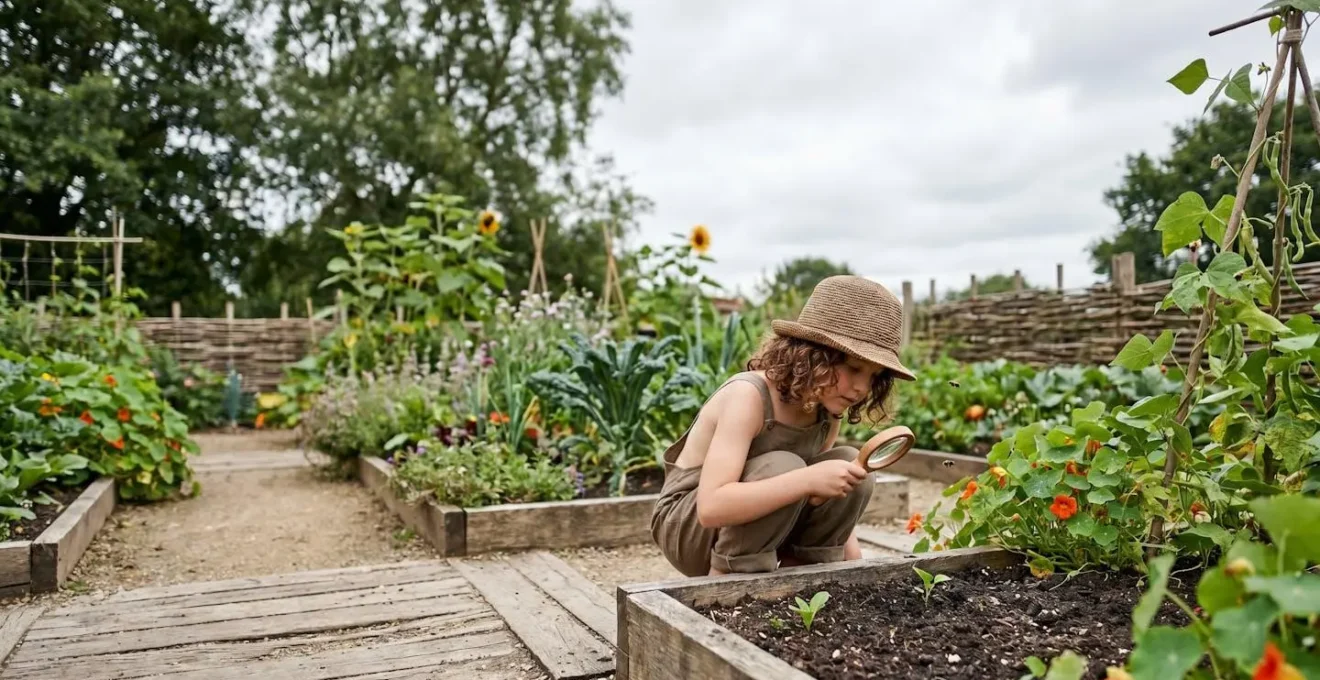
The real magic of a garden STEM kit isn’t the experiment itself, but fostering a scientific mindset; success comes from embracing inquiry and « productive failure, » not just following instructions.
- Hands-on learning isn’t just fun; it builds deeper, neurologically-proven memory pathways compared to textbook learning.
- Allowing a child to fail, tweak, and re-test an experiment is more valuable than achieving the « correct » result on the first try, as it teaches the core of the scientific method.
Recommendation: Shift your goal from completing an activity to asking « What if…? » questions. Your role isn’t to be an instructor, but a co-explorer in your own backyard laboratory.
For many parents looking for smart, screen-free summer activities, the idea of turning the garden into a science lab is instantly appealing. We buy STEM exploration kits with visions of our children, brows furrowed in concentration, discovering the secrets of photosynthesis or the architecture of a beetle’s wing. The common approach is to follow the instruction manual to the letter, hoping a perfectly executed experiment will ignite a lifelong passion for science. We focus on the « what »—building the model, mixing the solutions, getting the expected result.
But what if this focus on a successful outcome is the very thing that stifles genuine scientific curiosity? The real value of these kits isn’t in their ability to produce a neat, predictable result. It lies in their potential to transform a child’s thinking from passively following steps to actively questioning the world around them. This shift requires a different approach from parents—one that moves beyond the instruction booklet and embraces the messy, unpredictable, and powerful process of true scientific inquiry.
This guide delves into the cognitive science that explains why this method is so effective. We’ll explore why letting your child fail is a pedagogical masterstroke, how simple block play can predict future math success, and why adding a touch of art to engineering creates better problem-solvers. Forget the pressure of the « perfect experiment »; it’s time to discover how to cultivate a real scientist in your own backyard.
To help you navigate this journey from instructor to collaborator, this article breaks down the core principles for transforming your garden into a dynamic learning environment. The following sections will guide you through the science of learning, practical choices for tools, and the mindset needed to foster true discovery.
Summary: How to Turn Your Garden Into a STEM Laboratory
- Why Does Inquiry-Based Learning Stick Better Than Textbooks?
- Homemade Microscope or Store-Bought: Which Is Better for Beginners?
- The Instruction Trap: Why You Should Let Them Fail at the Experiment?
- STEM or STEAM: Why Adding Art Improves Engineering Skills?
- When to Use Which Kit: Matching Science to the Seasons
- Why Does Block Play Predict Better Maths Scores at GCSE?
- How to Use Apps to Log Wildlife for Real Scientific Studies?
- Creating a Biodiversity Lab: How to Teach Ecology in Your Backyard?
Why Does Inquiry-Based Learning Stick Better Than Textbooks?
Inquiry-based learning is a powerful educational approach where children learn by investigating questions and problems, rather than simply memorizing facts from a book. It’s the difference between reading that plants need sunlight and designing an experiment with one plant in a cupboard and one on the windowsill to see what happens. This hands-on, self-directed process engages the brain on a much deeper level, leading to significantly better retention and understanding. The learning isn’t just theoretical; it’s earned through experience.
The data overwhelmingly supports this. When children are active participants in their learning, the knowledge simply sticks. For instance, research on active learning demonstrates that participants show a 93.5% retention rate after one month, compared to just 79% for passive learners. The effect is profound across the board, with a comprehensive meta-analysis of 72 studies showing significant positive effects for inquiry-based learning on activities, performance success, and overall outcomes.
This isn’t just about engagement; it’s about neurology. The act of physically interacting with a concept creates stronger, more complex neural pathways. As noted by one educational research group, this has been visibly confirmed in brain imaging. According to their findings, brain scans also show increased activity in sensory and motor-related areas when people think about concepts they had hands-on experience with. When a child touches the soil, observes the insect, and measures the plant’s growth, they are building a multi-sensory memory that a textbook illustration can never replicate. They are not just learning a fact; they are creating a rich cognitive anchor.
Homemade Microscope or Store-Bought: Which Is Better for Beginners?
When you decide to explore the microscopic world in your garden, a key question arises: should you invest in a polished, store-bought microscope or try building a simple one at home? A commercial microscope offers high magnification and clarity, allowing for impressive views of cell structures or tiny aquatic life. It delivers that « wow » factor quickly and reliably, which can be a great hook for an easily discouraged child. It represents a direct path to a specific scientific outcome: seeing the very small.
However, the process of building a homemade microscope—even a basic water-drop version—offers a different, and arguably more profound, learning opportunity. It shifts the focus from the *object of observation* to the *principles of observation*. By constructing the device, a child isn’t just using a tool; they are grappling with the fundamentals of optics, lenses, and magnification firsthand. The goal becomes understanding how we see, not just what we see.
This simple DIY project demystifies the technology and fosters a sense of agency and engineering prowess.
As this image illustrates, the moment of discovery is not just in seeing the magnified leaf vein, but in realizing « I made this happen. » The inevitable trial and error—adjusting the droplet size, finding the right distance—is not a bug but a feature. It’s an organic lesson in iteration and problem-solving. So, which is better? For a quick and impressive view, the store-bought kit wins. But for a deeper, more foundational lesson in scientific principles and engineering, the homemade journey is unparalleled. The best approach might be both: start with a DIY version to learn the principles, then « graduate » to a commercial one to apply that knowledge.
The Instruction Trap: Why You Should Let Them Fail at the Experiment?
One of the hardest things for a parent to do is watch their child struggle. When an experiment from a STEM kit goes « wrong »—the solution doesn’t change color, the structure collapses—our instinct is to jump in, point to the instructions, and fix it. We want them to succeed. But in science, failure isn’t the opposite of success; it’s a critical part of the process. Shielding a child from this « productive failure » robs them of the most valuable lesson of all: that science is not about following a recipe, but about investigation and adaptation.
This idea is rooted in a powerful learning theory. As one analysis on educational psychology notes, the method is based on a core principle: « learning is an active process in which learners construct new ideas or concepts based on previous experiences and knowledge. » When an experiment fails, the child is forced to stop and think: « Why didn’t that work? Was the water too cold? Did I add too much? What if I try it this way? » This is the moment true scientific thinking is born. The unexpected result is not an error; it’s data. It prompts new questions and new hypotheses.
Your role as a parent isn’t to be the expert with all the answers, but the facilitator who provides « cognitive scaffolding »—just enough support to prevent total frustration but not so much that you solve the problem for them. It’s about asking guiding questions like, « That’s interesting, it didn’t do what we expected. What do you think is happening? » This reframes the « failure » as a puzzle and empowers the child to take ownership of the discovery process. True learning happens when they connect the dots themselves.
Action Plan: Fostering Productive Failure
- Bridge the Concrete and the Abstract: Always connect the hands-on task to the « why. » After they’ve seen a seed sprout, introduce terms like « germination » to link the experience with scientific language.
- Model Scientific Curiosity: When something doesn’t work, respond with enthusiasm: « How fascinating! That’s not what the book said would happen. We’ve found something new! » This frames unexpected outcomes as interesting data, not mistakes.
- Provide Timely Hints, Not Solutions: If they are truly stuck, offer a small hint to get them moving again (e.g., « I wonder if the temperature of the water matters? »). This preserves their ownership of the discovery.
- Document the Process: Encourage them to keep a « lab notebook » (even a simple scrapbook) to draw what happened, note their mistakes, and write down their new ideas. This builds metacognitive skills—the ability to think about one’s own thinking.
STEM or STEAM: Why Adding Art Improves Engineering Skills?
The acronym STEM (Science, Technology, Engineering, and Maths) has become a household term. But a powerful evolution of this concept is gaining momentum: STEAM, which integrates an ‘A’ for Arts. At first glance, adding art to a rigorous scientific discipline might seem like a « soft » addition. But in reality, it’s a crucial component that unlocks higher levels of creativity, problem-solving, and innovation. The arts are not a distraction from science; they are a catalyst for better science.
Consider the task of building a bridge out of twigs in the garden. A purely STEM approach would focus on structural integrity, load-bearing capacity, and efficiency. A STEAM approach incorporates these elements but also asks: How can the bridge be aesthetically pleasing? How does it fit into the landscape? This requires the young engineer to think about design, symmetry, and form—all artistic principles. This integration of function and form pushes them to think more holistically and find more creative solutions to structural challenges.
This isn’t just a quaint theory; it’s backed by educational outcomes. Studies show that integrating arts into technical education has a measurable impact on key skills. For example, research from the Rhode Island School of Design found that students in STEAM programs showed enhanced problem-solving abilities, increased creativity, and better collaboration skills. Art teaches students to be comfortable with ambiguity, to express ideas visually, and to approach problems from multiple perspectives—all essential skills for any 21st-century scientist or engineer. In the garden lab, this could be as simple as asking your child not just to identify a flower, but to draw it in detail, forcing them to observe its structure more closely than a simple glance ever would.
When to Use Which Kit: Matching Science to the Seasons
A common mistake is to think of the garden as only a spring and summer laboratory. This limits the scope of discovery and misses the incredible scientific phenomena that each season offers. A truly dynamic backyard lab operates year-round, with activities and exploration kits tailored to the unique opportunities of the current season. The key is to shift from a fixed set of experiments to an observational mindset, asking, « What is the garden teaching us *right now*? »
In the spring, the garden is bursting with obvious lessons in biology. This is the time for germination kits, studying the life cycles of plants, and observing the return of pollinators. A simple magnifying glass becomes a powerful tool for examining sprouting seeds and emerging insects. In summer, the focus can shift to ecology and solar energy. Build a solar oven to cook a marshmallow, study the complex food web in a patch of flowers, or set up a rain gauge to measure precipitation during a summer storm.
But the learning doesn’t stop when the weather cools. Autumn is perfect for physics and decomposition. Study the aerodynamics of falling helicopter seeds, chart the changing colours of leaves (chromatography), and create a compost bottle to observe the breakdown of organic matter. And winter, often seen as a dormant period, is a fantastic laboratory for geology and chemistry.
Even a seemingly barren winter garden is rich with scientific potential. This is the ideal time to take soil samples and analyze their composition, study the crystalline structure of frost on leaves, or investigate how different animals have adapted to the cold. By matching the tools and the inquiry to the season, you teach a profound lesson: science is not a one-time event but a continuous process of observation and adaptation.
Why Does Block Play Predict Better Maths Scores at GCSE?
It may seem like a huge leap to connect a toddler’s block-stacking with a teenager’s GCSE maths results, but a growing body of research shows a direct and powerful link. The simple act of playing with blocks builds a crucial cognitive skill known as spatial reasoning. This is the ability to think about objects in three dimensions and to visualize and manipulate shapes in your mind. It’s the skill an architect uses to design a building, a surgeon uses to navigate the human body, and a mathematician uses to understand complex geometric concepts.
When children build with blocks, they are running countless physical and mental experiments. They are intuitively learning about gravity, stability, balance, and symmetry. They are comparing sizes, recognizing patterns, and understanding concepts like « half, » « more than, » and « equal to » in a tangible, physical way. This hands-on experience builds a strong foundation for abstract mathematical thought later in life. In fact, research published in Child Development demonstrates that children who were better at copying complex block structures also performed better on early math tasks.
Research in the science of learning has shown that experiences like block building and puzzle play can improve children’s spatial skills and that these skills support complex mathematical problem solving in middle and high school.
– Researchers at University of Delaware and Temple University, Playing With Blocks May Help Children’s Spatial and Math Thinking study
This connection is so strong because spatial skills and mathematical skills are highly intertwined in the brain. Activities that improve one often improve the other. So when your child is deeply focused on building a tower in the garden, they aren’t just playing. They are training their brain for future success in subjects that require abstract and logical thinking. It’s one of the most effective, play-based ways to prepare them for the challenges of formal mathematics education.
How to Use Apps to Log Wildlife for Real Scientific Studies?
One of the most exciting ways to elevate your backyard lab is to contribute to real-world scientific research through « citizen science. » This involves ordinary people collecting and sharing observations that are then used by professional scientists to study biodiversity, climate change, and animal migration. With the rise of powerful smartphone apps like iNaturalist or eBird, turning your child’s fascination with a ladybug or a visiting robin into valuable data has never been easier.
These platforms do more than just identify species; they teach the rigor of scientific documentation. When you upload a photo of an insect, the community and AI algorithms help identify it, but you are also prompted to record the date, time, and precise location. This act of logging data transforms a casual observation into a verifiable data point. It gives your child’s explorations a profound sense of purpose: they are not just « bug hunting, » they are helping to map the biodiversity of their local area.
To ensure the data is truly useful, it’s important to follow best practices that mirror professional scientific methods. This means being meticulous and ethical in your observations. Here are some key principles to practice:
- Systematic Documentation: Don’t just observe randomly. Mark off a small, permanent area (a one-meter square, known as a « quadrat ») and document everything you find within it. Return to it weekly or monthly to record changes, teaching the method of longitudinal study.
- Use Appropriate Tools: Use magnifying lenses or even a digital microscope attachment for your phone to get clear photos for accurate species identification. Accuracy is key for data quality.
- Practice ‘Leave No Trace’: The golden rule of fieldwork is to observe without disturbing. Teach your child to watch wildlife from a respectful distance, to return rocks or logs to their original position, and never to handle animals. This maintains the integrity of the habitat and the data.
- Engage in Community Verification: Explain that on platforms like iNaturalist, other users will confirm or suggest identifications. This is a simplified version of the scientific peer-review process, a cornerstone of how science validates knowledge.
- Analyze Your Own Data: Most apps allow you to download your own observation history. Periodically sit down with your child and look for patterns. « Did we see more bees in June than in May? Which birds only visit in the winter? » This teaches the final step of the scientific method: data analysis.
Key Takeaways
- True learning comes from inquiry and « productive failure, » not just following instructions to get the « right » answer.
- Hands-on activities create stronger, multi-sensory memories that are neurologically proven to be more durable than textbook learning.
- Integrating art (STEAM) and encouraging physical play (like block building) develops crucial spatial reasoning and creative problem-solving skills that are vital for future engineering and math success.
Creating a Biodiversity Lab: How to Teach Ecology in Your Backyard?
To truly transform your garden into a laboratory, the final step is to see it not as a collection of individual plants, but as a complex, interconnected ecosystem. Teaching ecology starts with understanding that the most important action happens in places we don’t always look: in the soil, under the leaves, and at night. Your backyard isn’t just a place to grow flowers; it’s a living web of producers, consumers, and decomposers.
Start with the foundation of it all: the soil. A soil testing kit can reveal the pH and nutrient composition, leading to a discussion about what plants need to thrive. But go deeper. A powerful microscope can reveal the « invisible » world of microorganisms that form the base of the soil food web. This is where the real magic happens.
Examining a single handful of rich, living soil can reveal a universe of textures, moisture, and organic matter. This tactile investigation is a lesson in geology and biology combined. It shows that « dirt » is not just dirt; it’s a dynamic, living habitat. This focus on the unseen world can be extended to other areas, such as setting up a simple pitfall trap (a cup buried in the soil) to see what nocturnal insects are active, or a white sheet under a bush at night with a flashlight to attract different kinds of moths.
Case Study: Applying Ecological Methodology in the Garden
To move from casual observation to rigorous science, you can adopt methodologies used by professional ecologists. As demonstrated in educational programs at botanical gardens, a key technique is the use of a « quadrat. » This involves marking a permanent one-meter square area in your yard. Students are taught to systematically record all life and any changes within this square over time—every new plant that sprouts, every insect that visits. By combining this structured observation with tools like microscopes to explore soil microorganisms, students learn to collect rigorous data. This transforms their backyard into a genuine research site, revealing the complex and often invisible foundations of the garden ecosystem.
Ultimately, turning your garden into a STEM laboratory is less about having the fanciest kit and more about adopting a mindset of curiosity, inquiry, and embracing the beautiful messiness of real science. Start small, ask questions, and get ready to be amazed by the universe waiting to be discovered just outside your door.