In summary:
- Transform a simple walk by focusing on sensory experiences (textures, sounds, smells) instead of just collecting objects. This simple shift helps calm hyperactive minds and builds focus.
- Teach children to be nature guardians with the « Observe, Don’t Disturb » rule: only investigate items already on the ground, ensuring the living ecosystem remains untouched.
- Extend the adventure indoors by using your discoveries for ethical art projects and wildlife-themed obstacle courses, reinforcing the day’s learning through play.
Another grey winter afternoon, and the kids are bouncing off the walls. The thought of another uninspired walk around the block, pleading with them to « just keep moving, » feels exhausting. You know getting them outside is the right answer, so perhaps you reach for the old classic: a scavenger hunt. But let’s be honest, the « find a pinecone, find a smooth stone » list has lost its magic. It often ends with a bag of random bits and the same old refrain of « I’m bored! »
We tend to think of these hunts as simple distractions, a way to get from A to B. But what if the scavenger hunt itself wasn’t the goal, but a gateway to something much deeper? What if we could use it not just to keep kids moving, but to calm their minds, spark genuine curiosity, and build a real, lasting connection to the world around them, even in the heart of the city? This is where a Forest School approach changes everything. It shifts the focus from collecting to connecting, from seeing to observing.
This isn’t about finding more impressive things; it’s about seeing the world in a more impressive way. We’re moving beyond the « what » and diving into the « why » and « how. » This guide will show you how to re-imagine the winter scavenger hunt as a powerful tool for your family’s well-being.
We’ll explore the science behind why this kind of focused observation is so calming for an active mind. We’ll give you the tools to create an engaging list that works anywhere, and the know-how to keep everyone warm and happy. Most importantly, we’ll show you how to turn this simple activity into a foundation for creativity, play, and even a form of empowerment against climate anxiety. Let’s get ready to explore.
Summary: The Ultimate Guide to a Meaningful Winter Scavenger Hunt
- Why Does Searching for Textures Calm a Hyperactive Mind?
- How to Create a Scavenger List That Works in a City Park?
- Thermals or Snowsuits: What Gear Keeps Kids Warm for 1 Hour Outside?
- The Picking Mistake: Teaching Kids to Observe Without Destroying Nature
- How to Use the Hunt Findings for an Art Project at Home?
- How to Build an Obstacle Course in a Small Living Room?
- Why Does Knowing Local Bugs Help Fight Climate Anxiety?
- Creating a Biodiversity Lab: How to Teach Ecology in Your Backyard?
Why Does Searching for Textures Calm a Hyperactive Mind?
If you’ve ever felt your own mind quieten while watching waves or listening to wind in the trees, you’ve experienced the core principle at play. A child’s mind, especially a hyperactive one, is often battling a storm of competing demands for its attention. The digital world, busy schedules, and indoor environments constantly pull their focus. A winter sensory hunt acts as a powerful circuit breaker by engaging what scientists call « soft fascination. »
This concept is a cornerstone of Attention Restoration Theory. Unlike the hard focus required for schoolwork, which drains mental energy, nature provides stimuli that are effortlessly engaging. As researchers in the field explain:
Nature is argued to contain ‘softly’ or intrinsically fascinating stimuli which can be appreciated in a contemplative way without mental effort.
– Attention Restoration Theory researchers, Frontiers in Psychology – Cognitive Restoration in Children
When you ask a child to find « something bumpy, » you’re not just giving them a task; you’re inviting them into a state of mindful observation. Their brain filters out distractions and focuses on the single, gentle command to touch, to feel, to compare. The intricate patterns of frost on a leaf, the rough texture of bark, the surprising softness of moss—these details capture attention without demanding it. This isn’t just a theory; research demonstrates that 30 minutes in natural environments restored directed attention in children. It’s a mental reset button, hiding in plain sight on a winter’s day.
This is why a sensory hunt is so much more effective than a simple collection list. You are guiding your child to use their senses as anchors, grounding them in the present moment and allowing their overtaxed mental resources to recover. It’s a natural, joyful form of meditation that replaces « stop fidgeting! » with « what does that feel like? ».
How to Create a Scavenger List That Works in a City Park?
The secret to a scavenger hunt that captivates any child, anywhere, is to stop hunting for *things* and start hunting for *experiences*. An object-based list (« find a pinecone ») is finite and depends entirely on what’s available. A sensory and action-based list is infinite and works just as well on a bustling city street as in a deep forest. This approach encourages creative problem-solving and deepens observation skills.
Forget the printable lists with pictures of acorns. Your new list is a series of prompts that engage all the senses. The goal is for your child to point, describe, and share their discovery, not just stuff it in a pocket. This also brilliantly solves the « don’t pick living things » dilemma we’ll cover later.
Here’s how you can build a list for a typical British city park:
- Texture Hunt: Find something bumpy (tree bark, a manhole cover), something smooth (a worn stone, a metal railing), something spiky (a thistle, holly leaf), and something soft (moss, a pigeon’s feather).
- Colour Quest: Find three different shades of brown. Find a flash of brilliant red (a berry, a postbox). Find the colour of the winter sky reflected in a puddle.
- Sound Map: Stand still for one minute. What’s the furthest sound you can hear (a siren, a distant train)? What’s the closest (your own breathing, a dog barking)? Can you hear the wind?
- Shape Shifters: Find a perfect circle (a drop of water, a knot in a tree). Find a pattern that repeats (bricks on a path, railings on a fence). Find a natural spiral (a snail shell, an unfurling fern).
This method has a magical effect. It transforms the mundane into the magnificent. A boring patch of grass becomes a landscape of different textures. A simple tree becomes a universe of colours and patterns. You are teaching your child not *what* to see, but *how* to see. You are giving them the tools to find wonder everywhere, a skill far more valuable than a pocketful of wilting leaves.
Thermals or Snowsuits: What Gear Keeps Kids Warm for 1 Hour Outside?
There’s no such thing as bad weather, only bad clothing. It’s a cliché, but it’s the absolute truth of parenting in winter. A potentially magical hour of exploration can be cut short after ten minutes by a whining, cold child. The goal isn’t just to survive the cold; it’s to be so comfortable you forget it’s there. And staying out is important; national health guidelines recommend 60 minutes daily of moderate-to-vigorous physical activity for children. Your job is to enable that.
The debate between thermals and snowsuits is the wrong question. The right question is: how do I layer? The « three-layer system » is the gold standard for outdoor professionals and it works just as well for a five-year-old in the park.
- The Base Layer: This is the layer against the skin. Its job is to wick sweat away to keep you dry. Wetness is the enemy of warmth. This is why cotton is a terrible choice—it holds moisture like a sponge. Opt for merino wool (pricier but amazing) or synthetic fabrics like polyester. Think long-sleeved tops and leggings.
- The Mid Layer: This is your insulation layer. Its job is to trap warm air. A fleece jacket or fleece trousers are perfect. The thickness depends on the temperature. It’s better to have a couple of thinner fleeces you can add or remove than one giant, bulky one.
- The Outer Layer: This is your shield. It must be waterproof and windproof. For kids, an all-in-one puddle suit or snowsuit is often the easiest option, as it covers everything and has no gaps for wind or rain to get in. If using a separate jacket and trousers, ensure they are properly waterproof, not just « shower-resistant. »
Don’t forget the extremities! A warm hat, waterproof gloves or mittens (mittens are warmer as fingers share heat), and warm socks (again, wool or synthetic, not cotton) inside waterproof boots like wellingtons are non-negotiable. With the right layering, your child becomes a self-contained, adventure-proof unit, ready for a full hour of discovery, no matter what the British winter throws at you.
The Picking Mistake: Teaching Kids to Observe Without Destroying Nature
A child’s first instinct upon finding something beautiful is to possess it. To pick the flower, to strip the bark, to pocket the mushroom. It comes from a place of love and curiosity, but it’s what I call the « Picking Mistake. » Our role as nature mentors is to gently guide that impulse from « I want to have it » to « I want to understand it. » This is perhaps the most profound lesson a scavenger hunt can teach: respect for the ecosystem.
Explain in simple terms that winter isn’t a dead season; it’s a resting season. That tight little bud on a twig holds the promise of a leaf for the spring. That bark is the tree’s skin, protecting it from disease. That mushroom is busy releasing spores to make more mushrooms. By taking these things, we interrupt a vital process. We are teaching them to see the world not as a collection of objects for their use, but as a community of living things they are a part of.
The solution is not to forbid but to provide an alternative framework. We replace the collection bag with a toolkit for observation and a simple, memorable rule for what we can touch.
Your Action Plan: The ‘Observe, Don’t Disturb’ Method
- Ground: Only interact with items that have already naturally fallen to the ground. This ensures you’re not harming a living organism.
- Grey (or Brown/Dead): Choose only materials that are clearly at the end of their life cycle—brown leaves, not green ones; brittle twigs, not flexible ones.
- Gone: Make sure the item is fully detached from its parent plant or the ground. A fallen leaf is fair game; one you have to pull off is not.
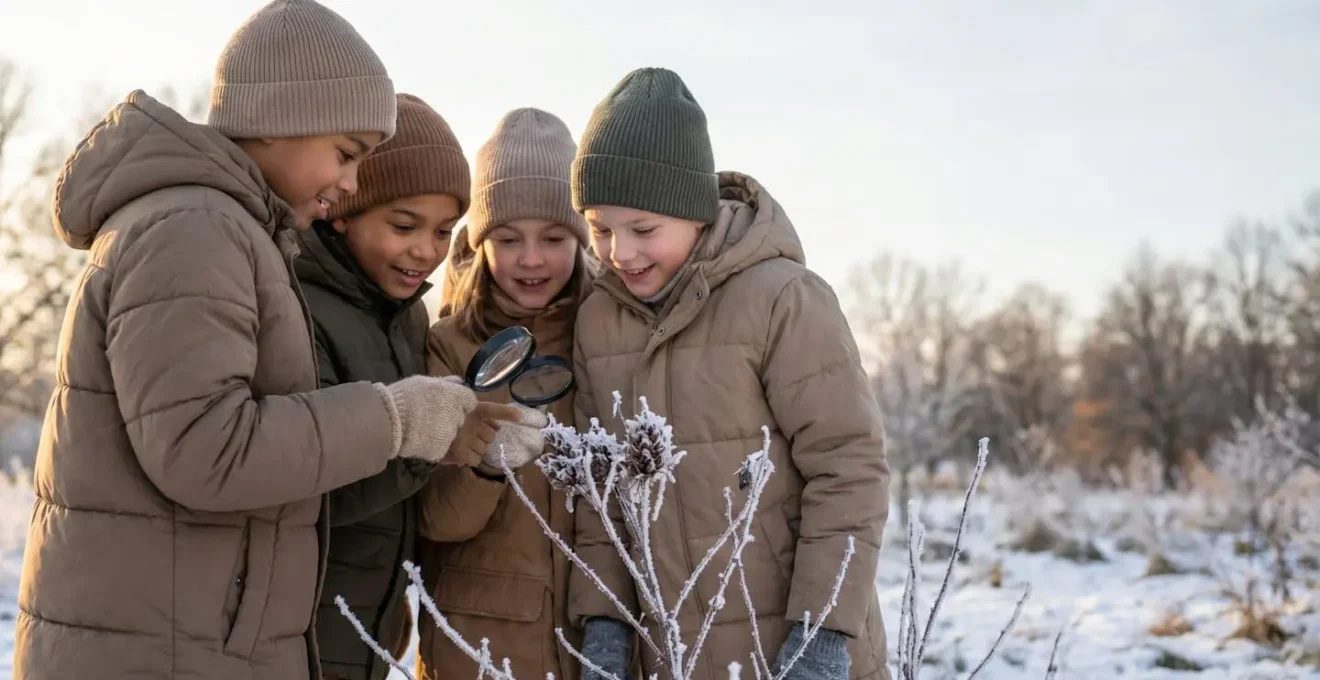
- Tools, Not Bags: Replace the collection bag with an observation kit. A magnifying glass to see the tiny world up close, a small mirror to look under leaves without picking them, and a phone or camera to « collect » a picture.
- Explain the ‘Why’: Gently explain that picked winter buds mean no spring flowers, stripped bark can make a tree sick, and harvested fungi can’t spread their spores for next year.
By framing it this way, you’re not saying « no. » You’re saying, « let’s be detectives! » You’re elevating their role from a mere collector to a respectful scientist, a guardian of the wild space they are exploring. This simple shift in mindset is foundational to building a generation of true nature lovers.
How to Use the Hunt Findings for an Art Project at Home?
The adventure doesn’t have to end when you take your muddy boots off at the front door. Bringing the experience home reinforces the learning and provides a creative outlet for all that inspiration. But in line with our « observe, don’t destroy » principle, our art projects will use memories and impressions, not a bag full of depleting natural resources.
One of the most powerful techniques is creating a « Winter Field Guide » using bark rubbings. This is a classic Forest School activity that teaches observation, pattern recognition, and art all at once. Here’s how it works:
- During your hunt, identify trees with different bark textures (a smooth, silvery birch vs. a craggy, deep-grooved oak).
- Take a piece of paper (thin paper works best) and hold it against the trunk.
- Using the side of a crayon (with the paper peeled off), rub firmly over the paper. The texture of the bark will magically appear.
- Back at home, label each rubbing with the tree species (if you know it), the location, and the date. You can bind these pages together to create your very own, completely unique field guide to your local park.
For items that were too small or delicate to rub, we can embrace the concept of ephemeral art—art that isn’t meant to last. This idea beautifully mirrors the cycles of nature itself, a key lesson in ecological literacy.
Case Study: Ephemeral Nature Weaving
Urban Forest education programs successfully implement temporary art installations where children build simple four-stick looms and weave using only dead/fallen materials collected ethically: long dried grasses, flexible twigs, pine needles. This approach teaches both natural material properties and the concept of impermanence in nature, as weavings are eventually returned to the environment to decompose, completing the cycle and reinforcing nutrient cycling concepts.
This project is profound. It teaches children that beauty doesn’t have to be permanent and that returning things to the earth is a valuable and necessary part of life. Instead of a dusty collection on a shelf, they create a beautiful memory and participate actively in the great cycle of growth and decay.
How to Build an Obstacle Course in a Small Living Room?
Some days, the weather truly wins, and you’re stuck indoors. But that doesn’t mean the spirit of your winter adventure has to fade. An indoor obstacle course is the perfect way to burn off energy, but we can make it so much more than just a pile of cushions. We can use it to physically re-enact the behaviours and challenges of the winter wildlife we’ve been learning about. This isn’t just play; it’s embodied learning.
By mimicking how animals move and survive, children develop their gross motor skills, balance, and spatial awareness, all while deepening their connection to the creatures of the forest. Your living room transforms from a prison into a habitat. Each piece of furniture gets a new, wild purpose.
Here are the stations for your Winter Wildlife Simulation Course:
- The Hibernating Bear Den: Drape a blanket over a dining table or between two chairs. Kids must crawl slowly in and out, thinking about what a bear needs to survive the long winter sleep.
- Snowdrift Navigation: Scatter pillows and cushions across the floor. This is a deep snowdrift! Children must wade and high-step through them, feeling the effort it takes to move through deep snow.
- The Fallen Log Balance Beam: Place a line of masking tape on the floor (or use a rolled-up rug). This is a slippery log over a frozen river. They must walk along it without falling in, honing their balance.
- The Snowshoe Hare Jumps: Designate a few spots on the floor (using paper plates or more tape). These are safe spots from a predator. Kids must perform big, soft-footed jumps between them, just like a hare with its big feet.
- The Red Squirrel’s Tree Climb: Safely, and with supervision, the sofa becomes a mighty oak tree. They must scramble up and over it to get to their drey (a nest of blankets on the other side).
To add an extra layer, you can hide pictures of the things you found on your outdoor hunt along the course. As they complete a station, they have to find and identify a « food source » or a « track, » blending the physical and intellectual challenges into one seamless, joyous game.
To remember
- Focus on sensory experience, not just collecting items, to calm busy minds and build focus.
- Teach observation without destruction using the « Ground, Grey, Gone » rule to create nature guardians.
- Connect outdoor discoveries to indoor learning through ethical art and wildlife-themed play to build lasting ecological literacy.
Why Does Knowing Local Bugs Help Fight Climate Anxiety?
It can feel overwhelming. We hear big, scary news about the climate, and it’s easy to feel powerless. Our children absorb this anxiety, often without the context to process it. While we can’t shield them from reality, we can give them a powerful tool to fight despair: agency through knowledge. And it starts with something as small as a bug.
Focusing on the micro-level of a local ecosystem provides a tangible, understandable counter-narrative to the overwhelming global story. When a child learns to identify a ladybug, finds a praying mantis egg case, or understands the role of a woodlouse, they are no longer just a passive observer of « nature. » They become a knowledgeable participant. They have a secret—they know that winter is not dead. They have seen the evidence of hidden life and resilience.
This discovery of life persisting, of intricate strategies for survival happening right under their nose, is incredibly empowering. It shifts their perspective from one of loss and fear to one of wonder and appreciation. They see that even in the harshest conditions, life has a plan. This is not about ignoring the problems; it’s about building the psychological fortitude to face them. As researchers have noted in related fields, the effect is profound.
This discovery of resilience is a powerful antidote to eco-despair.
– Environmental education researchers, Children and Nature Network research on nature connection benefits
When your child can point to a bare twig and say, « There are hundreds of insects waiting to be born in there, » they are armed with hope. They have tangible proof of nature’s tenacity. And in knowing their own small patch of the world so intimately, they develop a fierce love for it. That love, born from knowledge, is the most powerful and sustainable driver for wanting to protect it.
Creating a Biodiversity Lab: How to Teach Ecology in Your Backyard?
You have now moved beyond simple walks. You’ve mastered sensory observation, ethical interaction, and creative expression. The final step is to put on your scientist hats. Your garden, or even a small patch of your local park, is not just a patch of green—it’s a living laboratory. By introducing simple scientific methods, you can teach fundamental ecological concepts like biodiversity, phenology, and nutrient cycling in the most hands-on way imaginable.
One of the most accessible methods is the « Winter Transect Study. » It sounds complex, but it’s wonderfully simple. You use string to mark out a single square metre of ground. This becomes your official study area. Your mission is to document everything that is happening within that square over time. You count the dormant plants, look for signs of insects (egg cases, burrows), and note evidence of decomposers like worm castings or fungi. You can draw a map of your square, creating a biodiversity inventory. Returning to the same square in spring and summer will reveal the dramatic story of seasonal change (phenology).
Another powerful experiment makes the invisible world of decomposition visible, revealing the « recycling team » of the ecosystem.
Case Study: The Decomposer Observation Jar
Urban forest education programs successfully teach nutrient cycling by having children create mini-ecosystems in large glass jars. By layering soil, snow, and dead leaves/twigs collected during winter hunts, students observe over weeks how fungi and microbes (nature’s recycling team) break down organic materials. This hands-on decomposer lab makes the invisible visible, demonstrating that winter isn’t dormant but actively transforming last season’s growth into next season’s soil nutrients, completing the cycle of life in a tangible way children can monitor and document.
These activities transform children from passive recipients of information into active investigators. They are not just learning about ecology; they are *doing* ecology. They are gathering data, observing change, and understanding the profound, interconnected web of life that churns away even under a blanket of winter snow.
By following this path, from simple sensory awareness to your own backyard biodiversity lab, you’ve done more than just survive winter. You’ve used it as a canvas to paint a richer, deeper, more resilient connection to the natural world for you and your children. This is the true magic of a Forest School-inspired scavenger hunt.