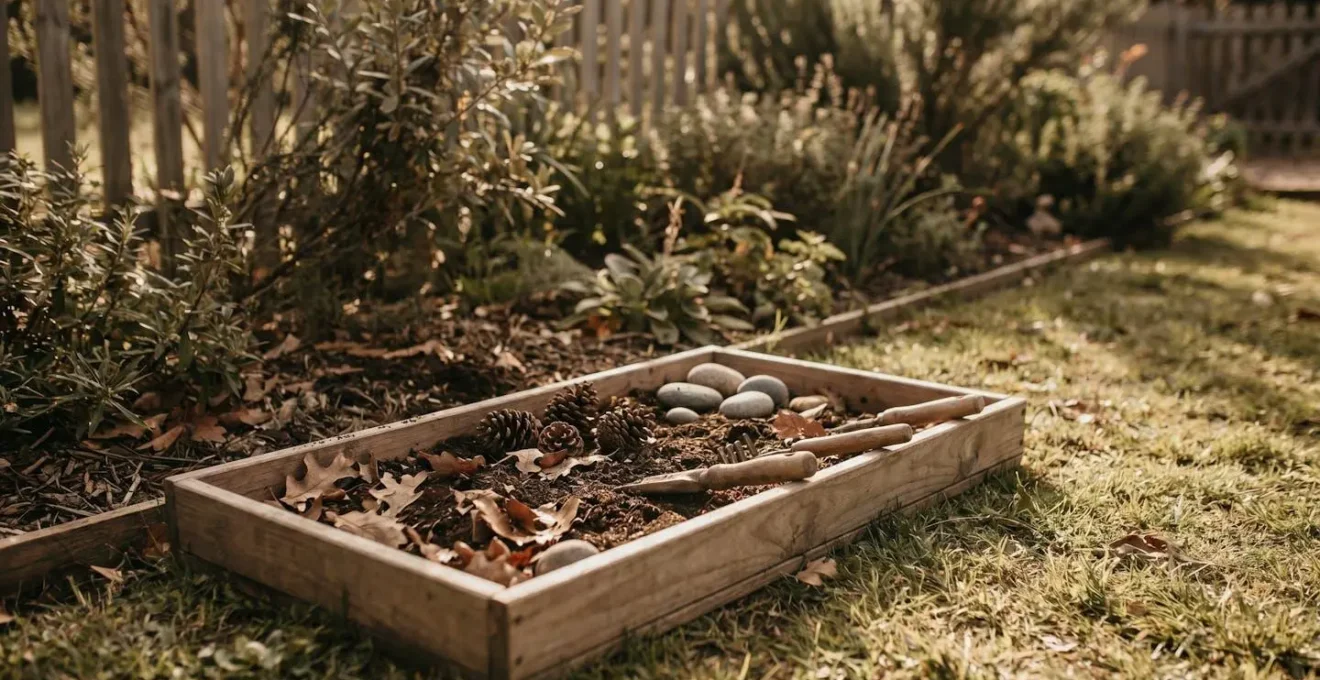
In summary:
- Forget expensive plastic toys; nature provides the richest, most complex sensory materials for free.
- Focus on « taste-safe » and ephemeral activities using kitchen scraps and garden finds to eliminate safety worries and clean-up stress.
- Simple, natural materials like earth, water, and leaves offer superior tactile feedback and neural benefits compared to uniform products like kinetic sand.
- The goal is not to create a Pinterest-perfect setup but to foster a process-focused experience that builds crucial brain connections.
As a parent, you’ve likely seen the stunning, rainbow-coloured sensory bins online and felt a mix of inspiration and pressure. The desire to give your child the best developmental start is powerful, but so are the realities of a tight budget, limited storage space, and the sheer exhaustion at the thought of cleaning up a mountain of dyed rice. Many guides suggest cheap fillers or plastic toys, but this often just leads to more clutter and less meaningful engagement. These approaches miss the fundamental point of sensory play.
But what if the most powerful tools for your child’s development aren’t in a craft store aisle but right outside your door or in your kitchen compost? What if the key isn’t creating a permanent « station » but embracing temporary, process-focused activities? This guide shifts the perspective from buying and storing to discovering and experiencing. We will explore how to build a profoundly effective sensory play environment for less than £20, not by finding cheaper plastic, but by leveraging the incredible (and often free) power of natural, ephemeral materials. It’s time to trade the overwhelm of « stuff » for the deep, brain-building magic of the real world.
Throughout this guide, we will delve into the science behind messy play, offer practical recipes for taste-safe activities, and compare different materials to help you make informed choices. We will also address the critical, yet often overlooked, topics of overstimulation and spatial reasoning, providing screen-free solutions that you can implement today.
Summary: Your Guide to a Budget-Friendly, Brain-Boosting Sensory Station
- Why Does Messy Play Boost Brain Connections in Toddlers?
- How to Make Taste-Safe Sensory Bins for Babies Who Put Everything in Their Mouths?
- Kinetic Sand or Homemade Playdough: Which Offers Better Tactile Feedback?
- The Overstimulation Trap: When Too Much Sensory Input Causes Tears
- How to Set Up a Splash Zone That Takes 5 Minutes to Clean?
- Jigsaw Puzzles or Building Blocks: Which Develops Better Mental Rotation?
- Why Does Creative Art Increase Neural Plasticity in Children?
- How to Improve Spatial Reasoning in Preschoolers Without Screens?
Why Does Messy Play Boost Brain Connections in Toddlers?
That delightful chaos we call « messy play » is far more than just a fun way to pass an afternoon; it is the very work of childhood brain development. When a toddler plunges their hands into mud, squishes playdough, or shreds paper, they are not just making a mess. They are engaging in a process called synaptogenesis, where their brain is rapidly forming and strengthening billions of neural pathways. Every new texture, smell, and sound creates a new connection, laying the foundational architecture for all future learning.
These early sensory experiences are fundamental. The tactile feedback from manipulating different materials builds fine motor skills, hand-eye coordination, and body awareness. According to research highlighted by HeadStart, these early visual and motor skills are not isolated; they are directly related to later math and language abilities. A child who learns how different materials react—some squish, some pour, some stack—is conducting their first physics experiments and learning about cause and effect in a tangible way.
The open-ended nature of messy play is its superpower. Unlike a toy with a specific function, a pile of wet sand or a bowl of « earth dough » has infinite possibilities. This freedom encourages creativity, problem-solving, and imagination. The brain isn’t just receiving information; it’s actively organising it, making predictions, and adapting its strategies. This active engagement is precisely what strengthens cognitive functions, proving that the most important learning experiences are often the messiest.
How to Make Taste-Safe Sensory Bins for Babies Who Put Everything in Their Mouths?
The « mouthing » phase is a critical and completely normal part of a baby’s development. It’s how they explore the world, gathering sensory information about texture, density, and taste. However, it can turn parents’ sensory play dreams into a high-alert supervision nightmare. The solution isn’t to avoid sensory bins but to create them with materials that are not just non-toxic, but genuinely edible. This removes the anxiety and allows your baby to explore freely and safely.
Your kitchen is a treasure trove of taste-safe sensory bases that cost next to nothing. Instead of dyed rice or plastic beads, think about the potential in your food waste and pantry staples. These natural materials provide a rich variety of textures and smells that synthetic alternatives simply cannot replicate. From the fluffy clouds of aquafaba foam to the cool, jiggly resistance of gelatin, each substance offers a unique tactile experience that is completely safe if (and when) it ends up in your baby’s mouth.
The beauty of this approach is its simplicity and adaptability. You don’t need special recipes or ingredients. It’s about seeing the potential in everyday items. A bit of cornstarch and cocoa powder becomes a prehistoric world for toy dinosaurs, while the strands of a cooked spaghetti squash become a delightful nest of « worms » to discover. These experiences engage multiple senses in a holistic, safe, and budget-friendly way.
As you can see, the focus is on the richness of natural textures. The combination of soft cooked vegetables, fragrant herbs, and purees provides a multi-sensory feast that encourages gentle exploration. It transforms the sensory bin from a container of « stuff » into a vibrant, edible landscape.
Your Action Plan: Four Taste-Safe Sensory Bin Ideas
- Aquafaba Foam: Whip the liquid from an unsalted chickpea can with a hand mixer to create stiff, fluffy peaks resembling a bubble bath. It’s entirely non-toxic and safe if your baby eats a handful.
- Gelatin Rescue Missions: Prepare unflavored gelatin and suspend safe, edible items like blueberries or steamed carrot chunks inside. Allow your baby to dig and liberate the trapped snacks.
- Taste-Safe « Soil »: Mix cornstarch and cocoa powder with water to create a mud-like consistency. This non-Newtonian fluid is firm when squeezed but runny at rest, perfect for dinosaur or bug play.
- Cooked Spaghetti Squash: This creates long, noodle-like strands that are naturally soft and taste-safe for high chair or sensory bin exploration, offering a unique tactile experience.
Kinetic Sand or Homemade Playdough: Which Offers Better Tactile Feedback?
In the world of sensory play, kinetic sand and playdough are commercial titans. They offer a clean, predictable, and contained experience. However, when we look at them through the lens of providing rich, varied tactile feedback, their uniformity can be a limitation. The human brain, especially a developing one, thrives on complexity and variation. While kinetic sand is mesmerizing in its unique properties, it always feels the same. Homemade playdough is warm and malleable at first but becomes uniformly cool and can dry out. These materials are good, but they are not the whole story of tactile learning.
To truly enrich a child’s sensory world, we should look to materials with more variable properties. As the experts at Rhythms of Play note, « Natural materials and toys made out of them feel good to play with. They have texture, weight, smell, and a warmth or coolness to them that plastic toys just don’t have. » This is the crucial difference. An « Earth Dough » made from soil, flour, and water isn’t just a tactile experience; it’s an olfactory and thermal one, too. Its texture is unpredictable, its temperature is cool and natural, and its lifecycle—from wet mud to dry, crumbly earth that can be rehydrated—teaches a profound lesson about material transformation.
When comparing these options, the goal isn’t to declare a single « winner. » It’s about understanding what each material offers. Commercial products provide consistency, which can be calming for some children. Homemade and natural materials, on the other hand, provide complexity, unpredictability, and a deeper connection to the natural world. They challenge the brain to adapt and process a wider range of information. For a budget under £20, the choice is clear: materials from your garden and pantry offer a superior, more holistic sensory education for a fraction of the cost.
This comparative table, drawing on insights from a recent analysis of play materials, highlights the different dimensions of sensory feedback.
| Material Type | Texture Variety | Temperature Properties | Olfactory Dimension | Lifecycle & Learning | Cost (£) |
|---|---|---|---|---|---|
| Kinetic Sand | Uniform, consistent | Room temperature, static | None/synthetic smell | Remains static, no change over time | 8-12 |
| Homemade Playdough | Uniform when fresh | Warm initially, cools | Can be scented with extracts | Dries out, demonstrates material ‘death’ | 1-2 |
| Earth Dough (soil+flour+water) | Variable, unpredictable | Natural cool temperature | Rich earthy scent, can add herbs | Evolves, can be rehydrated or composted | 0-1 |
| Natural Play Materials | Highly variable textures | Changes with environment | Complex natural scents | Seasonal changes, biodegradable | Free |
The Overstimulation Trap: When Too Much Sensory Input Causes Tears
In our enthusiasm to provide rich sensory experiences, it’s easy to fall into the « more is more » trap. We fill a bin with rainbow rice, glitter, scented oils, and a dozen different toys, hoping to create a wonderland of stimulation. But for a young developing brain, this can quickly become overwhelming. Overstimulation occurs when a child is bombarded with more sensory input—sights, sounds, smells, textures—than they can process, leading to meltdowns, withdrawal, or frantic, unfocused behaviour. The goal of a sensory station is not to assault the senses, but to gently engage them.
The antidote to this sensory chaos is a more mindful, « less is more » approach, often referred to as a sensory diet. This involves intentionally curating the environment to be calming and focused. One of the most powerful strategies is to incorporate principles of biophilic design—our innate tendency to connect with nature. Swapping harsh fluorescent lights for natural sunlight, and replacing chaotic bins of dyed pasta with a single, fascinating natural object—like a large, veiny leaf to trace or smooth stones to listen to as water trickles over them—can dramatically reduce sensory overload.
Creating quiet retreat zones is also essential. A simple nook with soft cushions, a blanket, and a few natural wood toys can be a sanctuary for a child who needs a break. It validates their need to regulate and provides them with a safe space to do so. Furthermore, studies indicate that children today spend significantly less time in free outdoor play, which is a natural regulator. By bringing a natural, calming colour palette of greens, browns, and wood tones into our play spaces, we can help mitigate this deficit and create an environment that supports, rather than overwhelms, their developing nervous systems.
Your Checklist for a Calmer Sensory Environment
- Create a Calm Visual Environment: Use natural light when possible, avoid flickering fluorescent lights, and establish dim, soft lighting in play areas.
- Focus on Single Natural Elements: Replace chaotic, multi-coloured bins with focused activities like tracing the veins on a single large leaf or pouring water over stones.
- Establish Quiet Retreat Zones: Set up a low-stimulus space with soft cushions, blankets, and natural materials for children who need a sensory break.
- Use a Natural Colour Palette: Organize the sensory station with a limited palette of greens, browns, and wood tones, following biophilic design principles for a calming effect.
- Prioritize Process over Product: Encourage slow, focused interaction with one or two materials at a time, rather than presenting a dozen options at once.
How to Set Up a Splash Zone That Takes 5 Minutes to Clean?
Water play is one of the most beneficial and beloved sensory activities, but the dread of the ensuing flood can deter even the most dedicated parent. The key to stress-free water play isn’t better mops or more towels; it’s a smarter, more integrated setup. By thinking like a garden designer instead of a housekeeper, you can create a splash zone where the « mess » is not a problem to be cleaned up, but a beneficial part of the system. This approach saves time, reduces waste, and even teaches children about natural cycles.
The most elegant solution is to position your water play station outdoors, directly adjacent to a garden bed or container plants. Any spills, splashes, or the final « dumping » of the water at the end of play don’t create a puddle on the patio; they naturally irrigate the plants. This requires zero mopping and turns clean-up into a positive contribution to your garden. The water, now enriched with tiny organic particles from leaves or twigs used in play, provides a nutrient boost for the soil.
For those without a garden or playing indoors, the « self-contained planter tray station » is a game-changer. A large, shallow plastic or terracotta planter tray, available for £5-£10 at any garden centre, becomes the entire world for the activity. It’s large enough for play but has a raised lip that contains the majority of the water. When playtime is over, the entire tray can be easily carried to a sink or outside to be emptied. Furthermore, by providing child-sized cleanup tools like a small sponge, a miniature scoop, or a tiny watering can, you transform the act of cleaning into a Montessori-inspired practical life activity, empowering your child to take ownership of their space.
This setup demonstrates the principle perfectly. The contained tray keeps the activity manageable, while its position on the lawn means any overflow is beneficial, not destructive. It’s a simple, elegant, and highly effective solution for hassle-free fun.
Jigsaw Puzzles or Building Blocks: Which Develops Better Mental Rotation?
When it comes to developing spatial skills, jigsaw puzzles and building blocks are classic, screen-free powerhouses. Both are excellent, but they train the brain in slightly different ways. Jigsaw puzzles are a fantastic exercise in 2D mental rotation and pattern matching. A child learns to hold an image of a piece in their mind, rotate it, and see if it fits a specific, pre-determined space. Building blocks, on the other hand, introduce the complexity of the third dimension. They require a child to think about structure, balance, and how objects relate to each other in 3D space. But what if we could go even deeper?
The missing ingredient in many conventional play activities is language. A fascinating controlled experiment revealed that preschoolers’ spatial rotation skills improved after just five days of simply being exposed to more spatial language during play. When we narrate their actions with words like « under, » « over, » « through, » « next to, » « triangle, » and « cube, » we give them the vocabulary to categorise and reason about the spatial properties they are observing. This language helps them build a mental framework that accelerates the development of these crucial skills, turning simple play into a powerful cognitive lesson.
While puzzles and blocks are great, the natural world offers even more complex and effective challenges for mental rotation. The non-uniform shapes of nature force the brain to work harder. For example, challenging a child to deconstruct a pinecone and then try to reassemble it is a far more complex cognitive task than fitting a perfectly cut puzzle piece. Similarly, building a small shelter for a toy animal using only found twigs, bark, and leaves forces a child to mentally rotate and fit irregular 3D objects, solving a real-world engineering problem. These nature-based activities provide a richer, more challenging, and ultimately more effective education in spatial reasoning.
Your Action Plan: Nature-Based Spatial Challenges
- Pinecone Deconstruction: Have your child carefully pull apart a pinecone and then try to reassemble it. This teaches mental rotation with organic, non-uniform shapes, providing a complex cognitive challenge.
- Shadow Play Learning: Use a simple light source to project shadows of twigs and leaves. The child can rotate the twig to observe how the 2D shadow changes, creating a hands-on mental rotation lesson.
- Natural Shelter Building: Challenge your child to build a small shelter for a toy animal using only found bark, leaves, and twigs. This forces mental rotation and the fitting of irregular objects in 3D problem-solving.
- Free Outdoor Exploration: Provide opportunities for babies and toddlers to crawl and move freely outdoors, experiencing different viewpoints and how spatial relationships change as they move.
Why Does Creative Art Increase Neural Plasticity in Children?
Neural plasticity is the brain’s incredible ability to reorganise itself by forming new neural connections. It’s the physiological basis of all learning and adaptation. Creative art, particularly art that involves natural and unpredictable materials, is a powerful engine for driving this plasticity. When a child engages in a creative process without a predetermined outcome, their brain is forced to be flexible, to problem-solve, and to adapt. It can’t rely on old, established pathways; it must forge new ones.
Consider the difference between a colouring book and Land Art. A colouring book has a clear goal and defined boundaries. Land Art, inspired by artists like Andy Goldsworthy, involves creating art using only found natural objects—leaves, stones, twigs, petals. The materials are imperfect and irregular. A stone might not be the right shape; a leaf might crumble. This forces the child’s brain to constantly reassess and adapt its plan. This very process of adapting to imperfection fosters flexible neural pathways, building a more resilient and creative mind.
This is further supported by evidence on sensory engagement. A 2024 study in Frontiers in Education found that children who interacted with multisensory materials demonstrated stronger cognitive engagement, longer attention spans, and improved flexibility in their learning strategies. Activities like Hapa Zome (the Japanese art of hammering leaves to transfer their pigments onto fabric) or creating ephemeral art with water on hot pavement are deeply multisensory. They engage fine motor skills, cause-and-effect reasoning, and, in the case of disappearing art, teach a profound lesson on process and non-attachment—all of which are key for a healthy, plastic brain.
Key takeaways
- Ditch the plastic and embrace the power of free, natural materials like mud, water, leaves, and stones for superior sensory development.
- Prioritise « taste-safe » and ephemeral activities to reduce parental anxiety about safety and clean-up, making play more enjoyable for everyone.
- To prevent meltdowns, adopt a « less is more » approach, creating calm, focused play zones with natural elements rather than chaotic, overstimulating environments.
How to Improve Spatial Reasoning in Preschoolers Without Screens?
In a world saturated with digital interfaces, the fundamental, real-world skills of spatial reasoning are more important than ever. Spatial reasoning—the ability to understand and reason about objects in 3D space—is a key predictor of success in STEM fields. The good news is that the best tools for developing this skill are not apps or videos; they are sticks, stones, and the child’s own body moving through space. The foundation of all spatial awareness is proprioception: understanding where one’s body is in the world.
As research on spatial development shows that strong body awareness, built through free outdoor movement, is essential. When a child crawls under a bush, climbs over a log, or navigates an obstacle course, they are conducting complex spatial calculations. They are judging distances, understanding positional concepts (over, under, through), and learning how their body relates to the environment. This physical, embodied learning is something no screen can replicate.
We can then build on this physical foundation with constructive play. Activities like building towers with pebbles and mud « mortar » or creating simple maps of the garden are powerful, hands-on lessons in physics, geometry, and representation. These tasks require children to negotiate how different shapes fit together, understand balance and load-bearing, and link a 2D representation (a map) to a 3D space. An activity as simple as a « shape scavenger hunt, » where a child looks for circles, triangles, and squares in their environment, builds a crucial bridge between abstract geometric concepts and the real-life spatial world they inhabit.
The Power of Construction Play
Constructive play activities, such as building with blocks or completing puzzles, serve as a cornerstone for developing spatial reasoning in young children. These activities help children understand how different shapes and sizes fit together, fostering mental rotation and spatial visualization. Outdoor games like obstacle courses or scavenger hunts are particularly effective, as they involve navigating space, judging distances, and understanding positional concepts in a dynamic, real-world context.
By shifting our focus from buying products to facilitating natural processes, we can create profoundly enriching experiences that build healthier brains, stronger bodies, and a deeper connection to the world—all while respecting our budget and our living space.