The most powerful way to build a child’s spatial intelligence isn’t found in an app or a specific toy, but by engineering a data-rich 3D environment that provides constant physical feedback.
- Real-world objects like blocks and baking ingredients teach tangible lessons about physics, volume, and structure that flat screens fundamentally cannot replicate.
- Activities that translate the 3D world into 2D (like map-making) and back again build the precise mental flexibility required for advanced problem-solving in STEM fields.
Recommendation: Shift your focus from providing ‘educational’ toys to curating daily experiences that force your child’s brain to build, test, and refine its own 3D mental model of the world.
As a parent, you want to give your child a head start in a world increasingly shaped by science, technology, engineering, and maths (STEM). You hear that spatial reasoning is a critical building block for success, but the most common « solutions » pushed are educational apps and digital games. This creates a paradox: how do you build these essential skills while also following your instinct that more screen time isn’t the answer for a young, developing mind?
The conversation often revolves around common advice like « play with blocks » or « do puzzles. » While not incorrect, this advice misses the fundamental mechanism at play. It’s like telling someone to build a bridge by giving them a pile of bricks without explaining the principles of physics. The true key to unlocking your child’s potential isn’t in the specific toy, but in understanding *why* certain activities work. It’s about seeing the world through the eyes of an engineer and transforming your home and daily routines into a living laboratory for spatial learning.
This guide will not just give you a list of activities. It will deconstruct the core principles behind spatial intelligence. We will explore why the tangible, three-dimensional world is an infinitely better teacher than any 2D screen, how to turn simple chores and walks into powerful learning opportunities, and how to recognize the developmental milestones that show your child’s internal « 3D model » of the world is growing in complexity and accuracy. Prepare to stop buying toys and start engineering experiences.
To help you navigate this engineering-based approach to early learning, this article is structured to build your understanding from foundational concepts to practical, everyday applications. Explore the sections below to master each aspect of screen-free spatial development.
Summary: A Practical Blueprint for Building Spatial Skills
- Why Does Block Play Predict Better Maths Scores at GCSE?
- How to Teach Map Reading Skills During a Weekend Walk?
- Jigsaw Puzzles or Building Blocks: Which Develops Better Mental Rotation?
- The 2D Risk: Why Screen Apps Fail to Teach True Spatial Depth
- When to Introduce 100-Piece Puzzles: Following Your Child’s Pace
- Why Is Baking the Best Way to Teach Fractions and Weights?
- STEM or STEAM: Why Adding Art Improves Engineering Skills?
- Playful Learning at Home: Integrating Maths into Daily Chores?
Why Does Block Play Predict Better Maths Scores at GCSE?
The connection between a preschooler’s block tower and their future maths grades isn’t magic; it’s physics and engineering in miniature. A long-term study that followed children for 14 years, from preschool through high school, found a stunning correlation. After controlling for general intelligence, a child’s performance on block-building tasks at age 4 was a significant predictor of their maths test scores, the number of advanced maths courses taken, and their overall maths achievement throughout their school career. This isn’t a coincidence; it’s a demonstration of a foundational learning process.
When a child plays with blocks, they are not just stacking. They are running a series of rapid, physical experiments. They are testing hypotheses about gravity, stability, and load distribution. A tower that is too narrow at the base will fall. A bridge without proper support will collapse. This immediate, physical feedback loop is a powerful teacher. The child learns to mentally model a structure, predict its behavior, and then adjust their design based on the real-world outcome. This iterative process of design, test, and refine is the very essence of the engineering mindset.
Furthermore, the complexity of their play evolves. Early play is simple stacking, but it progresses to more complex structures like enclosures and patterns. It is this progression in complexity that matters most. In fact, research from Eastern Connecticut State University demonstrates that the intricacy of a child’s block creations directly predicts their growth in mathematical learning. They are learning about symmetry, geometry, and spatial relationships not as abstract concepts, but as tangible rules that govern the physical world. They are, in essence, discovering the language of mathematics through their hands.
How to Teach Map Reading Skills During a Weekend Walk?
A simple walk around the neighborhood or in a park is a perfect opportunity to teach one of the most critical spatial skills: cartography. Map reading is a profound cognitive exercise. It requires a child to translate the rich, three-dimensional world they experience into a flat, two-dimensional symbolic representation, and then back again. This mental transformation—from 3D to 2D and back to 3D—is a high-level spatial task that builds incredible mental flexibility.
Start by becoming a narrator of your spatial world. The key is to use consistent and descriptive spatial language. Don’t just say « let’s go to the park. » Say « Let’s walk *forward* to the end of the block, turn *right* at the big oak tree, and walk *past* the red car to get to the swings. » You are providing a verbal overlay that structures their perception of space. This verbal « scaffolding » helps them build a mental map before they ever see a physical one.
The next step is to make the invisible visible. Encourage your child to become the cartographer. After a walk, ask them to draw a map of your route. It won’t be accurate, and that’s the point. The « errors » show you how they perceive space. Maybe they draw landmarks that are important to them much larger than they are in reality. This is a window into their spatial priorities. You can then use these child-created maps on your next walk, turning navigation into a fun game. This active engagement, where the child is both creator and user of the map, solidifies the connection between the real environment and its symbolic representation.
- Play ‘hidden treasure’ games: Hide an object and give spatial directions: ‘Walk forward five steps, turn toward the big oak tree, look *between* the rocks.’
- Use consistent spatial vocabulary: Incorporate position words (under, next to), direction words (left, right), and distance words (close, far).
- Encourage map drawing: Have your child draw familiar places like your walking route or the playground.
- Practice ‘map hide and seek’: Let your child create simple maps with landmarks to guide you to hidden objects.
Jigsaw Puzzles or Building Blocks: Which Develops Better Mental Rotation?
Parents often wonder which is « better » for their child’s development: jigsaw puzzles or building blocks. An engineer’s answer is that it’s the wrong question. It’s like asking if a wrench is better than a screwdriver. Both are essential tools, but they are designed for different, complementary jobs. Building blocks are primarily for 3D construction and understanding structural physics. Jigsaw puzzles, on the other hand, are a masterclass in a different but equally vital skill: 2D mental rotation and pattern matching.
When a child works on a jigsaw puzzle, they hold a piece in their hand and must mentally rotate it to see if it fits a space in the puzzle. This act of « seeing it in their mind’s eye » is a direct exercise of their mental rotation abilities. They are strengthening the neural pathways that allow them to manipulate shapes and objects mentally. This is a critical skill not just for future engineers who need to visualize components, but for anyone who needs to read a map, assemble furniture, or even pack a car efficiently.
The language you use during this play is a powerful accelerator. As spatial cognition geographer Julie Dillemuth points out, these skills are teachable, but parents are often not « tuned in » to the topic. Simple verbal cues like « Does this piece fit here? » « Try turning it, » or « Look for a piece with a straight edge » provides the vocabulary for their actions. In fact, according to experimental research, preschoolers significantly improved their spatial rotation skills after just five days of being exposed to this kind of targeted spatial language during play.
There is growing evidence that strong spatial reasoning skills in preschool help support math learning in elementary school. Beyond math, spatial thinking is important in and of itself for fostering interest in science, math and technology.
– Dr. Nora Newcombe, Temple University researcher, as quoted by KQED
So, the answer is not to choose one over the other. The goal is to provide a balanced diet of spatial challenges. Use blocks to build up and understand the Z-axis (depth), and use puzzles to master the manipulation of shapes in the X-Y plane (2D space). Together, they build a complete and robust 3D mental model.
The 2D Risk: Why Screen Apps Fail to Teach True Spatial Depth
The allure of « educational » apps that promise to teach spatial skills is strong, but they suffer from a fundamental, insurmountable limitation: they are flat. A screen can simulate three dimensions, but it cannot replicate the rich, multi-sensory data the real world provides. Your child’s brain, especially in the early years, is wired to learn from physical interaction. True spatial understanding is built not just through the eyes, but through the hands, the body’s sense of balance (vestibular system), and its awareness of its own position in space (proprioception).
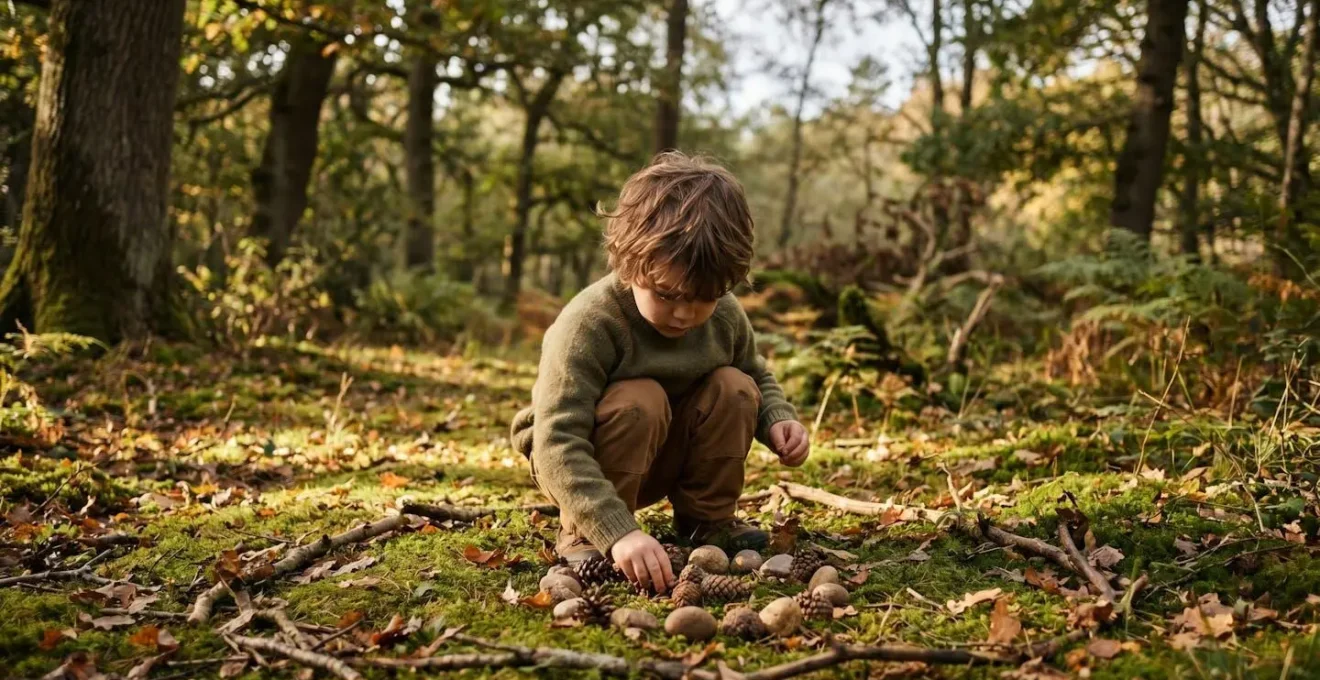
This paragraph introduces the core concept of why physical interaction is superior to screen-based learning for spatial development. To truly understand this, it’s helpful to visualize the richness of a real-world environment. The illustration below captures how a child experiences natural depth and texture, information that is entirely absent from a flat screen.
As the image suggests, when a child moves through a real environment, they experience critical visual cues like motion parallax—where closer objects appear to move faster than distant ones. They feel the texture of bark, the weight of a stone, and the resistance of a branch. This constant stream of physical data creates a robust and accurate 3D model in their brain. A screen offers none of this. Tapping on a digital block provides no information about its weight, texture, or center of gravity. You can’t feel its edges or sense its balance. This lack of a physical feedback loop is a critical deficit.
This is not just a philosophical argument; it’s a matter of developmental science. Early childhood is a sensitive period for brain development, and as research on early cognitive development shows that, the developing brain expects a certain type of stimulation from the world. When it receives the simplified, non-physical data from a screen instead of the rich data from the real world, it’s like trying to learn to swim by reading a book about it. The fundamental experience is missing.
When to Introduce 100-Piece Puzzles: Following Your Child’s Pace
Parents often look for age-based milestones: « When should my child be able to do a 100-piece puzzle? » From an engineering perspective, this is like asking when a bridge should be able to hold 100 tons. The answer is: when its underlying structure is strong enough to support the load. The same is true for a child. The ability to tackle a complex puzzle isn’t tied to a birthday; it’s tied to the development of their underlying observational and spatial reasoning skills.
Instead of focusing on piece count, focus on observing your child’s behavior during play, especially in nature. The natural world is the ultimate open-ended puzzle, and how your child interacts with it provides all the clues you need to gauge their readiness for more complex, structured tasks. Do they notice the difference between a round pebble and an oval one? Can they follow the path of an ant trail? Are they starting to sort their collected leaves by color or shape? These are the real developmental milestones.
Observing these stages allows you to provide the « just right » challenge. If your child is sorting objects by a single attribute (e.g., all the brown leaves), they are ready for simple shape-sorter toys. If they start creating patterns, they are ready for more complex puzzles with repeating elements. Following their lead ensures that the challenge is engaging, not frustrating. You are not pushing them to meet an arbitrary standard; you are providing the next logical step in their unique developmental journey. The 100-piece puzzle is not the goal; it is a potential outcome of a well-supported development process.
Your 5-Stage Observation Checklist: Gauging Spatial Readiness in Nature
- Stage 1 (Early Spatial Awareness): Observe if your child begins sorting natural objects by one attribute like color. This indicates readiness for identifying simple shapes in nature (e.g., round stones vs. oval leaves).
- Stage 2 (Comparative Sorting): Watch for sorting by multiple attributes (e.g., size AND shape). This signals they are ready to compare different tree barks, leaf patterns, or seed types.
- Stage 3 (Path Tracing): Notice if your child can visually follow continuous lines like vines or ant trails. This is a sign they are ready for simple trail mapping activities.
- Stage 4 (Pattern Recognition): See if they identify and predict repeating patterns, like petal arrangements or leaf veins. This means they are ready for observing more complex patterns like fern fractals.
- Stage 5 (Symbolic Representation): Look for their ability to create simple drawings that represent real spaces. This shows they are ready to make maps of familiar areas, indicating landmarks and spatial relationships.
Why Is Baking the Best Way to Teach Fractions and Weights?
While block play teaches structural engineering, the kitchen—and specifically baking—is a preschooler’s first and best laboratory for process engineering and chemistry. It’s the ultimate multi-sensory experience for learning abstract mathematical concepts like fractions, volume, and measurement in a tangible, delicious way.
When a recipe calls for « half a cup of flour, » that’s not an abstract concept. It’s a physical action with a visible result. The child can see that the 1/2 cup measure is smaller than the 1 cup measure. They can feel the weight of the flour. They can experience what happens when you have to use the 1/4 cup measure twice to equal the 1/2 cup. They are performing addition with fractions without ever seeing an equation. They are learning about equivalence and conversion in a context that matters to them—the creation of cookies.
Baking also introduces the concept of irreversible processes, a key idea in science and engineering. You can mix flour, sugar, and eggs, but once you apply heat, you create something entirely new. You can’t « un-bake » a cake. This teaches cause and effect in a powerful way. It also provides endless opportunities for estimation and prediction. « Will this be enough dough for 12 cookies? » « What happens if we add more chocolate chips? » Each question is a mini-scientific hypothesis.
The process turns your kitchen into a measurement-rich environment. You have teaspoons, tablespoons, cups, ounces, and grams. You have timers that measure seconds and minutes. You have oven temperatures. By involving your child in this process, you are immersing them in a world of practical mathematics, where numbers and units have a direct, physical meaning and lead to a tangible, rewarding outcome.
Key Takeaways
- Spatial reasoning is not an innate talent but a skill built through physical interaction with a 3D environment.
- The most effective « toys » are often everyday tasks like baking or chores, which provide tangible feedback on concepts like volume, weight, and geometry.
- Screens are fundamentally limited because they lack the physical and sensory feedback (weight, texture, parallax) necessary for building a robust 3D mental model.
STEM or STEAM: Why Adding Art Improves Engineering Skills?
In the push for STEM, the « A » for Arts in STEAM can sometimes feel like a soft, unnecessary addition. From an engineering standpoint, this is a profound misunderstanding. The arts, particularly visual arts, are not a diversion from technical skills; they are a direct and powerful training ground for one of the most critical engineering abilities: visualization.
An engineer must be able to look at a 2D blueprint and mentally construct the 3D object it represents. They must be able to imagine how different components will fit together, how a system will move, and where potential conflicts might arise. This is a purely imaginative, spatial act. Drawing, sculpting, and even arranging natural objects into a collage are direct exercises of this exact skill. When a child draws a picture of their house, they are grappling with perspective, proportion, and how to represent a 3D structure on a 2D plane.
Furthermore, art encourages creative problem-solving and prototyping. There is no single « right » answer in art. It’s a process of iteration and exploration. If a child’s clay sculpture keeps falling over, they have to diagnose the structural problem and engineer a solution—perhaps by widening the base or adding an internal support. This is identical to the process an engineer uses to debug a design. The « A » in STEAM provides a low-stakes environment to practice the high-stakes thinking required in STEM.
The impact of developing these foundational skills is enormous. In fact, one study estimated that if all students in the U.S. received dedicated spatial skills training—the very kind that art and physical play foster—the number of students who enter college with the spatial abilities of a typical engineering student would double. The « A » is not a luxury; it is a strategic accelerator for developing a true engineering mindset.
Playful Learning at Home: Integrating Maths into Daily Chores?
You have now seen how specific activities like block play, baking, and art can build spatial skills. The final and most powerful step is to adopt an engineering mindset and see your entire home and daily routine as a learning landscape. The goal is to move from discrete « learning activities » to a state of continuous, playful exploration embedded in everyday life. Chores, often seen as a drag, are prime opportunities for this transformation.
Instead of just « raking the leaves, » you can practice « Leaf Raking Geometry. » Challenge your child to rake the leaves into a perfect circle, a square, or a spiral maze. They are now engaging with large-scale geometry and planning. Instead of just « watering the plants, » you can start an exploration of « Watering Physics. » Ask them to predict how much water a pot needs (volume estimation) or what angle they need to tilt the watering can to reach a distant plant (trajectory). Every mundane task holds a hidden lesson in maths or physics.
This approach has a profound effect. It reframes chores from something that must be endured into a puzzle to be solved. It teaches a child to look at the world with curiosity and to see the underlying systems and patterns. This is the ultimate goal: to cultivate not just a set of skills, but a way of thinking. You are teaching them to be problem-solvers, observers, and systems thinkers. You are laying the groundwork for them to see a challenge not as an obstacle, but as an interesting problem to be deconstructed and solved.
- Leaf Raking Geometry: Rake leaves into specific geometric shapes or create a walkable maze, teaching large-scale spatial design.
- Watering Physics Exploration: Ask prediction questions about volume, flow rate, and trajectory during plant watering.
- Garden Plot Ratio Planning: Plan planting using ratios (e.g., ‘1 marigold for every 3 tomato plants’) and density concepts.
- Compost Sorting Categorization: Turn sorting compost into a multi-variable puzzle (greens vs. browns, size, decomposition state).
- Natural Unit Measurement: Use handfuls or baskets as units of measure and then translate them to standard units, connecting estimation to formal measurement.
Now that you are equipped with the engineering mindset to see the learning potential in every object and task, the next step is to begin consciously integrating this approach. Start today by choosing one daily chore and transforming it into a playful experiment in spatial reasoning.