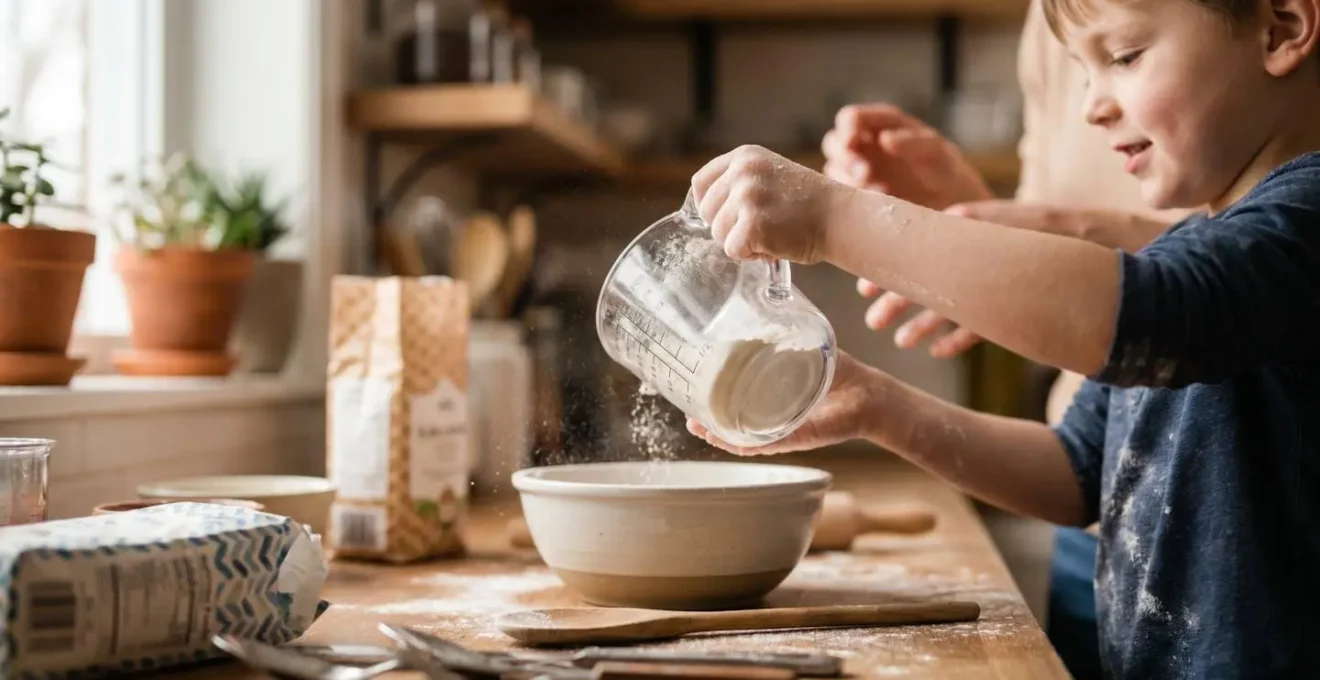
The secret to raising a mathematical thinker isn’t to turn your home into a classroom, but to stop trying to « teach » and start noticing the complex maths already happening in everyday play.
- Forcing « lessons » during chores can extinguish a child’s natural curiosity and motivation.
- Real-world, hands-on activities like baking and block play build stronger, more intuitive neural pathways for maths than abstract worksheets.
Recommendation: Shift your focus from creating teaching moments to providing a rich environment and a vocabulary that helps your child make sense of the mathematical world they already inhabit.
The pressure on parents to be their child’s first teacher can feel immense. We see the world through a lens of ‘teachable moments’, and our homes can quickly fill with educational toys, flashcards, and the quiet guilt of unused maths workbooks. We’re told to make learning fun, so we try to turn folding laundry into a geometry lesson or cooking dinner into a lecture on fractions. But what if this approach, however well-intentioned, is actually counterproductive? What if the relentless effort to turn every activity into a structured lesson is the very thing that kills a child’s innate love for figuring things out?
The common advice suggests gamifying chores or finding apps that drill arithmetic. These methods treat maths as a bitter pill that needs a sugary coating. This perspective misses a profound truth that unschooling families have long understood: children are natural mathematicians. They are born pattern-seekers, problem-solvers, and system-builders. They don’t need us to invent artificial learning opportunities; they need us to see, acknowledge, and give language to the complex mathematical thinking they are already engaged in during their self-directed play.
This isn’t an argument for parental neglect, but for a radical shift in perspective. Instead of asking, « How can I teach my child maths during this chore? », we should be asking, « What mathematical thinking is already happening here, and how can I join in? » The answer lies not in more structure, but in more freedom; not in more teaching, but in more authentic connection and observation. It’s about ditching the ‘lesson plan’ mentality and embracing a world where maths is not a subject to be taught, but a language to be spoken and a landscape to be explored together.
This guide will explore how to cultivate this environment. We’ll dismantle the ‘lesson trap’, understand the science behind why real life sticks better than worksheets, and discover how to nurture deep mathematical understanding in short, playful bursts that feel like connection, not work.
Summary: The Unschooling Parent’s Guide to Real-World Maths
- Why Is Baking the Best Way to Teach Fractions and Weights?
- How to Turn the Weekly Shop into a Budgeting Lesson?
- Worksheets or Real Life: Which Stick Better in Memory?
- The « Lesson » Trap: Why Turning Play into Work Kills Motivation
- How to Teach Concepts in 5-Minute Bursts?
- Why Does Block Play Predict Better Maths Scores at GCSE?
- STEM or STEAM: Why Adding Art Improves Engineering Skills?
- How to Improve Spatial Reasoning in Preschoolers Without Screens?
Why Is Baking the Best Way to Teach Fractions and Weights?
Baking is often touted as a maths activity, but its true power is usually misunderstood. It’s not about drilling the fact that two half-cups make a whole cup. It’s about building an intuitive, physical sense of proportional reasoning. When a child measures, they’re not just reading numbers; they’re engaging with volume, weight, and density in a tangible way. A cup of flour feels different from a cup of sugar. This is where real understanding begins, far from the 2D world of a textbook page.
The real magic happens when you move beyond simply following a recipe. Ask a simple, playful question: « What if we only wanted to make half a batch of cookies for just the two of us? » Or, « What if we wanted to make a giant cake and needed to double everything? » Suddenly, you’re not just following instructions; you’re problem-solving. This act of scaling a recipe up or down is a direct, hands-on precursor to understanding multiplication and proportional relationships. The child isn’t just « doing fractions »; they’re manipulating them to achieve a delicious goal.
This process allows them to physically test hypotheses. What happens when you use a tablespoon instead of a teaspoon? The result is immediate and sensory. They learn that these units of measurement are not arbitrary symbols but have a real-world impact. They can see, touch, and taste the difference. This creates a rich, multi-sensory memory that is far more durable than a rule memorised for a test. The goal isn’t the perfect cookie; it’s the rich, exploratory process that gets you there.
How to Turn the Weekly Shop into a Budgeting Lesson?
The supermarket is a living, breathing maths textbook, but only if we stop seeing it as a race to the checkout. Instead of a chore to be rushed through, the weekly shop can become a masterclass in budgeting, estimation, and economic decision-making. The key, as always, is to hand over a measure of genuine control and responsibility, turning the child from a passive passenger in the trolley to an active financial stakeholder.
It starts with a simple premise: a real budget. Give your child a small, realistic amount (£5 or $5) and a mission (« You are in charge of buying the family’s snacks for the week with this money »). This simple constraint immediately introduces the core concepts of scarcity and choice. They can’t have everything. A choice for the expensive crisps means a choice against the yoghurt pots. This isn’t a theoretical exercise; it’s the real-time calculation of opportunity cost. You don’t need to lecture about it; the experience teaches it.
This is the perfect environment to introduce the practical art of estimation. « About how much do you think our total will be? Let’s round each item to the nearest pound/dollar as we put it in the cart. » This turns the entire shop into a running mental maths game. The moment of truth at the till—comparing their estimate to the actual total—provides instant, non-judgmental feedback. It’s a game where « getting it right » is a fun surprise, not a test score. This playful practice builds number fluency far more effectively than a page of rounding exercises.
Your Action Plan: The 5-Step Grocery Store Budgeting Game
- Assign the Mission: Before entering the store, give your child a small, realistic budget (e.g., £5 for snacks) and a clear goal. Explain that they are the decision-maker within this limit.
- Introduce Unit Price: Show them the smaller numbers on the price tag. « This big box costs more, but see here? It’s actually cheaper per biscuit. » This plants the seed of critical value comparison.
- Practice ‘Trolley Estimation’: As you shop, encourage rounding each item’s price to the nearest pound or dollar. Keep a running, verbal tally. This makes mental arithmetic a natural part of the process.
- Frame the Trade-Off: When faced with a choice, frame it in terms of opportunity cost. « If we get these fancy juice boxes, we won’t have enough left for the bananas. Which is more important for our week? »
- The Checkout Reveal: Compare your estimated total with the final bill. Celebrate the closeness of the guess. This is not a test, but the satisfying feedback loop that solidifies the learning.
Worksheets or Real Life: Which Stick Better in Memory?
Why does learning fractions by baking feel so much more effective than a worksheet? The answer lies in a fascinating field of science called embodied cognition. This theory posits that our thinking is not an abstract process confined to our brains, but is deeply interconnected with our bodies and our physical experiences in the world. We don’t just think with our minds; we think with our hands, our senses, and our movements.
A worksheet presents maths as a set of abstract symbols to be manipulated according to rules. It engages a single sense (sight) and a narrow cognitive channel. In contrast, real-world activities are multisensory. When a child builds with blocks, they feel the weight and texture, they see the shapes from multiple angles, they hear the clatter as a tower falls. This rich sensory input creates stronger, more complex neural pathways. In fact, embodied cognition research shows that learners’ actions influence how they think, with physical manipulatives and gestures creating much more robust learning than symbols alone.
Think of it like learning to ride a bike. No amount of reading diagrams or solving physics equations (the worksheet approach) will teach you how to balance. You learn by doing—by feeling the subtle shifts in weight, the wobble of the handlebars, and the momentum carrying you forward. The knowledge becomes part of your muscle memory. The same is true for mathematical concepts. When a child physically holds two quarter-cup measures and sees that they fill the half-cup measure perfectly, they are not just learning a rule. They are internalizing the concept of equivalence in a way that is intuitive, memorable, and deeply understood.
The « Lesson » Trap: Why Turning Play into Work Kills Motivation
Here is the most dangerous pitfall in a well-meaning parent’s journey: The « Lesson » Trap. It’s the moment we see our child happily playing, and our internal ‘teacher’ voice whispers, « This is a great opportunity to teach them about… ». We interrupt their flow to ask pointed questions, to correct their method, or to formalize their game into a structured activity. And in that moment, we inadvertently turn joyful, self-directed exploration into work.
The science behind this is explained perfectly by Self-Determination Theory (SDT), a foundational theory of human motivation. According to its creators, Ryan and Deci, intrinsic motivation—the desire to do something for its own sake—thrives on three core psychological needs: Autonomy (the feeling of being in control of one’s own actions), Competence (the feeling of being effective and mastering challenges), and Relatedness (the feeling of connection to others). When we hijack our child’s play to insert a lesson, we strip them of their autonomy. The activity is no longer theirs; it’s ours. We impose our own goals, undermining their sense of competence by implying their way isn’t « right. »
As foundational research by Ryan and Deci on Self-Determination Theory points out, children are born curious and playful. Our job isn’t to create this motivation, but to create the conditions for it to flourish. When we turn play into a quiz, we are sending a clear message: the real purpose of this activity is not the fun you are having, but the academic outcome I want you to achieve. The child’s motivation shifts from intrinsic (I’m doing this because it’s interesting) to extrinsic (I’m doing this to please my parent), and the magic is lost.
From the time of birth, children, in their healthiest states, are active, inquisitive, curious, and playful, even in the absence of specific rewards. The maintenance and enhancement of this inherent propensity requires supportive conditions, as it can be fairly readily disrupted by various nonsupportive conditions.
– Ryan, R.M. & Deci, E.L., Self-Determination Theory and the Facilitation of Intrinsic Motivation
How to Teach Concepts in 5-Minute Bursts?
If formal lessons are out, how does any learning actually happen? It happens in the spaces in between. The unschooling approach isn’t about setting aside an hour for « maths time. » It’s about a thousand tiny, five-second to five-minute interactions that are woven into the fabric of daily life. This method aligns perfectly with the natural attention spans of young children. Instead of one long, overwhelming session, you have dozens of small, low-stakes, and highly relevant learning moments.
One effective strategy is the ‘Concept of the Week’. This doesn’t mean you announce it or put up a poster. It’s a quiet focus for you, the parent. Let’s say your theme is « symmetry. » On Monday, as you’re looking at a leaf, you might casually remark, « Oh, look how this side is a perfect mirror of that side. It’s symmetrical. » On Wednesday, while making sandwiches, you might cut one diagonally and say, « I wonder if we can make these two triangles match up perfectly. » On Friday, you might just point at a building with a balanced design. There’s no quiz, no demand for a response. You are simply « strewing » an idea and a vocabulary word into the environment.
Another powerful tool is the ‘Maths Question of the Day’. This is a single, playful, open-ended question posed at a regular time, like breakfast or during the drive to school. It shouldn’t have a single right answer. « I wonder how many blue cars we’ll see today? » « What if we had to share this pizza with ten people instead of four? » The most critical part of this is the wait time. After you ask, wait. Count to ten in your head. Give their brain the space to process and formulate a thought. These tiny, consistent bursts of mathematical thinking normalize the subject, framing it as a fun and curious way to look at the world, not a chore to be completed.
Why Does Block Play Predict Better Maths Scores at GCSE?
It might seem like a huge leap to connect a toddler’s block tower with their teenage exam results, but a growing body of research shows a direct and powerful link. The simple act of playing with blocks is one ofthe most effective ways to develop a child’s spatial reasoning—the ability to think about objects in three dimensions and to visualize and manipulate shapes in one’s mind.
When children build, they are constantly solving complex physics and engineering problems. How high can I stack these before they fall? Which shape makes a stronger base? How can I create a bridge that spans this gap? They are learning about balance, symmetry, gravity, and stability through hands-on experimentation. They are mentally rotating shapes, predicting outcomes, and learning from failure when a tower spectacularly collapses. This is the very foundation of mathematical and scientific thinking.
This isn’t just a theory; it’s backed by hard data. Studies have shown that a child’s spatial skills in their early years are a strong predictor of their later success in STEM fields. In fact, research shows spatial skills in early years predict later performance in subjects like maths, science, and engineering. The spatial vocabulary we use around them—words like ‘on top’, ‘underneath’, ‘next to’, ‘through’, and ‘around’—further strengthens these connections. So when your child is deeply engrossed in building, they are not « just playing. » They are doing the essential groundwork for their future as a logical, analytical thinker.
STEM or STEAM: Why Adding Art Improves Engineering Skills?
In the push for more science and tech education, the arts are often seen as a fluffy extra, the first thing to be cut when budgets are tight. But this view is based on a false dichotomy between the analytical and the creative. The most innovative thinkers, from Leonardo da Vinci to Steve Jobs, have always worked at the intersection of art and science. The move from STEM (Science, Technology, Engineering, Maths) to STEAM (adding the « A » for Arts) recognizes this crucial synergy.
Art and design introduce concepts that are often missing from a purely technical education: aesthetics, narrative, and human-centered purpose. They ask « Why? » and « For whom? » not just « How? ». Adding an artistic layer to a technical challenge can dramatically improve engagement and the quality of the outcome. It provides context and meaning, which are powerful motivators for learning.
Case Study: The Puppet Dragon and the Castle Walls
A fascinating study highlighted this very principle. Researchers asked a group of children to perform a block-building task. One group was simply given the instructions, while another was told a story: a friendly puppet dragon needed their help to rebuild a castle for the king and queen. The study found that adding this simple narrative context was associated with significant improvements in the children’s spatial skills. The story gave them a reason *why* the castle walls needed to be a certain height or couldn’t have gaps. As research by Casey et al. demonstrates, the artistic narrative provided meaningful context and aesthetic constraints that enhanced the engineering-type spatial task.
This shows that creativity is not the opposite of technical skill; it is its vital partner. When we allow children to build stories around their block creations, or to design beautiful patterns with manipulatives, or to draw maps of their imaginary worlds, we are not distracting them from « real » learning. We are giving them the tools to be more innovative, more engaged, and ultimately, more successful engineers and problem-solvers.
To recap
- The goal is to cultivate mathematical thinking, not just teach arithmetic procedures.
- Intrinsic motivation, driven by autonomy and competence, is more powerful and sustainable than external rewards or pressure.
- Real-world, hands-on, multisensory experiences create far stronger and more flexible understanding than abstract symbols on a page.
How to Improve Spatial Reasoning in Preschoolers Without Screens?
In a world saturated with « educational » apps, it’s easy to believe that digital tools are the best way to develop modern skills. However, when it comes to the foundational skill of spatial reasoning, the most effective tools are often the most timeless and tangible. Developing a sense of space, shape, and position is an inherently physical process. It’s about how a child’s body relates to the world around them, an understanding that cannot be fully replicated on a two-dimensional screen.
The best playground for spatial development is the world itself. Encourage big body movement. Can you crawl under the table? Can you climb over the sofa cushion? Can you make yourself as small as a mouse and then as tall as the door? This builds proprioception—an internal sense of one’s own body in space—which is intrinsically linked to external spatial awareness. The irregular, unpredictable challenges of the natural world are even better. Climbing a tree, navigating a woodland path, or building a den with fallen branches provides a richer and more complex set of spatial problems to solve than any uniform, manufactured toy.
Language is the glue that makes these experiences stick. As your child plays, narrate their actions using rich spatial vocabulary. « You’re hiding inside the box! » « You climbed so high up the ladder! » « You went around the tree and through the bushes. » This connects their physical experience to the abstract words, building a mental map. You can then take this a step further by actually making maps. After a walk to the park, get out crayons or blocks and try to represent the journey. « First we went past the big red postbox, then we turned left at the tall oak tree. » This act of translating a 3D experience into a 2D representation is a highly sophisticated spatial reasoning task, and one that is deeply engaging and entirely screen-free.
By shifting your perspective from ‘teacher’ to ‘co-explorer’, you give your child the greatest gift: the confidence to see themselves as a capable mathematical thinker, and the joy of discovering that maths isn’t just a subject in a book, but a fundamental and beautiful part of the world around them.