In summary:
- Shift your role from a reactive referee who assigns blame to a proactive coach who builds skills.
- Treat sibling conflict not as a problem to be stopped, but as a vital curriculum for learning negotiation and empathy.
- Use neutral narration (« sportscasting ») to describe what’s happening without judgment, allowing children to see the situation objectively.
- Validate all feelings but not all behaviors, creating a safe space for emotional expression while maintaining clear boundaries.
The sounds are painfully familiar in any household with more than one child: « He hit me! » « But she took my toy first! » As a parent, your instinct is to rush in, determine the culprit, demand an apology, and restore a fragile peace. You become a permanent, exhausted referee in a game with no end. This constant cycle of judgment and enforcement, while well-intentioned, often leaves at least one child feeling misunderstood and resentful, and teaches them very little about resolving disagreements on their own.
The common advice to « make them say sorry » or « just separate them » offers only a temporary ceasefire, not a lasting solution. But what if we reframed our entire approach? What if every squabble over a toy, every argument over who gets the blue cup, wasn’t a failure of parenting but a critical, real-time lesson in your child’s social-emotional curriculum? The true key to harmony isn’t stopping fights, but transforming them into learning opportunities. It requires a fundamental shift in your role: from judge to mediator, from arbiter to coach.
This guide provides a professional mediator’s toolkit, adapted for the living room floor. You will learn practical, empathy-based techniques that empower your children to navigate their own conflicts. We will explore how to describe disputes without judgment, why forced apologies backfire, how to create physical spaces for negotiation, and ultimately, how to build a foundation of psychological safety where conflict can be resolved constructively, not just suppressed.
By stepping away from the referee’s whistle, you give your children the space and the tools to develop skills that will serve them for a lifetime, turning sibling rivalry into a powerful engine for social and emotional growth. The following sections break down these strategies into clear, actionable steps.
Summary: A Mediator’s Guide to Sibling Fights Without Taking Sides
- How to Use « Sportscasting » to Describe Conflicts Without Judging?
- The Forced Apology Mistake: Why It Breeds Resentment?
- Why Is Sibling Conflict Actually Good for Social Skills?
- How to Set Up a « Peace Corner » for Negotiation?
- When to Step In: Identifying the Line Between Bickering and Bullying
- How to Use the « Name It to Tame It » Technique Effectively?
- How to Validate Feelings Without Agreeing with the Behavior?
- How to Create Psychological Safety at Home for Anxious Kids?
How to Use « Sportscasting » to Describe Conflicts Without Judging?
When you hear a conflict erupt, your first instinct might be to investigate and assign blame. « Sportscasting » offers a powerful alternative that immediately de-escalates tension by positioning you as a neutral observer, not a judge. The goal is to narrate the events factually and without emotion, just like a sports commentator describing a play. Instead of « Stop hitting your brother! » you might say, « I see two children who both want the same red block. Ben, your hands are on the block, and so are yours, Leo. You’re both pulling. »
This technique does several things at once. It shows your children you are paying attention and understand the situation. It models neutral, non-accusatory language. Most importantly, it gives them a moment of pause to see their own actions from an outside perspective, creating the mental space needed to start problem-solving. As parenting expert Janet Lansbury explains, this approach is fundamentally about trust. In her article, « 5 Benefits of Sportscasting Our Child’s Struggles, » she notes that by narrating instead of fixing, we communicate our belief that our children are capable of resolving their own issues.
To be effective, sportscasting must remain completely impartial. Here are some core principles to follow:
- Describe actions and feelings: « You look very frustrated that she took the doll. Your face is red, and your fists are clenched. »
- Avoid labels: There is no « victim » or « aggressor. » There are simply two people with competing needs. Describe what you see, not who is « right » or « wrong. »
- Stay neutral even when triggered: « You didn’t want me to turn off the TV. You are shouting to let me know how angry you are. »
- Encourage solutions: After narrating, you can open the door for their input: « Hmm, this is a tough problem. Two children, one truck. What could we do? »
This shift from directing to describing is the first step in moving from a referee to a conflict coach. It lays the groundwork for children to see the problem as something they can solve together, rather than a fight to be won.
The Forced Apology Mistake: Why It Breeds Resentment?
In the aftermath of a sibling skirmish, the parental go-to is often a swift command: « Say you’re sorry. » It feels like the right thing to do—a quick, clean way to teach accountability and restore order. However, compelling a child to apologize when they don’t feel remorse is not only ineffective but can be actively harmful. It teaches them that words can be meaningless, that a ritual can replace genuine feeling, and that the goal is to appease the adult in charge rather than to mend a relationship.
A forced apology often breeds deep resentment in both children. The « apologizer » feels shamed and misunderstood, their own feelings of anger or injustice dismissed. The recipient of the insincere apology learns nothing about empathy and can often feel worse, sensing the lack of authenticity. In fact, research from the University of Michigan shows that children can clearly distinguish between willing and coerced apologies, and that recipients of forced apologies actually felt worse than those who received a genuine one. The study highlights that the insincerity is transparent to other children.
The goal should be to cultivate the conditions for a sincere apology, which can only come from a place of empathy and understanding. This means shifting the focus from the word « sorry » to the act of « repair. » As research scientist Craig Smith states in the study:
Coercing your child to apologize is going to backfire. Other kids don’t view that apologizer as likable.
– Craig Smith, University of Michigan Center for Human Growth and Development
Instead of forcing the words, try focusing on the other child’s feelings. « Look at Sarah’s face. She’s crying because her tower was knocked down. What could we do to help her feel better? » This might lead to helping rebuild the tower, getting an ice pack, or offering a different toy. These acts of repair are far more meaningful and educational than a hollow, mandated apology.
Why Is Sibling Conflict Actually Good for Social Skills?
It can feel deeply counter-intuitive, but the constant bickering that drives parents to distraction is not a sign of failure; it is one of the most important training grounds for a child’s social development. The family home is a relatively safe laboratory where children can practice complex interpersonal skills. Every argument over who gets to be the leader in a game or who had the remote first is a mini-lesson in negotiation, conflict resolution, emotional regulation, and seeing another person’s perspective.
When we constantly step in to solve these disputes, we rob our children of these valuable learning opportunities. We send the message that they are incapable of handling disagreement and that an external authority is always needed to resolve conflict. Conversely, when we provide a framework for them to work through it themselves, we empower them. As a 1998 study on sibling interactions noted, this process is essential for skill development. It’s a key tenet of what can be called « conflict as curriculum »—viewing these moments as teaching opportunities rather than disruptions.
Research on sibling relationships confirms that these interactions are a crucible for developing a « theory of mind »—the understanding that others have different thoughts, feelings, and intentions. According to an analysis of sibling relationship development, children practice this understanding through teasing, pretend play, and, most importantly, conflict resolution. When siblings successfully navigate a disagreement, they learn to manage their own intense emotions, articulate their needs, listen to another’s viewpoint, and work towards a mutually agreeable compromise. These are the exact skills that predict success in friendships, classrooms, and future workplaces.
Of course, this doesn’t mean letting all fights devolve into chaos. The parent’s role as a mediator is to ensure physical and emotional safety. But by seeing conflict as a skill-building exercise, you can shift your mindset from frustration to facilitation, asking « What can they learn here? » instead of « How do I make this stop? »
How to Set Up a « Peace Corner » for Negotiation?
While sportscasting helps de-escalate conflict in the moment, creating a designated physical space for problem-solving can ritualize and honor the process of negotiation. A « Peace Corner » or « Peace Table » is not a time-out spot for punishment, but a neutral zone where siblings can go to work through their disagreements with a structured process. This physical separation from the « scene of the crime » helps calm emotions and signals that it’s time to switch from fighting to talking.
The setup should be simple, intentional, and calming. It’s not about expensive furniture, but about creating an environment that encourages connection and respect. The key is to establish a space that feels special and is solely dedicated to peaceful resolution.
Introducing this space to children when they are calm is essential. You can role-play how to use it, explaining that it’s a special place to go when they have a « big problem » to solve together. The structure of the space and its associated rituals provide a predictable and safe container for difficult conversations. Over time, children may even start to take themselves to the Peace Corner without parental prompting, a significant step towards independent conflict resolution.
Action Plan: Auditing Your Home for a Peace Corner
- Identify the Zone: Scout for a quiet, neutral, and easily accessible spot in your home that is away from high-traffic areas and major distractions.
- Set the Stage: Collect two equal chairs or cushions and a small table. Equality in seating is crucial to symbolize a balanced power dynamic.
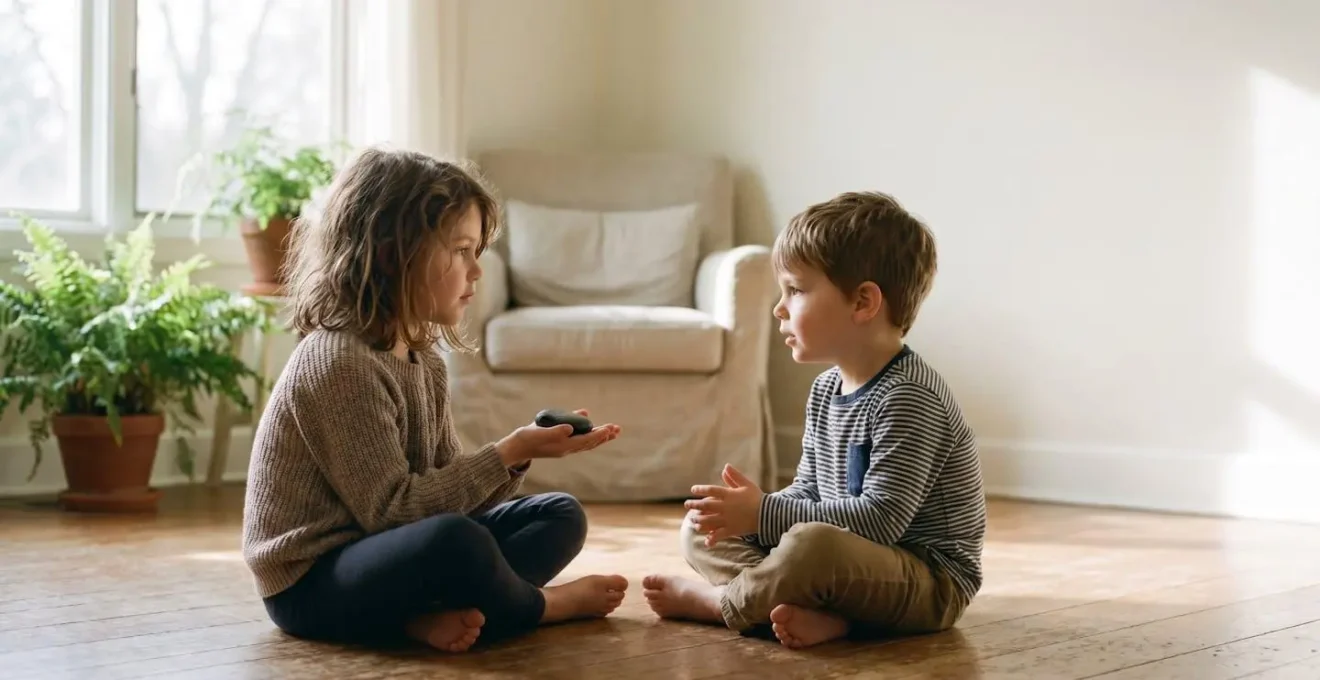
- Choose the Talking Piece: Find a single, special object (a smooth river stone, a small decorative plant, a « talking stick ») that only the person speaking is allowed to hold.
- Add Calming Elements: Gather natural items like wood, plants, or soft textiles. Ensure the area has soft, non-interrogating light to promote a sense of calm.
- Visualize the Rules: Create and post simple visual icons or short phrases for the core rules: ‘Take turns speaking,’ ‘Listen with your heart,’ and ‘Work together for a solution.’
When to Step In: Identifying the Line Between Bickering and Bullying
Adopting a mediator role doesn’t mean a completely hands-off approach. While typical sibling bickering is a healthy part of development, it’s crucial for a parent to recognize when a conflict crosses the line into bullying. The key difference lies in the power dynamic. Bickering is a conflict between equals; both children have a chance to « win » or « lose, » and the roles of aggressor and victim often switch back and forth. Bullying, however, involves a persistent power imbalance where one child consistently targets another who has difficulty defending themselves. This can be due to a difference in age, size, or social-verbal skills.
Signs that bickering has veered into bullying include a repeated pattern of aggression, an intent to cause genuine harm (physical or emotional), and a clear and consistent victim who shows signs of fear or distress even when not in direct conflict. In these cases, parental intervention is not just appropriate, but necessary to ensure the emotional and physical safety of the targeted child. This is no longer a « conflict curriculum » opportunity; it is a safety issue.
For everyday bickering, however, the goal is to intervene as little as possible. As parenting educator Sara Kuljis advises, letting those in the conflict devise their own solutions is far more effective than imposing one. This fosters a sense of agency and competence. Indeed, according to research from the University of Waterloo, when parents actively use a mediation approach—helping children articulate their own feelings and ideas for solutions—the children become more constructive and compromise more often in future conflicts. The parent’s job is to ask questions like, « What do you need? » and « What could you do differently next time? » rather than providing answers.
So, when should you step in? Intervene immediately for safety (physical or cruel emotional attacks). Intervene to mediate if the children are « stuck » and unable to de-escalate on their own. But for the low-level, everyday squabbles, try waiting. Give them a chance to practice their skills. You might be surprised at their ability to find a resolution when they know a referee isn’t about to blow the whistle.
How to Use the « Name It to Tame It » Technique Effectively?
In the heat of a conflict, a child’s brain is flooded with emotion. The logical, problem-solving part of their brain (the prefrontal cortex) is temporarily offline, while the reactive, emotional part (the amygdala) is in full control. This is why telling an enraged child to « calm down » or « use your words » is often completely futile. The « Name It to Tame It » technique, coined by psychiatrist Dr. Dan Siegel, is a simple yet profoundly effective way to bridge this gap.
The strategy involves helping a child identify and label their emotion. By giving a name to the big, scary feeling, you help activate their prefrontal cortex, which brings a sense of calm and control. It’s the first step in moving from a state of being overwhelmed *by* an emotion to being able to observe it. This isn’t about telling them how they feel; it’s about making an educated guess and reflecting it back to them: « Wow, you look so angry right now. Your face is all red. » Or, « It seems like you are feeling very frustrated that the tower fell. »
When you get it right, you’ll often see a visible change in your child. Their shoulders might relax, their breathing might slow down. They feel seen and understood, which is often what they are fighting for in the first place. This act of labeling the emotion does not excuse the behavior (like hitting), but it acknowledges the underlying feeling that drove it. It’s a foundational tool of emotional coaching.
To use this technique effectively:
- Be a detective, not a director. Use tentative language like « It seems like… » or « I wonder if you’re feeling… »
- Focus on the primary emotion. Anger is often a secondary emotion covering up hurt, fear, or frustration. Try to guess the feeling underneath. « You look angry, but I wonder if you’re also feeling sad that your brother won’t play with you. »
- Keep it simple. A single word is often enough: « Disappointed. » « Jealous. » « Furious. »
Once the emotion is named and the child begins to calm, the door to problem-solving finally opens. Only then can you begin to discuss what happened and what can be done about it.
How to Validate Feelings Without Agreeing with the Behavior?
This is perhaps the most nuanced and critical skill in a parent-mediator’s toolbox. Many parents fear that acknowledging a child’s negative feelings (« I hate my sister! ») is the same as condoning them. This confusion often leads them to shut down the emotion (« Don’t say that! »), which only makes the child feel more misunderstood and escalates the conflict. The key is to separate the feeling from the action. The rule is simple: all feelings are acceptable, but not all behaviors are acceptable.
Validation means showing your child that you understand and accept their emotional experience. It sounds like: « It is so frustrating when someone takes your toy without asking. I would be angry too. » Notice this statement does not say, « It’s okay to hit your sister. » It simply reflects the child’s feeling back to them, letting them know their emotional reaction is normal and valid. This simple act of empathy is profoundly calming and is often all a child needs to feel safe enough to let go of the anger.
The « Speaker/Listener » technique is a structured way to practice this. As described by therapists, the parent-mediator helps each child articulate their feelings while the other listens. You might say to one child, « Tell your brother how it felt when he grabbed the book. » Then you’d turn to the other and ask, « What did you hear your brother say? » This process separates feeling from blame and focuses on impact. It validates the speaker’s experience while teaching the listener empathy. It’s a way to brainstorm what to do differently next time, such as asking, « Next time your sister grabs your toy, what’s another way you could respond instead of pushing? »
Once a child is calm and feels understood, you can then guide them toward empathy for the other person involved. As parenting researcher Craig Smith suggests in a discussion on the topic, « When your child is calm, help them see how the other person is feeling, and why. » This is the moment to move toward repair. « Your sister is crying. What do you think would help her feel better? » The focus shifts naturally from your child’s anger to the other child’s hurt, paving the way for a genuine, unforced act of kindness.
Key takeaways
- Sibling conflict isn’t a parenting failure; it’s a fundamental part of learning social negotiation and emotional regulation.
- Your role is not to be a judge who finds blame, but a neutral mediator who facilitates communication and coaches skills.
- Validating feelings (« It’s okay to be angry ») while setting firm boundaries on behavior (« It’s not okay to hit ») is the core of effective mediation.
How to Create Psychological Safety at Home for Anxious Kids?
All of the techniques discussed—sportscasting, validating feelings, avoiding forced apologies—rest on a single, vital foundation: psychological safety. This is the belief a child holds that they can express their true feelings, make mistakes, and even fail at resolving a conflict without losing the love and respect of their caregivers. For a child, especially an anxious one, home must be the safest place in the world to be imperfect. Without this safety, they will not risk the vulnerability required to negotiate, compromise, or show empathy.
Creating this environment isn’t about eliminating rules or consequences. It’s about ensuring the parent-child connection remains secure, even amidst conflict. It means a child knows that while their behavior (hitting, yelling) might be unacceptable, *they* are never unacceptable. You communicate this through your tone, your body language, and your consistent focus on connection before correction. It’s getting down on their level, making eye contact, and saying, « This is hard. We’ll figure it out together. »
Predictable routines and family rituals are powerful tools for building this sense of safety. When a child knows what to expect, their ambient level of anxiety decreases, leaving more cognitive resources for managing social challenges. These don’t have to be elaborate; they can be as simple as a special handshake, a consistent bedtime story, or a weekly family game night. These small, repeated moments of positive connection create a deep well of security that children can draw from when they feel upset or overwhelmed.
Ultimately, your own emotional regulation is the most critical factor. When you can remain calm and centered in the face of your children’s intense emotions, you act as an external regulator for their nervous systems. You become their safe harbor in an emotional storm. By modeling that big feelings are manageable and not catastrophic, you give them the confidence to navigate their own emotional worlds, and by extension, their conflicts with each other.
Start today by choosing just one of these techniques to focus on. Transforming your home from a courtroom into a training ground for empathy is a gradual process, and every small step builds a foundation of peace and connection for years to come.