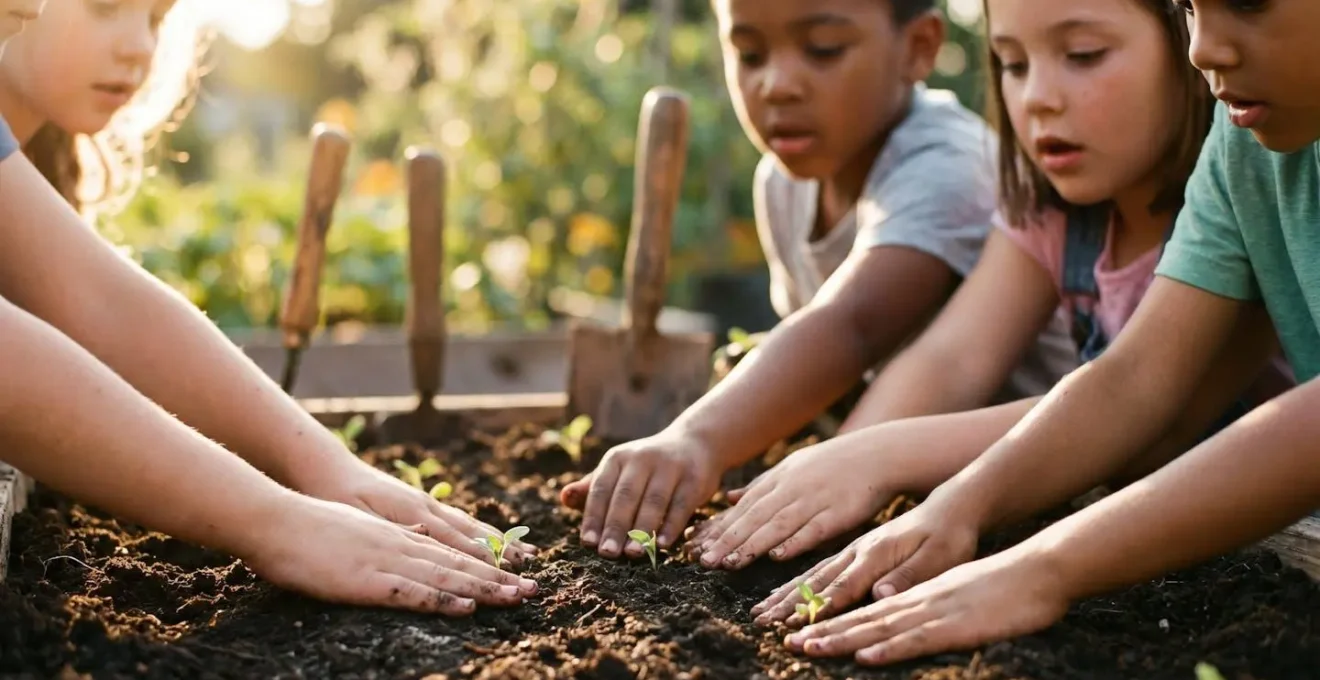
Raising an eco-conscious child isn’t about listing disasters; it’s about building their power to act.
- Action is the most effective antidote to a child’s eco-anxiety, transforming feelings of helplessness into agency.
- Local, tangible projects (like a worm farm or bug watching) teach complex ecological systems better than abstract, global facts.
Recommendation: Focus on developing your child’s agency through hands-on, creative, and local stewardship projects that build confidence and real-world skills.
As a parent, you want to teach your child to love and protect our planet. But how do you do that without passing on a crippling sense of dread? The news is filled with alarming headlines, and it’s easy to feel overwhelmed. Many well-intentioned guides suggest familiar steps: sort the recycling, watch nature documentaries, or talk about endangered species. While these actions are valuable, they often fall short. They can present environmentalism as a series of chores or, worse, a list of unstoppable disasters, feeding the very anxiety we hope to prevent.
What if the key isn’t just showing them the problem, but giving them the tools to feel like part of the solution? What if the most powerful lessons in sustainability aren’t learned from a screen, but from the soil in their own backyard? This guide shifts the focus from passive consumption of information to active creation of solutions. We will explore a more empowering approach, one rooted in psychology and hands-on experience. It’s about transforming eco-anxiety into agency, seeing « waste » as a resource for creativity, and understanding that the most profound environmental lessons often start on a micro-scale.
This article will guide you through a practical and positive framework for raising a young ecologist. We will delve into why small, tangible actions are the best cure for climate worry, how to turn your kitchen scraps into a living classroom, and why local engagement builds more resilience than focusing on global catastrophes. By the end, you will have a clear roadmap to foster genuine, joyful, and lasting environmental stewardship in your child.
Summary: Raising Young Ecologists: A Guide to Action-Based Stewardship
- Why Is Action the Best Antidote to Eco-Anxiety in Kids?
- How to Teach Decomposition with a Worm Farm?
- The Doomism Risk: Why Only Talking About Disaster Paralyzes Kids?
- Local Cleanup or Global Charity: Where Should Kids Start?
- When to Celebrate Earth Day: Making It a Yearly Tradition
- Why Does Knowing Local Bugs Help Fight Climate Anxiety?
- Why Does Reusing Trash Teach Better Design Skills Than New Materials?
- Upcycled Art Projects: Teaching Sustainability Through Creativity?
Why Is Action the Best Antidote to Eco-Anxiety in Kids?
The feeling of helplessness is the root of anxiety. For children, hearing about vast, complex problems like climate change without a clear path to contribute can be paralyzing. The antidote, therefore, isn’t more information, but meaningful action. Engaging in tangible environmental projects shifts a child’s mindset from that of a worried spectator to an empowered participant. This develops what psychologists call agency—the belief that one has the capacity to influence outcomes. When a child sees the direct result of their effort, whether it’s a cleaner park or a thriving plant they grew, they build a sense of control and competence.
This isn’t just a feel-good theory; it’s backed by research. Studies on youth psychology show that eco-anxiety is a growing concern, with research revealing that 44% of children aged 10-14 worry about the future impact of climate change. However, other studies demonstrate a powerful solution. A comprehensive study of young Australians found that when young people felt a sense of community responsibility for environmental issues, their intention to act positively for the environment increased. This process strengthens their internal locus of control, proving that tangible, community-level action is a direct pathway to building psychological resilience and proactive environmental behavior.
By focusing on small, achievable tasks, we teach children the most important lesson in sustainability: that their actions matter. This feeling of making a difference, no matter how small, is the most powerful tool we can give them to combat the despair that often accompanies awareness. Action builds hope, and hope is the fuel for a lifetime of stewardship.
How to Teach Decomposition with a Worm Farm?
Abstract concepts like « the circle of life » or « nutrient cycling » can be difficult for children to grasp from a textbook. A worm farm, or vermicomposter, transforms this abstract idea into a living, tangible ecosystem they can observe and care for. It’s not just a science project; it’s a direct lesson in transformation, demonstrating how kitchen « waste » isn’t an end point but a beginning. Children can see, touch, and smell the process as their leftover apple cores and vegetable peels are converted into rich, dark compost by the tireless work of worms.
This hands-on experience provides multiple layers of learning. First, it fosters responsibility. The worms are living creatures that depend on the child for food and a balanced environment, teaching care and consistency. Second, it offers a visceral understanding of ecosystems. Kids learn what worms can and cannot eat, how moisture levels affect the bin, and how a community of organisms works together to create something valuable. The illustration below highlights the key layers of this dynamic process, from fresh scraps at the top to nutrient-dense vermicast at the bottom.
As the cross-section shows, a worm farm is a miniature model of the planet’s natural recycling system. By participating in it, children don’t just learn about decomposition; they practice it. This grounds them in the principles of a circular economy, where resources are reused rather than discarded. It sparks a lifelong interest in gardening and sustainable living, turning an abstract environmental concept into a practical and rewarding daily habit.
The Doomism Risk: Why Only Talking About Disaster Paralyzes Kids?
In our passion to educate children about environmental challenges, it’s easy to fall into the trap of « doomism »—focusing exclusively on catastrophic scenarios like melting ice caps, widespread pollution, and species extinction. While awareness is important, an unrelenting diet of disaster-focused news paralyzes the developing mind. When problems seem too big and solutions too distant, the natural human response is to shut down. For children, this can manifest as sadness, fear, anger, or a sense of profound helplessness, which ultimately leads to inaction and denial.
The statistics are stark. According to recent research, nearly 3 in 5 youths (60%) reported feeling very or extremely worried about environmental problems, with a majority experiencing overwhelming negative emotions. This is precisely the paralysis that doomism creates. To counter this, we must balance problem awareness with solution-oriented action. The conversation needs to shift from « The world is in trouble » to « Here is a problem, and here is something we can do about it. » This reframing is critical for building resilience. As researcher Maria Ojala notes, knowledge without tools is a recipe for hopelessness.
Learning about climate change without acquiring the tools to cope with the emotions that accompany this knowledge may lead to hopelessness and denial.
– Ojala, M., Frontiers in Psychology – Eco-anxiety in children scoping review
Instead of just showing a documentary about ocean plastic, we can organize a cleanup at a local stream. Instead of just talking about deforestation, we can plant a tree. This approach fosters what psychologists call « meaning-focused coping, » where individuals find purpose and empowerment in their response to a crisis. It teaches children that while problems are real, so is their power to be part of the solution.
Local Cleanup or Global Charity: Where Should Kids Start?
It’s tempting to introduce children to the big, global environmental organizations, thinking that contributing to a large-scale cause is the most impactful way to help. While these charities do crucial work, for a child, the impact is abstract. Donating money to save a distant rainforest doesn’t provide the same formative experience as physically cleaning up a local park they play in. The key to fostering lifelong stewardship is to start within their circle of control—their home, their school, their neighborhood.
Local action provides immediate, visible feedback. When a child spends an hour picking up litter from a creek bed, they can turn around and see the direct result of their work: a cleaner, healthier environment. This tangible outcome reinforces their sense of agency and proves that their efforts make a real difference. It connects them to their own community and fosters a sense of ownership and responsibility for the places they love. This approach is exemplified by programs like Families in Nature in Austin, Texas, which connects families to their local environment through hands-on volunteering, demonstrating that stewardship begins with the world right outside your door.
Engaging in a community cleanup, as shown above, is more than just picking up trash. It’s a lesson in civics, collaboration, and the power of collective action. Children learn to work together towards a common goal and develop a deeper appreciation for their local ecosystems. This foundation of local care is what builds the capacity and desire for broader environmental engagement later in life. Starting small and local isn’t a lesser option; it’s the most powerful and psychologically sound strategy for raising an effective, engaged ecologist.
When to Celebrate Earth Day: Making It a Yearly Tradition
Earth Day is a wonderful opportunity to focus global attention on environmental issues, but its greatest value lies in its potential to be a catalyst, not a conclusion. For a child, celebrating the planet for one day a year can feel performative if the other 364 days are disconnected from those values. The true goal is not to make Earth Day a special occasion, but to make the principles of Earth Day a daily, year-round reality. It should serve as an annual touchstone—a time to celebrate the progress made, set new family « green goals, » and renew our commitment to the planet.
Making environmental stewardship a tradition means weaving it into the fabric of family life. This could mean establishing a weekly « nature walk » to observe the changing seasons, making a monthly trip to the farmers’ market a non-negotiable family outing, or setting aside a weekend each season for a larger project, like building birdhouses in winter or cleaning up a local beach in summer. These regular, repeated actions create a rhythm and a culture of environmental consciousness within the family. They become the « way we do things, » transforming stewardship from a concept into an identity.
As environmental education researcher Joy Palmer famously stated, this consistency is the single most important ingredient in fostering genuine care. A one-off project is an activity; a recurring practice is a value.
Regular exposure to nature is the single most important factor in fostering care and concern for the environment.
– Joy Palmer, Environmental educational researcher
Use Earth Day as your anchor. Plan your year around it. In the spring, start a garden. In the summer, commit to reducing plastic use on vacation. In the fall, learn to compost leaves. In the winter, research ways to save energy at home. By making eco-friendly actions a consistent and celebrated part of your family’s yearly cycle, you teach your child that caring for the Earth isn’t an event; it’s a way of life.
Why Does Knowing Local Bugs Help Fight Climate Anxiety?
It may seem like a stretch to connect identifying a ladybug in your garden to combating global climate anxiety, but the psychological link is direct and powerful. When a child learns to name and understand the « bugs » in their local environment, they are engaging in an act of deep connection. The world stops being a generic backdrop and becomes a specific, knowable place filled with individual actors. This process of observation and identification is a form of meaning-focused coping. Instead of feeling overwhelmed by a vast, abstract problem, the child is grounded in a small, manageable, and fascinating part of the solution: their own ecosystem.
This deep dive into the local environment fosters a sense of place and expertise. A child who can identify different types of bees, knows where to find roly-polies, and understands the role of spiders is not just a passive observer of nature; they are a knowledgeable steward of it. This expertise builds confidence and a sense of personal responsibility. A study on high school youth in a Student Climate and Conservation Congress found that programs promoting hands-on environmental observation successfully nurtured a positive environmental attitude, an internal locus of control, and a strong sense of personal responsibility. These factors, in turn, directly influenced their commitment to future environmental action.
Knowing your local bugs demystifies nature and makes it personal. It teaches children that an ecosystem isn’t something far away in a rainforest; it’s right under their feet. It’s in the pollinator visiting a flower, the decomposer in the soil, and the predator keeping other populations in check. This intimate knowledge replaces fear of the unknown with curiosity and care, building an emotional foundation for stewardship that is far more resilient than one built on fear of global disaster alone.
Why Does Reusing Trash Teach Better Design Skills Than New Materials?
Handing a child a blank sheet of paper and a box of new crayons offers limitless possibilities, but it teaches them very little about resourcefulness. Handing them a plastic bottle, a cardboard box, and a collection of bottle caps, and then asking them to build a rocket ship, teaches a far more valuable lesson: design within constraints. Working with « trash » or upcycled materials is not a second-best option for creativity; it is a masterclass in problem-solving, ingenuity, and engineering.
When you start with a pre-defined object—a yogurt cup, an egg carton—you are forced to see its inherent properties. What are its strengths? What are its weaknesses? How can its shape be incorporated into a new design? This process forces a child to think like an engineer or a designer. They must analyze the materials at hand and creatively adapt their vision to fit the resources available. This is a much higher-order thinking skill than simply executing a vision with perfect, purpose-built materials. It teaches flexibility, innovation, and the crucial understanding that resources are finite.
This approach fundamentally reframes the concept of waste. « Trash » is no longer an endpoint but a raw material full of potential. A child who learns to see a tin can as the potential wheel for a robot car or a plastic jug as the body of a watering can is internalizing the core principle of a circular economy. They are learning to see value where others see garbage. This skill is far more critical for a sustainable future than simply knowing how to sort items into a recycling bin. It is the creative engine that will drive the innovations we need to solve our planet’s biggest challenges.
Key Takeaways
- Action Creates Agency: Empowering children through tangible, hands-on projects is the most effective way to combat eco-anxiety and build a sense of personal power.
- Local Is Powerful: Focusing on local, observable ecosystems (like a garden or park) provides immediate feedback and fosters a deeper, more personal connection to the environment.
- Creativity Thrives on Constraints: Using « trash » for art and invention teaches more valuable problem-solving and design skills than working with new materials, fostering true resourcefulness.
Upcycled Art Projects: Teaching Sustainability Through Creativity?
Upcycled art projects are the perfect synthesis of the principles we’ve discussed. They are not just « crafts with trash »; they are tangible exercises in action, local resourcefulness, and creative problem-solving. When a child transforms a collection of bottle caps into a mosaic, or a stack of old magazines into a colorful collage, they are engaging in a powerful act of stewardship. They are actively diverting waste from the landfill, using their creativity to add value to discarded materials, and creating something new and beautiful without consuming new resources. This is sustainability in its most joyful and accessible form.
These projects serve as a powerful teaching tool for the entire family. They provide a natural starting point for conversations about consumption, waste, and the lifecycle of the products we use every day. Why do we have so many plastic lids? Where would this cardboard box have gone otherwise? This process encourages a mindset of « reduce, reuse, and then recycle. » It also celebrates progress and ingenuity, helping children feel proud of their ability to make a positive impact. Visiting a local nature preserve can further spark curiosity, showing them the natural world they are helping to protect through their actions at home.
The true beauty of upcycled art is that it shifts the narrative of environmentalism from one of restriction and sacrifice to one of abundance and creativity. It shows children that living sustainably doesn’t mean giving things up; it means seeing the world with new eyes, full of hidden potential. To get started, you can implement a simple plan to integrate these practices into your family’s routine.
Action Plan: Fostering Everyday Stewardship
- Reduce and Reuse First: Actively reduce waste by using less and finding creative new uses for items like containers or craft supplies before turning to recycling.
- Set Family Green Goals: Establish shared, measurable goals, such as reducing weekly trash by one bag or cutting down on food waste, to create mutual accountability and a sense of teamwork.
- Assign Specific Roles: Give each child a clear responsibility, like managing the compost bin or collecting bottles for redemption, to ensure they feel directly involved and essential to the family’s efforts.
- Explore Your Ecosystem: Plan regular visits to local farms, nature preserves, or science centers to connect home practices with the larger ecological picture and spark ongoing curiosity.
- Celebrate Progress: Make a point to recognize and celebrate achievements, whether it’s a particularly clever upcycled creation or meeting a family goal for reducing resource consumption.
The journey of raising a young ecologist is a marathon, not a sprint. It’s about planting seeds of curiosity, nurturing a sense of agency, and consistently modeling a life of mindful consumption and creative reuse. Start today. Pick one small, tangible project and watch your child transform from a worried observer into a proud, active steward of their world.